Showing posts with label Creative Schools. Show all posts

Saturday, January 14, 2012

Education - still firmly stuck in the 20th C ( or 19th)!


This small picture book points out the futility of trying to 'tinker' education into the 21stC - after trying several well known reforms it suggests what is required is a total transformation - 'a new horse' ( in the book a car!) -  not improving a faulty/failing system.

The other day I was talking to a young teacher who was starting to think what she might do with her class when the term starts.

We had a good discussion but it was soon clear to me that the advice I wanted to give would clash with what it was expected she would have to do. There is not much room for my thoughts these days and so my decision to keep clear of schools a good one. All the more sensible as schools will increasingly focused  on collecting data to prove their students are achieving appropriate standards in literacy and numeracy -and all the intended , or unintended , consequences that will eventuate from such a reactionary approach.

Most of my difficulty revolves around school expectation for literacy and numeracy - areas that have been highlighted by political pressure the past decades particularly the National StandardsIn literacy and numeracy most teachers (and principals) have very traditional, hard to change,  views.

As a result, as one UK commentator has written , 'the evil twins of literacy and numeracy have all but gobbled up the entire curriculum'.

Until new perspectives are developed education change will remain 'tinkering'; 'reararnging the deck chairs on the Titanic to get a better view'. As business philosopher Peter Drucker says, 'every organisation has to abandon almost everything if they are to thrive in the future' , he also wrote that 'the first countries to develop a 21st C education system will win the future'. New Zealand had such an opportunity  with the , now sidelined, with the 2007  New Zealand Curriculum.

Back to the school scene.

The key question to consider is what is the purpose, or point of, school in the 21st C? What attitudes, competencies, attributes or dispositions will students need  to thrive? What aspects of schooling do we need to keep and what new thinking is required? The answers to all these questions are available - one only has to read Sir Ken Robinson, Guy Claxton, or any number of insightful educationalists.

All their advice is most ignored - the status quo has an amazing power to ignore the need for change. Throw in the fear of the unknown, the views of populist  politicians, and pressure from conservative elements in society, and it seems all but impossible.

So what can schools do?

First, for all teachers to believe all students can learn given the right opportunities, and  appropriate help. This requires a personalised approach to learning - an approach premised on students being helped to construct their own meaning through guided experiences.

For all students to succeed it is important to tap into  every students particular gifts and talents  and that a curriculum active realistic enquiry is the way to achieve this. In earlier days, before political ideology took control of curriculum, many teachers were moving towards a creative education system.

These beliefs applied to literacy ( I prefer language arts) are not that difficult.

The literacy programme needs to be focused on developing all the skills required for students to make sense of, or comprehend, the material they are exposed in their cross curriculum inquiries. Language activities simply need to be 're framed' and determined by need required to complete deep learning in other areas.

I personally would be careful of ability grouping ( mental apartheid) and would not countenance streaming students into various ability classes  - both are techniques of outdated educational thinking.  The second is destructive to purposeful integrated learning- the first reinforces unnecessary attitudes.

As the ideas above  are part of the mindsets of most schools my thoughts find no room to be developed.
If literacy seems possible to integrate, or 'reframe',  into a a talent based inquiry curriculum mathematics seems even  more traditional and  problematic. Most primary teachers are not confident in this area - they have inherited the negative attitudes from traditional ability grouped programmes they themselves experienced.

So 'reframing' maths seems a bigger challenge.

Ironically all the current thinking in mathematics is about developing maths in real contexts and there are resources available to assist once mindsets are changed.

How students see maths is important ( their prior views). To change minds students need to be helped to develop positive attitudes - given leadership most teachers would be able to think of lots of positive ideas. A piece of good advice is to tell students that when they are doing exploratory maths that this is 'real maths' and that when using texts or developing algorithms it is 'practice' maths. And, if this distinction is made, for teachers to relate as much maths as they can to their current  inquiry study, to inject maths into their studies,  or to develop rich mathematical themes. 'Real' maths requires students working in groups rather than as individuals which is current practice.

As students are involved in realistic literacy and mathematical situations teachers are continually diagnosing progress. Students with special needs can be brought together to be given focused assistance in missing skills so they can return to 'playing the maths game'.

It is my belief that once teachers develop answers to the purpose of school in the 21stC then they can develop programmes with their students to develop the appropriate literacy and numeracy programmes that contribute to the development of every students gifts and talents and  required dispositions and attitudes.

Trouble is today political pressure is being placed on schools pushing school to 'stick to riding horses' into the twenty first century.

No place for me in such a failing system.

Thursday, January 12, 2012

Education to realize the talents of all - students and teachers.


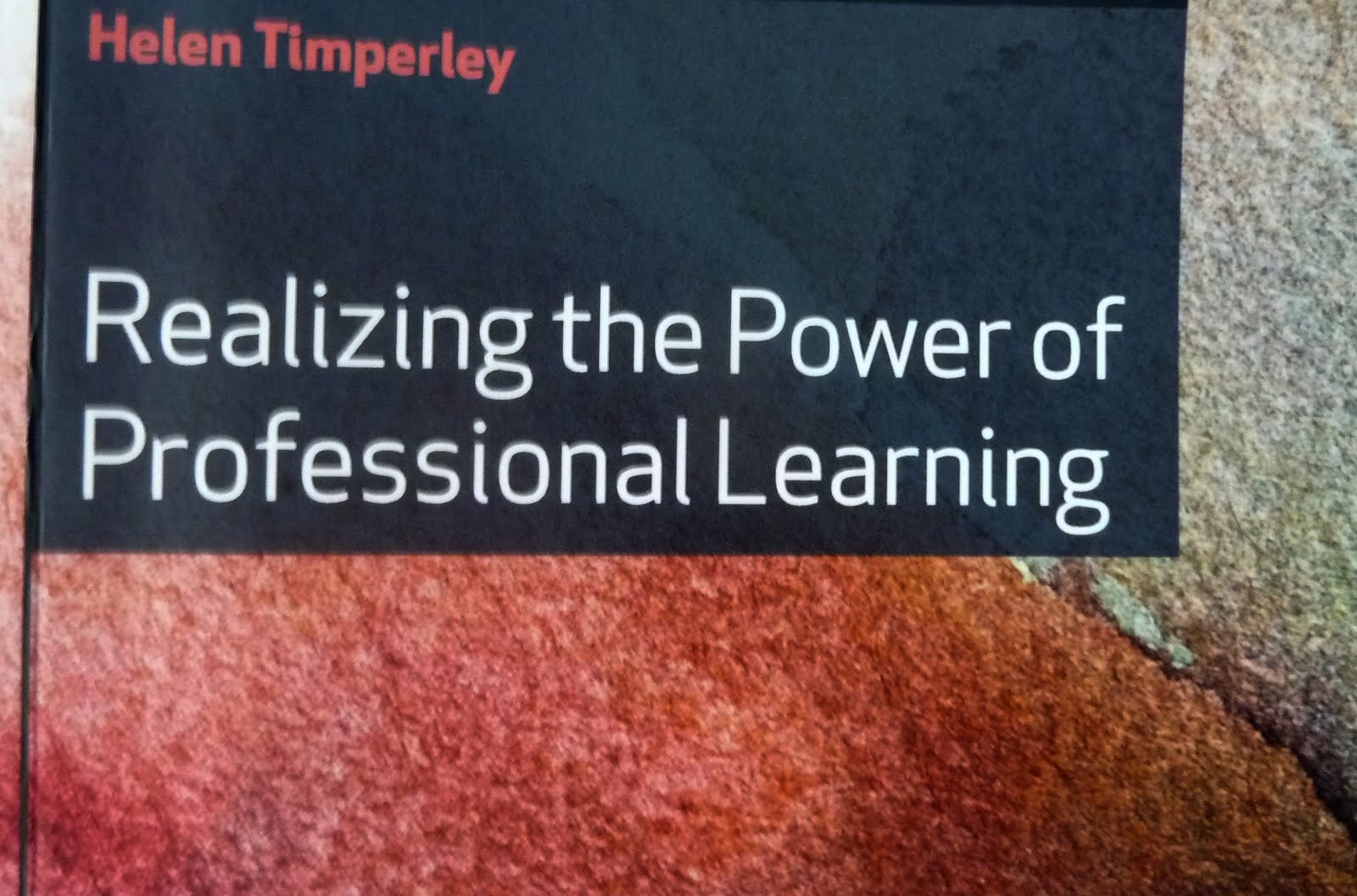
This book by educational researcher Helen Timperley published 2011, is all about tapping the power of teachers to enable all students to succeed. It is about helping teachers learn rather than telling them what to do; about putting student learning at the heart of the educational process; about developing a explicit inquiry approach to learning for teachers, students and principals;  about engagement not compliance. It seems like common sense -  but well researched common sense.

It seems their is a new consensus emerging - one that places empowering teachers as central to educational change. For many Timperley's book simply confirms beliefs many of us have held for years -  that it is the teachers professionalism that counts.  Developing teacher capacity to make informed judgements using an inquiry learning model  has underpinned the writings of Gwen Gawith ( Action learning) and Dr John Edwards, David Perkins,  Guy Claxton, Dean Fink and, more recently, even Michael Fullan who now writes that creating conditions to develop teacher confidence and ability is the key rather than imposing national agendas.  For those with a longer memory the excellent research of the Learning In Science Project ( 1980s) fits in with this 'new' constructivist thinking an approcah that values the prior ideas of students but with  a greater emphasis on teachers' thinking.

Creative principals and teachers have aways believed this although Timperley's book certainly outlines the inquiry cycle in endless detail. It is a shame the government is not following this capacity building approach instead of their obsession with imposing National Standards. This is a book that sees teachers as reflective professional judging success by evidence  not technicians complying to top down demands.

I am sure this will be a popular book for principals who want to  develop 'their' schools as inquiry learning communities where 'self regulated learners'  are able to demonstrate 'deep learning'.

In the introduction the editors of the series write that  education's mission  is 'enable everyone, without exception, to develops all their talents to the full and to realize their creative potential'.

To me this is the point of a modern education system .

The editors write that education has not 'aways kept up with the times'  and 'still seems in the past century'.  They continue that 'tinkering around the endless will not help' and that 'a bold and imaginative re-orientation to educational purposes' is required ; 'about what education could be; not what it has been'.

Unless school leaders appreciate that current thinking is the problem, that there is a need for a 'step change' in professional development,  they will continue to be 'tinkering'.

The book challenges school leaders to develop the 'conditions teachers need to learn in order to make a difference' and that these conditions reflect those needed by their students.

The book is about how teachers learn and why certain approaches to professional development work - an approach valuing and  engaging teachers prior conceptions. It is about appreciating the importance  of what teachers think about their studentsabout teachers  believing all students can learn rather than having a fixed innate intelligence.

The book is premised on the need for teachers to be engaged actively in practical  activities rather than just sitting and receiving knowledge from those who claim to know more than the teachers themselves.

And that the key to any success is teachers seeing their students improve as a result of their actions

Such ideas challenge school leaders and learning facilitators to create the learning conditions to empower teachers and to ensure student progress results. 'For far too many teachers...staff development is a demeaning mind numbing process and they passively sit and git"'

The various chapters of the book outlines in detail an inquiry process that actively involves teachers and implications for school leadership.

The  teacher inquiry model and knowledge building cycle is as follows:


What knowledge and skills do students need to meet important goals.

What knowledge and skills do we as teachers need to meet the needs of their students.

Opportunities to deepen and refine professional skills.

Engaging students in new learning experiences.

Evaluating the impact of changed actions?

( As mentioned in the introduction the editors of the series write that  education's mission  is 'enable everyone, without exception, to develops all their talents to the full and to realize their creative potential'. Imagine if the inquiry learning cycle was based around teachers working to realize this?)

The book makes it clear that this inquiry mindset  is an ongoing iterative process  resulting , if successful, in adaptive practitioners who are aways on the alert for opportunities to improve their teaching. It is also a process that is the default mode that humans are born with and one that underpins scientific and artistic innovations - all forms of 'enlightened trial and error'.

The cycle begins and ends with students and is sited in the real life circumstances individual teachers work in . The process is highly dependent on teachers assessing what students already know and what they can do - their prior experiences, and what they need to do, and how will they know if successful.

The second part of the cycles is determining what teachers need to know and be able to do to ensure all students achieve identifiable success. Students success depends on what teachers  do.  Teacher skill is the single most important influence on students learning so deepening teacher professional knowledge is vital and this is best learned through the inquiry process by trying out and evaluating  new ideas.

It is obvious that the school leaders role is to ensure conditions are in place for teachers to learn and to challenge and support their teachers - teachers are, in this respect, the leaders class. And, as with any class, it is not possible to believe all teachers are equally skilled. And also, as with teacher, leaders cannot choose to work with only those willing if a difference is to be made for all teachers. No teacher can be 'let of the hook.'

The remainder of the book details the various stages and implications of the learning inquiry process.

If I have a criticism, in contrast to the fine words in the preface about developing full range of talents of all students most examples refer to literacy programmes and the author writes that  some feel ( as I do) that  'has been at the cost of a wider and richer curriculum'. It is obviously easier for schools to use fit for purpose assessments of literacy and numeracy but a 21stC education requires a broader view of learning.

One example I enjoyed was  how one secondary teacher developed new knowledge to deal with misbehaving students.Another excellent example was the outlining of the research of Russell Bishop's Kotahitanga research which  illustrated the importance of relationships and cultural differences - and the negative impact of deficit theories of learning.

My favourite example was that of a UK secondary school exploring the development of the six personal learning and thinking skills to develop students as 'independent inquirers, creative thinker, reflective learners, team workers, self managers and effective particpators', to ensure students were prepared for a more challenging curriculum. The staff at this school developed a set of indicators to be considered as evidence of students being more reflective and independent.

If I were a principal this would be the area I would want to develop, along with a focus on developing all students gifts and talents, as they reflect the essence of the 2007 New Zealand Curriculum.

The key to develop engaged learners requires a rich inquiry based programmes across the curriculum and it would be  shame to see inquiry cycles limited to literacy and numeracy.

The book discusses the value of outside catalysts  to bring in a 'new lens' and to challenge 'existing social norms where these norms are directed to reinforcing rather than challenging the status quo'. Respectful relationships (  'relational trust') are required in all situations to promote inquiry habits of mind throughout the school. The importance of coaching, scaffolding of help, that leaves responsibility with the teacher is also an issue.  This of course applies to teachers and their students as well as between leaders,  facilitators and teachers.

The inquiry approach, if implemented,  will uncover teacher beliefs that will be problematic particularly if teachers hold traditional transmission view, or beliefs about innate fixed ability in contrast to growth mindsets. To ensure success  prior views  of teacher must be valued - the evidence of student success needs to be seen as the final arbiter. Uncovering teacher views is vital for any development to occur or for conflicts to be revolved.

The importance of school wide coherence is important but the author writes it 'can conjure up images of alignment with everything looking the same....Coherence  in a learning system, in fact, requites high levels of energy and innovation with studnts'. 'In reality, if leader wish teachers to become responsive to students, then adaptations should be expected'. ' The question is not about faithful implementation - 'adaptive experts are disciplined innovators who monitor their effectiveness in terms of the engagements, learning and well being of all students in their care'.

Adaptive students, adaptive teachers and adaptive schools is  the point of powerful professional learning.To be successful requires the collective will of all involved.

Monday, January 2, 2012

Educational quotes 2 : School As A Learning Community


For the past decade or so we have seen schools being forced to comply to a business managerial ideology that has all but crushed the common sense and creativity of innovative teachers and schools. We believe now is the time to reclaim schools as democratic learning communities based on shared values and teaching beliefs that realize the gifts and talents of all students.

 Peter Senge introduced the idea of the 'Learning Organisation', Now he says... to change we need to stop thinking like mechanics and to start acting like gardeners... Companies are actually living organisms not machines'  From 'Fast Company Magazine

'Community building must become the heart of any school improvement effort.
Thomas Sergiovanni

'Culture is the underground stream of norms, values, beliefs, traditions, and rituals that builds up over time as people work together, solve problems, and confront challenges .This set of informal expectations and values shapes how people think, feel, and act in schools.' Deal and Patterson 98
 
'Some schools develop 'toxic' cultures which actively discourage efforts to improve teaching or student achievement.' Deal and Patterson 98

'To cope with a changing world, any entity must develop the capacity of shifting and changing - of developing new skills and attitudes; in short, the capability of learning.'
A De Gues, The Living Company
 
'Secondary education is a more purely industrial age institution than any business.' Peter Senge 'The School That Learns'
 
(Our large schools)..are organized like a factory of the late 19th C : top down, command control management, a system designed to stifle creativity and independent judgment.' David T Kearns CEO Xerox
 
'Most schools are drowning in events…An attention deficit culture' Peter Senge
 
'If we remain wedded to the way education is currently provided we cannot imagine other ways.. we need some imagination , some fantasy, some new ways of thinking - some magic in fact' Hedley Beare Prof of Educ Melbourne
 
'We must act as if our institutions are ours to create, our learning is ours to define, our leadership we seek is ours to become. Peter Block Philosopher
 
'Many of our schools are good schools if only this were 1965'. Louise Stoll and Dean Fink
 
'If we want to create a workplace that values idealism, human connection, and real, in depth learning, we will have to create it ourselves'. Peter Block
 
'It is a tragedy that, for most of us, school is not a place for deepening our sense of who we are and what we are committed to. If it were, think of the lasting changes it would have made.' Peter Senge
 
'All human beings are born with unique gifts. The healthy functioning of our community depends on its capacity to develop each gift.' Peter Senge 'The Learning School.'
 
'Parents and educators…need to establish a culture in which security and clarity of expectations are balanced with the encouragement of playfulness, inquisitiveness and self reliance.' Guy Claxton in 'Wise -Up'
 
'In high performing schools…Teachers feel invigorated, challenged, professionally engaged, and empowered just because they are there.' Margaret Arbuckle US educator
 
'It is strange perhaps to realize that most people have a desire to love their organizations. They love the purpose of their school....They fall in love with the identity that is trying to be expressed. They connect to the founding vision.' Margaret Wheatley and Kellner Rogers
 
'The guiding principle being put forward is that schools must be self directing.' John Goodland
 
'As the world becomes more inter-connected organizations that will truly excel in the future will be ( those)... that discover how to tap people's commitment and capacity to learn.' Peter Senge 'The Fifth Discipline'
 
'Stories are the most effective ways of changing minds...there has to be a protagonist. There has to be a goal. There have to be obstacles people can identify with. There has to be an ultimate resolution - hopefully a positive one...what leaders do is put aside or reject the old story, the story you have grown up with. Leaders say, 'No it's a different story. You may not like it initially, but it's a better story in the long run, and you have to go with it and here is why...' . Howard Gardner 2004 'The Art and Science of Changing Peoples Minds.
 
'We can create our own characters and write our own script, if properly taught: 'In a very real sense...human being create themselves' and school can be stage on which children work through the plot, rehearse their roles, learn the cues, create social functions, try out their 'ideal selves' for size, play hero parts which demonstrate their capability for greatness.' Jerry Starratt Expert School Leadership
 
'Never doubt that a small group of thoughtful citizens can change the world. Indeed it is the only thing that ever has.' Margaret Mead
 
'Umuatu ngumuntu naga antu' 'A person is a person because of other people.' Zulu saying
 
'Ones actions ought to come from achieved stillness: not rushing on.' D H Lawrence
 
'It is difficult to know what a fish talks about, but you can be sure it is not about water.' Old joke
 
'We are truly the fish in the water of industrial age assumptions' Peter Senge
 
 Kettering (US inventor) has little time for conventional education. He thought genuine innovators were hobbled more than helped by what they had learned in school. Overly educated people were least likely to make new discoveries...they were too intent on doing things the way they had been taught.' Farson and Keynes 'Whoever Makes the Most Mistakes Wins.'
 
'Progress seldom leads to serenity, nor should it. A serene workforce is unlikely to try new things .Creative workers gripe a lot but at a high level...They are concerned about having the leeway and support to be create something new. They want their talents to be utilized. They crave a challenge'. Farston and Keynes 'Whoever Makes the Most Mistakes Wins.'
 
'This acceptance ( that neither success or failure are what it seems to be) produces work environments that are genuinely risk friendly, which is to say failure tolerant...Those who are passionately engaged in a task they care about are the ones most likely to achieve success...This is the samurai way.' Farson and Keyes 'Whoever Makes the Most Mistakes Wins'.
 
Life is like a cobweb, not an organizing chart.' Ross Perot US Computer Businessman
 
'We spend too much of our time worrying about the mosquitoes and not enough time concerning ourselves about the health of the pond.' Anon
 
'People come to relate to each other in predicable ways, which form a pattern that when defined the structure of relationships - norms, expectations, taken for granted habits of communicating. These patterns aren't fixed; they can change. Fast Company
 
' Communities of the mind are collections of individuals who are bonded together by natural will and to a set of shared ideals and ideals.' Thomas Sergiovanni
 
A learning organisation sees the environment. as messy, complex and volatile. It picks and chooses it's way attempting to use certain events as catalysts for action, turn constraints into opportunities, and blunt or minimise the impositions that do not make sense...because they know that that is the only way to survive and prosper in a complex environment. Michael Fullan
 
'Shared values are more important than paper and policies. We need, passion, people, and pride. Leadership not management.' Lester Levy
 
'Without question we have had a breakdown in the sense of community. The solution is to restore a sense of community...and doing within the school.' James Comer
 
Ko te pae tawhiti, whaia kia tata Ko te pae tata, whakamaua kia tina' ( Seek those distant horizons and cherish those you attain ) Maori saying
 
'It's not the biggest, the brightest, or the best that will survive, but those who adapt the quickest'. Charles Darwin
 
'To raise new questions, new problems, to regard old problems from a new angle requires creative imagination and makes real advances'
Albert Einstein
 
' Education for the future has left the harbour and is already on the open seas. Some educators are still clinging to the belief that the ship hasn't left and are invested in business as usual. Some educators are enjoying the freedom of the open seas .... excited about the foreign ports and places they will visit '
 Renata and Geoffrey Caine
 
'Changing public education is like punching a pillow or as someone once said like moving a cemetery; after you've done all the work you still have a cemetery.' Art Costa
 
'Our challenge. How do we create organisational coherence...how do we create structures that move with change, that are flexible and adaptive...that enable rather than constrain? How do we resolve the need for personal freedom and autonomy with organisational needs for prediction and control' Margaret Wheatley
 
'Biological systems are adaptable, resilient, and capable of generating perpetual novelty. That's not a bad list of attributes for a company of the future.' M Wheatley
'The essential purpose is to decide for oneself what is of genuine value in life. And then to find the courage to taker your own thoughts seriously Albert Einstein
 
'To control and sort young people for the sake of institutional efficiency is to crush the human spirit.' Ron Miller

Friday, December 30, 2011

Elwyn Richardson: NewZealand's pioneer creative teacher.


Elwyn Richardson with Margaret MacDonald. Margaret has just completed a thesis on Elwyn Richardson's place in creative teaching in New Zealand.

Take 15 minutes to view this U -Tube video of Elwyn's work and pass it on to others.

I was reading in an art book I was given for Christmas about all the influences that had contributed to the development to the artists personal style.

Everybody has people who have contributed to the beliefs they currently hold and I got to thinking who had made the greatest contribution to my own views about education.

In one way I was was rather privileged because most of my time in teaching, since the 60s, has been as an itinerant specialist teacher, first in nature study, later as an adviser in science and for a short time an art adviser. I say privileged because the various advisory roles enabled me to come across number of teachers whose approach to teaching and learning stood out from other teachers.

I have aways believed that the best professional development is to be gained by observing other teachers - particularly those who have the ability to draw the best out of their students. Teachers have a  profound respect for the advice from those who do the real work.Unfortunately, in recent decades, 'experts' from outside the classroom have become the sources of 'official'  knowledge and this has led to a reduction in the importance of those creative teachers. This is is a shame.

In my early years the most innovative teachers I was lucky to visit were principals of small rural schools.Bigger urban school were very traditional places in those days.  There isn't much point in mentioning names as all have long since retired but they, I realised later, were aware of the creative ideas that were in the air, in all areas of life, after the World War Two. In New Zealand progressive child centred ideas were being encouraged under the guidance of Dr Beeby the then Director of Education.

During the sixties I became involved with local art advisers ( who were under the guidance of National Art Director Gordon Tovey. With Gordon's encouragement the art advisers involved teachers to explore integrated  or related art studies.  With most classrooms having every part of the day timetables this was a revolutionary approach and suited those teachers in multi-age small schools who had the freedom to experiment.  Unfortunately such advisers, in a range of fields , are now history and  leaving an important inspirational gap that has never been filled.

Also during this time I became aware of the UK Junior Nuffield Science approach and worked with a number of local teachers to implement such ideas. This approach encouraged open ended inquiries based on children question making use of the immediate environment. This  dovetailed nicely with the ecological approaches that were being encouraged by nature study and later science advisers.

It was during this time I learnt about the exciting work of Elwyn Richardson  in his small school in the far North written up in his book 'In The Early World'.

Another important influence to my beliefs came from my visit to the UK to learn more about Nuffield Science and English child centred learning. The most important aspect was working in a very progressive school King Farm School Gravesend Kent.

Returning to New Zealand I worked with a small group of Taranaki teachers to develop what came to be known as the Taranaki Environmental Education Approach (the environment referred to the importance of stimulating classroom environments and making use of the rich local environment). This group combined ideas from the related art approaches,   English progressive teaching and the ideas of Elwyn Richardson ( who we had made contact with).

At this point my ideas about teaching and learning had become clear. Going teaching for a few years in the 70s  enabled me to put them into practice as did being a principal in the late 80s.

Since then lots of ideas from a range of educationalists have added to the mix.

Unfortunately sine 1986 the winds of change worldwide have sent school off in another direction towards standardised education -an approach that undermines the very creativity and diversity that New Zealand educators had gained world wide respect for

It is time for  schools to return to believing in the importance of creative teachers as the source of lasting changeTeachers will need to work together ( they now have the technology to do so) to articulate a set of beliefs for the new century - one thing that they could do is get behind the  almost side tracked 2007  New Zealand National Curriculum.

Elwyn remains as an inspiration of what can be achieved if we want to develop the talents and gifts of all students

Wednesday, December 28, 2011

Extreme views on Education -I think not!


In a comment to my  Christmas blog Mr and Mrs Symonds , formally of Auckland and now living in Sydney, wrote that it was 'because of people like you we have taken our children to be educated in Australia'.  'Your views on education', they wrote, 'are extreme' and 'out of touch with what parents want of a modern education system'.

They began their comment by saying they were 'glad I was going from New Zealand education' and concluded with the phrase 'weird and creepy' - I presume they were referring to themselves? And I have no idea who they  include in the 'people like you' comment nor what they define as a 'modern education system' that parents like them want.

Below is a comment from a New Zealand teacher now working  in Australia. Is this the  'modern system' that parents like the Symonds want? It certainly reflects the agenda of the current government in New Zealand.

'We are right into national testing over here. There is now national testing of all year 3, 5, 7, and 9 students. It just used to be in the other states. Victoria used to be told that we were lagging behind the other states but now, low and behold, after national teaching we are one of the top states. We also have online testing in Numeracy and Maths with the results going to the Department. This is done 3x a year. Our reports are also put directly into the Department. Accountability is everything, don't worry about the teaching. We are told that it does not matter where the students start our job is to get them up to national average and they are trying to bring in performance based pay as well. Also pay incentives for expert teachers and principals to work in disadvantaged areas.’

Sounds very Eastern European to me - something Joseph Stalin would have been proud of or right-wing political American thinkers today. Hardly modern.

Here is what one American educationalist has written ( Glickman 2006)

Today, measuring the accomplishments of students, teachers, and schools by standardised test scores and handing out rewards and punishments for reaching or failing to reach state and federal standards has become commonplace.

In such a climate, we typically err too much on the side of avoiding failure by relying on externally approved " research based" programmes, teaching methods, and assessments that are officially prompted by state and federal governments ( through their agencies).

What we lose in the process is imagination.Failure cannot go unchallenged, but what we have today is our own failure to imagine new possibilities and the worth of what has already worked well*. There is no tragedy in reaching for the stars and falling short; the greatest tragedy in never reaching at all.'

*added

Anyway the below are the 'extreme views' on learning I have been sharing (and will continue to do so) over the years.  I will leave it over to anyone who reads the blog to decide if they are  'weird and creepy' or 'not what parents want for a modern education'.

It is important to appreciate that students are  entering a new age of creativity ; an  era of knowledge creation - where the ability to continue learning, to  develop new ideas, even when confused, will be an important attribute.

I believe that a modern education system ought to focus on developing the talents and gifts of all students and not to judge their success on their test scores only in literacy and numeracy.

I believe that students future success depends on the power of their personal motivation realised :through making choices; achieving mastery; and in the process developing a powerful sense of personal autonomy. As part of gaining success students need to value personal effort and focused practice. These ideas are ignored by standardised testing. Effort and practice sound old fashioned but if neglected little learning will stick.

I believe that learning ought to based on helping students answer questions that engage them in realistic studies; studies that  call on whatever learning areas are necessary to solve the problem. And students also need to appreciate the power of collaborating with others by working in teams.

I believe that the role of the teachers is that of a creative learning coach who follow the advice of educationalist Jerome Bruner who said. 'teaching is the  canny art of intellectual temptation'. Teachers should help students construct their own learning  - and learning should be personalised to suit each learner.

I believe that teachers should ensure all  the various strategies and skills are in place ( including literacy and numeracy)  so students have every chance of success. This includes integrating modern information technology.

To achieve quality learning it is important for students to dig deeply into any learning challenge - to do fewer things well so as to develop the importance of personal excellence.

Can't see what is not 'modern' or is 'weird' in the above.

Thursday, December 8, 2011

Something all principals ought to have written to their students' parents


A principal and his website posting to parents

Where are we heading, and what have we lost to get there?

Danny Nicholls is principal of St Patrick’s Catholic School, Taupo. He runs a website intended for the school community and other interested readers. The beliefs and opinion expressed are his personal ones. Danny's blog is a well balanced description of the current environment schools find themselves in - if only more school principals ( or better still groups of principals) had written, or even shared similar newsletters.


One of the big building blocks of any school is curriculum delivery. Here in New Zealand we have a fantastic national curriculum which gives sufficient breadth for schools to develop and deliver really exciting and innovative programmes that meet local needs.

The New Zealand Curriculum has been bedded in over a few years now and replaced the more ‘tick the box’ style approach of the previous document.

In particular, the promotion of Key Competencies was a really exciting move towards developing what we want and most value for our students. This curriculum went through extensive consultation and trial/error periods before being accepted and used. I can recall many hours spent getting to understand the intent of this new curriculum and being very excited about its potential.

Sadly, it looks like we are not going to get the most out of this new curriculum, which has been hailed as a world leader by educational experts. The mood at the moment in New Zealand is one of accountability and narrow test scores which inevitably will mean schools not spending so much time on developing the Arts/Health and PE/Languages, as any gains made in those areas will not be directly reflected in national standards data. That to me is one of the most disappointing aspects of the forced imposition of the standards – not the accountability, because that's important to have, and what ERO do already – but what we have lost along the way.

I think back five years to the support my school received. We were a well performing school who were accepted on to a Health and PE contract. This enabled us to have a specialist teacher/consultant working in the school at regular intervals during the year developing teacher capability and confidence in teaching Health and PE. We also hosted a cluster Arts contract, which meant that the regional Arts adviser would run after school workshops once a term at our place, and teachers from around the region would come for a staff meeting in which they developed new skills in teaching an aspect of the Arts curriculum. I also had access to a Leadership adviser who visited once a term to meet with us to give advice or direction we may have needed and to keep us in the loop of the latest developments out of Massey University which was where we drew most of our PD from.

The landscape has changed dramatically and we work in a tighter economic environment, so there are no more Arts, Health, and PE or Leadership advisory positions available to schools. Any professional development or support offered by the Ministry of Education is solely focused on supporting the goals of national standards and is only accessible to those who can prove that they are failing their students. The message is that if you are doing a good job then you are on your own. At another level the message is also that the national focus is on the tail of achievement not extending the brighter children – there is literally nothing available to assist schools to challenge and extend brighter students.

The model being offered now is ‘contestable’ or ‘targeted’ meaning that schools, as of right, do not have access to advisory support but must either pay for it or prove that they are failing their communities and require external support. I find it sad to receive pamphlets from Waikato and Massey (geographically we are in the middle so get both institution’s mailings) touting for business at ‘competitive’ or ‘tailored’ rates – for services that schools used to receive as of right. Money that should be going on school based resources now needs to be spent on providing teachers with the ongoing professional development they require. I imagine both universities are working in difficult times and am saddened to see what we now have to work with. It is well known that the investment by government in education is significantly less than in other comparable nations – our system does have that ‘run on the smell of an oily rag’ ethos, and always has done – yet internationally our results are well above what could be reasonably expected. Not that you would know it if your only source of information on school performance came from those who really should know better.

We continue to hear about the ‘1 in 5’ are failing school’ from the government – as if this is solely a school failing and there are no other social issues in the mix. What about ‘1 in 5 came to school without breakfast today’, or ‘1 in 5 spend their schooling life bouncing from school to school with no stability or opportunity to cement learning patterns’, or even ‘1 in 5 who take 1 in 5 days off school regularly’ – not so catchy or vote grabbing. Anyone who understands a bell curve knows that there will always be those who do not achieve as well as others in particular areas. That is reality. I am not suggesting for a minute that we should not be concerned about raising achievement for the most vulnerable – we always should be, and I know in my school a disproportionate amount of time, money, energy and resources goes into just that – but where is the conversation about high achievers? Or even the ‘average joe or jill’ – do they get a look in?

Remember that summit/think tank held just after National were elected three years ago, investigating how to promote our nation and make it even better? There was a real focus on innovation and doing things differently. Nurturing the tall poppies to make them really blossom was a sound-bite I can recall. Sadly it seems that optimistic start to National's tenure has all but gone. They’ve governed through a tough patch with global financial problems and two national tragedies, so I don't begrudge them the decisions they've had to make in that sense – I just wish it wasn’t at the expense of our high achieving children.

My concern is that post election this narrowing will only get worse. Shonky, unreliable tables comparing schools to one another will begin appearing in newspapers. Schools will begin to be tagged as ‘excellent, ‘failing’ or anywhere in between based on manipulation of data and/or differing assessment practices. Teachers will continue to get bashed in the media despite 95% of them being dedicated, caring and effective professionals. There are a few bad eggs like in any profession yet from what you read in the media (and it will only get worse) it seems all teachers are ineffective. There is already a mini-exodus of school principals as the reality of what we are being charged with overseeing and implementing in our schools begins to take effect. This will only get worse over the next few years. The whispers about how our roles and employment conditions will change post-election will have dire consequences if realized.

National standards on their own will not make a difference to any child’s achievement. Parents who are engaged and work positively with schools already know or can easily find out how their child is doing. The ethos of partnership is eroding and being replaced by one of reporting and suspicion. So much money being invested in a scheme which has little if any benefit to children. And in the meantime a world leading curriculum is abandoned ...

I hope that whether through school/parent pressure, or just common sense, we will see the re-promotion of the NZ Curriculum as our guiding document. This should be the cornerstone of student improvement for our children not a narrow Literacy and Numeracy focus. Those areas are foundational and absolutely at the core of what a school does but we can be so much more than that.

Last night at our teacher meeting we did some preliminary work on our inquiry learning approaches for 2012. That was intended as the posting for today, but clearly I got sidetracked. My biggest concern is that such staff meetings in the current climate may become a luxury as we will need to spend the majority of our time on national standards compliance matters. This isn’t what I want for my children and I know parents in our community don’t want that either.

Unfortunately the debate and decision making on educational direction and policy shifted out of the hands of those actually doing the work some time ago. It is up to us instead to determine what is best at a local level as the national direction is already fixed.

Danny Nicholls

Principal


St Patrick's Catholic School, Taupo


Tuesday, November 1, 2011

To cultivate creativity -work like an artist!


My brother Graeme and self have a small exhibition in our home town of Waverley.

I have always associated myself with teachers who believe their role is to create the conditions to realize the creativity and talents of all their students. New Zealand has had such innovative teachers for many decades ( the most well known being Elwyn Richardson who developed his creative ideas in the 1950s).

Being a creative teacher is not easy because it goes against traditional approaches where teachers pass on to their students what it it they expect their students to know - usually following advice from those who have long since left the classroom. And as well such traditional teaching focuses on mainly ensuring basic skills are in place.

Today creative teaching is even more difficult as the current government is insistent on imposing national standards against professional advice in literacy and numeracy. At present these are more school standards but it doesn't take much insight to see that such standards ( which have issues with reliability) will soon morph into standardised national testing and league tables.

Read Kelvin Smythe's posting to see through the shallowness of many current 'best practice' approaches being foisted on teachers by contracted advisers and compliant principals.

If we had real educational leadership in our schools, rather than principals who seem happy to comply with imposed political directions, schools would become vital organisations to develop the talents and passions of all students - the kind of citizens we will need if we are to ever to become world leaders again.

The missing ingredient in school  are the conditions to develop the creativity of their teachers and in turn their students. It is not the issue of helping students get ideas from their teachers but more how to create the conditions for ideas to get the students.

Many artists say that ideas come to them from their experiences and what they do is to give form to such ideas in whatever medium they work in, be it sculpture, painting, dance. music, film or literature. And this approach applies to scientific discoveries.

So the question for teachers is how do they put themselves and their students in a frame of mind so they can receive inspiration when it comes to them. Creative artists, and scientists, spend lot of time sketching, experimenting , and playing around with others.

Collaboration with others with interests different from our own seems vital - combining ideas from other fields provides fertile ground for innovative ideas. Seeing patterns between various fields or experiences  is an attribute of creative people.

Creative people don't dismiss ideas because they seem strange - they are not trapped by pre-set intentions, goals or criteria. Some of the most important discoveries in science and art have been as the result of serendipity not planning

Once creative people   are attracted to an idea  they then throw themselves into the challenge as they begin the process of fleshing out their inspiration to give it shape - often ending up where they had no intention of being. And during this period they work long hours becoming single minded about bringing their ideas into tangible form.

Traditional schools are not a very good environment for such learning.

There are three basic practices for teachers to cultivate to develop creativity.

Immerse yourself in the area you are about to explore -  innovation often arises from  working with others. Consider the  conditions  past creative teachers needed? Link up with others - ideas emerge when people enter dialogue.

Secondly tolerate uncertainty. Resist the decision to rush to judgement because many ideas are stalled by premature judgement. Learn to appreciate ideas  that defy current expectations and learn to resist others who prefer to follow the beaten track.

Look for simple patterns as they emerge. As work progresses  take advantage of serendipity and mistakes - once again many scientific ideas have been developed by following up on mistakes.

Once the project is over take time to appreciate what has been achieved. Think about what has been learnt and what ideas flow out of what has been achieved. If the conditions are right new ideas will emerge even before the current ideas has been realised.

In a creative school the curriculum will emerge.

What is important is that both teachers and students develop the  creative mindset and are not distracted by imposed answers . As the New Zealand Curriculum states students should be their 'seekers , users and creators of their own knowledge'.

To achieve such a creative learning environment takes real leadership - it is about creating an environment that  encourages teachers and their students to become engrossed in real learning based on ideas that make sense to them.

Unfortunately too many schools are are too tied to control  habits left over from the last century.

Saturday, October 1, 2011

What Is A Teacher?


Guest post by Allan Alach

I found the following poem (written by Lee Crockett, Ian Jukes and Andrew Churches) on Tony Gurr's All Things Learning blog. Great blog to follow, by the way!

Given the current situation in New Zealand education, over the introduction of national standards, and the strong indications that national testing is on the way, I thought it was timely to be more positive and proactive about teachers, who have the power to make positive changes in the lives of children. This is, of course, with the proviso that politicians, of any kind, stay out of education!

What is a Teacher?

A guide, not a guard.

What is learning?

A journey, not a destination.

What is discovery?

Questioning the answers, not answering the questions.

What is the process?

Discovering ideas, not covering content.

What is the goal?

Open minds, not closed issues.

What is the test?

Being and becoming, not remembering and reviewing.

What is learning?

Not just doing things differently, but doing different things.

What is teaching?

Not showing them what to learn, but showing them how to learn

What is school?

Whatever we choose to make it.

Wednesday, September 7, 2011

Teachers have been led down the wrong path these past decades - time to control their own journey.


Teachers have been led down the wrong  path ( assembly line)  of a modern economic technocratic business model of teaching - all about measurement, comparison and standardisation.Nothing to do with the true purpose of education of developing the diverse talents of all students. Like workers in Henry Ford's factories teachers seem unaware of the effects of this standardisation approach.

Since the mid eighties education,along with every other aspect of our life, has been under the influence of a 'market forces' approach to life - an approach based on placing economic needs above equally important wider issues of the common good. Only things that can be measured are felt worthwhile. Competition and individual enterprise were to be the driving force of this brave new world. Life was seen as a form of 'economic Darwinism'.

To justify this approach politicians spread the myth that education is in crisis and that new ideas were needed to ensure students are 'produced' that can  contribute to the needs of the economy -an economy based on the philosophy of 'market forces' - a society based on competition - all to do with winners and losers.

The answer was to blame the teachers for failing students and, at the same time, seeing teachers as the solution to the problem. Unfortunately the issues on disparity of opportunities between students were ignored. The answer is  to impose on teachers  ways to improve student achievement  -and more importantly  in ways that technocrats could measure - reading, writing and mathematics. Hence National Standards. That New Zealand has been one of the top performing countries for these area since the 70s is happily ignored  as is the fact that the countries that were these ideas  are being implemented ( the UK and the US) are well  behind New Zealand  in international 'league tables'.

The imposed accountability model being imposed on schools have their roots in the discipline of economics rather than education. Education has been reduced to metrics, standardised teaching through 'best practices', endless testing and aggregated data to assess 'added value'.

Unfortunately this approach fails to capture the complex factors that go into teaching and learning and misses encouraging creativity, innovation and the tapping of the diverse talents of students. One measurement fits all it seems - students being sorted out into degrees of doubtful standards. An educational 'Procrustean bed'.

The economists like to see it alas improving 'human capital' of the teachers. Outside experts set about to improving schools, their vision not clouded by the reality that teachers face. 'Selected' teachers are then employed on contract , after being hurriedly trained,  to deliver schools imposed solutions. The idea of seeing principal as an 'instructional leader' has seen them turn from educators to monitors, evaluators, data collectors.This  obsession on accountability focused on  narrow literacy and numeracy targets is to the detriment of the wider curriculum. Such principals have become part of the problem.

What is being forgotten in all this is missing  any understanding about how teachers gain their individual expertise. Technocrats  work on the basis that it is a simple matter of transmission backed up by heavy handed compliance requirements ( as with the enforcing of approved targets in School Charters) . Finally  school are brought into line by  the power of the education Review Office who have their orders to ensure schools are complying.

All this has little to do with education. And it is worrying the number of school that go along with it all unaware of the consequences. It seems to be an example of 'creeping Eichmanism' - they feel they have no choice but to do what they are told. Some schools happily act as 'Judas Sheep' encouraging others to follow the wrong path - some don't  even realize they are on the wrong path

This current ideology of imposed school reform may look efficient but it is  dangerous to the development of teacher expertise and in turn to wider student creativity. Obviously it is important to improve the human capital of teachers  but it ought not to be the focus for school reform as it places pressure on individual teachers.Equally obviously every effort needs to be made to improve principal capability but once again it is not the real answer.

In reality teachers build up their expertise  through their relationships with other teachers - some call this 'social capital'. When one considers why some teachers are more effective than others it is not about training or qualifications it is more about where they go to get their knowledge? Where do they go when they have a problem? Where do they go to sound out their ideas? Who do they confide in? The answers to these questions are important. Where relationships in a school are characterised by high trust and frequent interactions this is when students are found to do their best.

In successful schools research is showing  teachers seek advice of each other - not outside 'experts' or their principals. Often teachers feel vulnerable in expressing their worries to outside 'experts' and principals. 'Social capital' is is a significant factor in both teacher and, in turn, their students' success. If teachers are isolated then their knowledge base suffers. Teachers who collaborate share a wide range of views and strategies for each other to pick up on in a non threatening environment. It is all too easy to get stuck if a teacher works alone, or doesn't feel comfortable in asking for help. With strong 'social capital ' ( sharing and collaborating) even teachers who might once have struggled improve. This is the power of a positive learning culture  and establishing this is possibly the key role of team leaders and principals. Buddying new teachers with trusted mentors is part of this approach as long as it is kept informal - this is the power of peer to peer learning.

It is worth considering how principals hinder or assist the developments of 'socil capital'. It seems that 'social capital' is improved when principals collaborate and share with other principals rather than trying to be instructional leaders.  They are best when they are developing 'external social capital' and acting in their schools as facilitators Surveillance cultures and heavy handed compliance add little to teacher capability.

All this shows that the current emphasis on imposing training to improve individual teacher capability is counterproductive. It would be better of those outside of the school  involved themselves in ways to encourage collaboration and sharing.

It also indicates the importance of the power of teachers sharing ideas with each other as a source of individual teacher growth. Talking other teachers is integral to teacher and , in turn, student success. A culture based on positive relationships is vital. Any effort by authority's to blame teachers for student failure is counterproductive.

And it shows that principals need to get out and share ideas with other principals, their parents and the wider community.

In my experience it has only been when teachers are sharing idea ( being their own experts) that real educational advances are made -and better still if this involves sharing expertise between schools.

Current  top down and compliance approaches by the Ministry, including most of all the ideology of standardised teaching/testing, is counterproductive.

Creative teachers have aways known this.

Let's ditch the 'you can have any colour as long as it is black' Henry Ford and his modern day followers and get back to  valuing diversity, creativity and the wise ideals of John Dewey.

Lets value the collective wisdom of creative  teachers.

Saturday, August 20, 2011

The power of visiting other schools


A display of work from Woodleigh School New Plymouth. Room environments are  important  'evidence' of what is held to be important by the school or teacher. Room environments send out powerful 'messages' to students and class visitors.

Last week I accompanied group of rural principals from out of the province  visit a selection of local schools worthy of observation. Schools were limited to ones I am familiar with and all were involved in inquiry learning to greater or lesser degree. None were totally inquiry focused schools with inquiry as their number one priority - this is difficult in today's environment.

It is my belief that focused school visits ( hence the need for a guide) are the most powerful means to gain professional development and, in particular, to gain insights in to what other schools/teachers feel important. This is all the more necessary as schools are increasingly under pressure to distort their teaching programmes by the need to respond to the reactionary and politically inspired introduction of National Standards.

What visitors gain depends on what they individually  bring to the situations visited. If ideas gained are to be made best use of then there needs to be focused action plans, assisted by an  independent 'outsider',  to implement ideas seen in their own schools and, at an agreed point, to evaluate progress.

I have to admit not being an entirely biased guideAs a result of my own experience I am influenced by an approach to teaching and learning that is somewhat in conflict with some of the idea currently being imposed or being implemented in schools.

My own agenda is:

To place in depth student inquiry studies central to all learning and for such inquiries not only to focus on the inquiry process but also to develop  in-depth understandings. Inquiries need to challenge and extend students' prior views. The most important phrase in the 2007 New Zealand Curriculum is for students to 'seek , use and create their own knowledge'.

To 'reframe ' literacy and, to a lesser degree numeracy, to ensure all the skills students require to undertake in-depth inquiry are in place.

Students need all the skills in place to 'seek and use' information. As for mathematics it needs to be based on real life or relevant inquiries to develop real 'feel' for mathematics.In my opinion the key to maths  is to do less maths and what is done to be done in depth. Conventional teaching places literacy and numeracy as the most important areas of learning and this will be further reinforced by National Standards.

 Literacy and numeracy  need to be seen as 'foundation skills' vitally important to be in place so as to allow students to complete their inquiry studies. I am also opposed to ability grouping and 'streaming' of such learning areas. I cannot see the latter suggestions being taken up by  teachers

To value the individual creativity, 'voice' and imagination of all students and in the process identify and extend every student's unique gifts and talents - every student's needs their own Individual Learning Programme.

With this in mind it would be interesting to learn what ideas individual visitors gained, what idea they saw that conflicted with their current ideas and what they intend to action on return to their own schools?

The challenge for teachers visiting inquiry based classrooms that value in depth understandings and student creativity, is to  begin with 'the  end in mind' by considering classroom displays, students' book work,  and students' competencies requiredand then to to consider all the various skills  that would need to be in place for students to develop and take responsibility for their own quality work  - both process and content.

Inquiry displays to have key questions , processes, and quality examples of finished work including research , language  and art - both descriptive, or observational, and creative.

Teachers should do their best to base their studies on students' questions and concern and to negotiate with their students  inquiry and learning tasks and also criteria for evaluating their achievements.

Students to have observational drawing and descriptive writing skills in place   in particular how to write 'research writing';  the writing up of experiments or activities; and  how to acknowledge sources of their information. Such skill teaching ought to be the focus of   'reframed' literacy and numeracy programmes.

Displays and student book work ought to illustrate studnts' prior ideas -answers ( theories) to their first questions;  learning can be evaluated by the degree students have extended their ideas.

Students need to be taught design /presentation skills so as to present their work in pleasing ways. If such 'scaffolds' , 'wizards' or guides are developed students need to be encouraged to make use of their own creativity.  Many students have never been taught how to layout their work. Best models are exhibits for Science or Maths fairs. Visual language skills need to be included in literacy programmes.

To achieve quality in depth  work students need to be placed in safe secure organisational patterns. Such patterns are best seen in the  literacy  and numeracy blocks but the group task idea needs to be extended to the afternoon inquiry studies. Few school do this.

In inquiry classrooms information technology ( ICT) is best integrated as a natural part of inquiry studies. New technology skills  could be introduced as a part of the literacy programme.

Other important aspects of a creative inquiry based  classroom.

Personalised writing about students' own lives. Student's able to focus on a small event in their lives and to write thoughtfully about it. Personal writing is the best way to ensure each child's voice is acknowledged. Such writing could be part of the literacy programme - with one piece completed , with an equally focused illustration, each week. Such writing could be an important part of any early reading programme.

Last thoughts:

Do fewer things well.

Slow the pace of students work.

Ensure students have skills and time to complete work

Value student's perseverance, effort or 'grit'.

Do the 'messages' of your classroom reflect and celebrate your students creativity .


Related blogs

Classroom displays

Quality student work

Student work

Observation skills

Personal writing


Friday, August 12, 2011

The artistry of the teacher.


A book put together by a master teacher - Bill Guild


Ministry bureaucrats, politicians, and many parents  seem to have simplistic view of the teaching learning process. Teachers teach , students learn. Ministry technocrats develop simplistic standards and school 'deliver'  them and then everybody knows how well students are achieving.Yeah right!

The dynamics of every classroom are different.

Every teacher brings with them their own set of beliefs and, often hidden , assumptions about how children learn, and the role of the teacher in the learning process. Even just being in a particular school will effect how teachers teach as they do their best to do what is expected of them.

The diversity of teachers is multiplied by the even greater diversity of  their students. Students come from different cultural backgrounds, home circumstances, different expectations ( based on their previous success or lack of it), and their own unique ways of perceiving and behaving.

Purposeful classrooms are webs of positive relationships but  in other cases rooms are 'tense' until the rooms develops a learning culture - in some cases this never evolves.  To make things even more difficult some children arrive in classes aligned with school expectations while others find classroom life problematic.

Alignment between home school and students is the ideal but where there is conflict this is not aways easily achieved.

Who ever thought teaching was easily - but paradoxically for some it is just that; teachers who have ,what Jerome Bruner writes, a certain 'artistry'. In the right conditions, or cultures,  most teacher can develop this 'artistry'.

Few people have studied life in a classrooms but one helpful research study ( Jackson 1968) researched life in American elementary schools.

Jackson looked at ways teachers judged their  own work and how they gained their satisfaction.

The following are the points he found:

Most teachers emphasized the importance of immediacy - their world revolved around the present -  as a result of their students' spontaneous responses.

The second issue was informality - they emphasized informal relationships with their pupils as being important while still  retaining their responsibility and authority.

Third was autonomy.While they welcomed guidelines and collaboration but they felt most comfortable with classroom doors closed and curricula guides tucked away.

The final point was individuality .Teachers assessed their success as teachers from their personal observations of their pupils.They knew when they were succeeding from the look on their students faces.

Such teachers sound like teachers who deserve to succeed because they are responding all the time to their pupils.

 It was noted what they did not do - they did not have behaviourally precise objectives, nor were they sympathetic to objective evaluation. The sample chosen were often not able to rationalize their approaches - they 'taught through the seat of their pants.'

Teachers, like their pupils, rise ( or settle) to the expectations that the school has of them. Once a school is thrown into higher state of excitation, by a wider vision and a new purpose, then the familiar and humdrum can be transformed. In such situations teachers extend themselves to meet new expectations.

Lessons here for school change models and leadership . Roland Barth has written that true transformation 'comes from within' - it cannot be simply  'delivered' to schools by contractual advisers armed with other peoples' 'best practice'. It is the culture that counts


Tuesday, August 2, 2011

Let's celebrate those few creative teachers -and even fewer creative schools. They are the future.


The dam builders - how to control the flow of a river?


The process of developing a truly creative classroom.

'The wish to preserve the past rather than the hope of creating the future dominates the minds of those who control the teaching of the young.'    Bertrand Russell

If teachers have in their minds the need to develop their class as a learning community of scientists and artists then during the year, as skills develop, greater responsibility can be passed over to students.

During the first term teachers and students focus on how to work with each other so as to develop relationships of mutual respect.

The success of any class will depend on the expectations, attitudes and skills the students bring with them ; what they are able to do with minimal assistance.

If the school has a clear vision of the attributes they would like their students to achieve then there will be a continual growth  of  independent learning  competencies from year to year.   Schools that achieve such growth in quality learning usually have spent considerable time developing a set of shared teaching and learning beliefs  that all teachers agree with and see purpose in. Underpinning such  beliefs are assumptions about how students learn and the need to create the conditions for every learner to grow towards their innate potential.

If the big picture of learning is clear then making choices to achieve the end in mind is simplified.

Unfortunately, unless there is decisive leadership to keep agreed belies to the forefront, it is easy for busy teachers to slip back to counterproductive behaviours.

There are two basic positions teachers can take. One is to see their role as 'teaching' students what they need by introducing activities to assist students learning. In such classrooms, no matter how friendly they look, teachers are in control  and determine activities.

In contrast, to the above 'soft' transmission approach, creative teachers hold the view that the students must do their own learning . Such teachers see their role as ensuring all the necessary skills are in place so students can control their own learning.  Such teachers see learning as a personalised process, one where students have to create, or construct, knowledge for themselves.

There is a world of difference between the two approaches and the latter approach is hard to find.

Most classrooms are heavily determined by the teachers. In tuch heavily controlled classrooms literacy and numeracy take up most of the day  -   other learning areas seem to offer only  a little light relief from the main teacher tasks. And in such schools individual  classrooms look remarkably similar  as teachers are expected to follow agreed formulaic  'best' practices. This is not helped by an obsessive need to test students progress in literacy and numeracy and will be compounded by the introduction of National Standards.

In creative classrooms, or those moving in this direction, the 2007 New Zealand Curriculum gives excellent support. The important issue for such teachers  is whether every students is developing a growing sense of confidence and responsibility for their own learning. Growth in resilience, adaptability, perseverance and creativity  are seen  as important as literacy and numeracy -  these being seen as 'foundation skils' necessary for students to 'seek, use and create their own knowledge'. At the heart of a creative approach is the need to ensure  that every opportunity  is given for every learners special set of talents and gifts to be  developed.  .

In a creative classrooms teachers do their best to ensure every learner is an active contributor, has the skills to work in teams, and  is able to exercise initiative and personal creativity.The teacher's goal is to ensure every  student develops a positive learning identity

In my experience teachers in  such classrooms believe in negotiating all learning and tasks with their students and, where it is not possible, are open about imposed requirements. Such teachers believe in doing fewer things well  to allow their students to dig deeply into whatever they are studying individually or in groups. The energy for all learning is provided by the engagement of students in learning tasks in all learning areas students see the point of.

To achieve such a creative classroom teachers need to have knowledge in the various learning areas ( or know where to access such information) and to be able to work together to share ideas and to learn off each other.

The teacher's role is one of being a creative learning coach -  aways being careful not to take responsibility for learning away from the learner.

In a creative classroom of scientists and artists I would expect to see:

Powerful learning experiences taking priority over literacy and numeracy tasks.

Learning tasks to be negotiated with students and many originating out of students questions and concerns.

Students working in self managing groups ( caring for and challenging each other) independent of the teacher.

All around the room (and  in students' book work, in their computer portfolios) quality  examples of their finished work across all learning areas, usually displayed as part of a group or class investigative study. The whole learning environment a celebration of students' talents and gifts.

Close reading of whatever is displayed showing individual 'voice' or creativity.

For a creative school  all that  is required is to replace 'teacher', in the above description, with  'principal' and 'students' with 'teacher'.

'Each learner is new puzzle for a teacher to unlock.' Matt Damon Actor

Sunday, July 17, 2011

An overwhelming creative experience


Astronauts entering the space shuttle: Zero Gravity theme.


I was invited to visit Opunake Primary School to see the culminating display of their current topic 'Zero Gravity'-  open to parents and the public the last two days of the term.

To make a change from suffering from the  endless wet days we had been having I decided to take up the offer. I knew more or less what to expect as I had visited several other end of term culminating displays. To add to the fun I decided to ask an old friend of mine to come just for the ride which is about 45 minutes from where I live. I didn't tell my friend we were going to visit a school. I didn't think it would be much of an enticement and when we pulled up at the school he said he would be happy to sit in the car until I had completed my visit.

I insisted he accompany me and to say that it was a mind changing experience for my friend would not be far from the truth.

Opunake school is a very special school. However, before the appointment of the current principal Lorraine, things were less than wonderful. Opunake is a decile four school with a forty percent Maori role and, at at the time of Lorraine's appointment, had little parental support and the staff somewhat demoralised.

Although I am a fan of individual creative teachers, believing they hold the power to develop ideas that can change schools, this power is magnified if a school is led by a creative principal

What makes the school special are the educational changes Lorraine has introduced to develop a more positive  inclusive learning community at the school. The changes are based around a collaborative approach to teaching combined with the use of a range of innovative teaching strategies.

At the end of each year students are asked to think about what concern they have and they would like to study.  This idea is based on the writings of American Middle School educator James Beane. Students contribute their ideas and from  their ideas common themes are  decided upon for the next years studies. Interestingly enough the students ideas easily cover normal curriculum requirements.

Once the theme has been decided upon a provocative title is decided upon and then the theme is explored for the term, or longer. Themes I have observed have covered 'Harry Potter' ( mainly maths and science)  'Are You my Mummy' ( Egypt), 'Shackleton', 'Space', 'The local Environment' - I can't remember the exact  more interesting titles.

The current thee was called ' Zero Gravity' - about space exploration.The photo  above does not do the study justice.

The  theme follows along the following process.

The teachers plan an interesting introductory experience to motivate a range of study  questions from the students which become the basis for the study.  For the Egyptian study the teachers put on a shadow play which involved  teachers acting as priests preparing body for the mummification  process. This was authentic enough for a year one student to tell his mum that the teachers cut up a year eight students but that it was OK because the young learner concerned said he had seen the 'victum' later in the library!

Following the introductory experience the  teachers plan activities for students, arranged in family groups, to be involved with.Older students are 'trained' to assist younger children. For the current study eighteen science experiments were planned - providing more physical science than most primary students experience in a year. This involves afternoons for the first week or two.

Literacy and numeracy programmes cover the mornings  no doubt content from current themes is involved.

The 'end on mind' is to prepare exhibits for the end of term display.These displays transform a room ( once two classrooms) into what can be best expressed as a school version of Te Papa. Once the displays are in place it is impossible to recognise the rooms as classrooms.

Following the family grouped experiences teachers, in their individual classrooms and teams, plan out their exhibits for the  display room and undertake  research about the theme. The school uses an inquiry approach across the school and a range of thinking skills but, as important as the process is, the whole point is to develop the end of term display/experience.

Back to our school visit.

Visitors enter the room through a Ground Zero Entrance Gate and are welcomed by an episode of Star Trek to add to the ambiance. Once over a a raised foiled covered entrance way the main room is entered.The entire space floor and ceiling is covered with black plastic.No outside light enters - light come from spotlights,computers and digital projector screens.  Visitors are confronted with large models of spaceships, moon buggies, alien tea parties, science experiments, white coated astronauts and a robot that has moving arms ( powered by students who take turns). Metres of tin foil has been used contrasted with white painted rockets, space shuttles, and moon buggies. And, as you get used to the experience, there are an endless range of childrens' research, art and language to admire.

To add to the excitement students are guiding their appreciative parents around and, while we were there, the local kindergarten was visiting. One can only imagine what they were thinking.

The next day I returned with a retired teacher who was, in my opinion, one of the most creative teachers of his time.I also invited a scientist ( who had been an adviser to the nearby Maui plant) who now writes science features for the local paper.

They too were impressed.

Opunake is a special school.

 
Design by Free Wordpress Themes | Bloggerized by Lasantha - Premium Blogger Templates