Showing posts with label Big Picture. Show all posts

Thursday, January 12, 2012

Education to realize the talents of all - students and teachers.


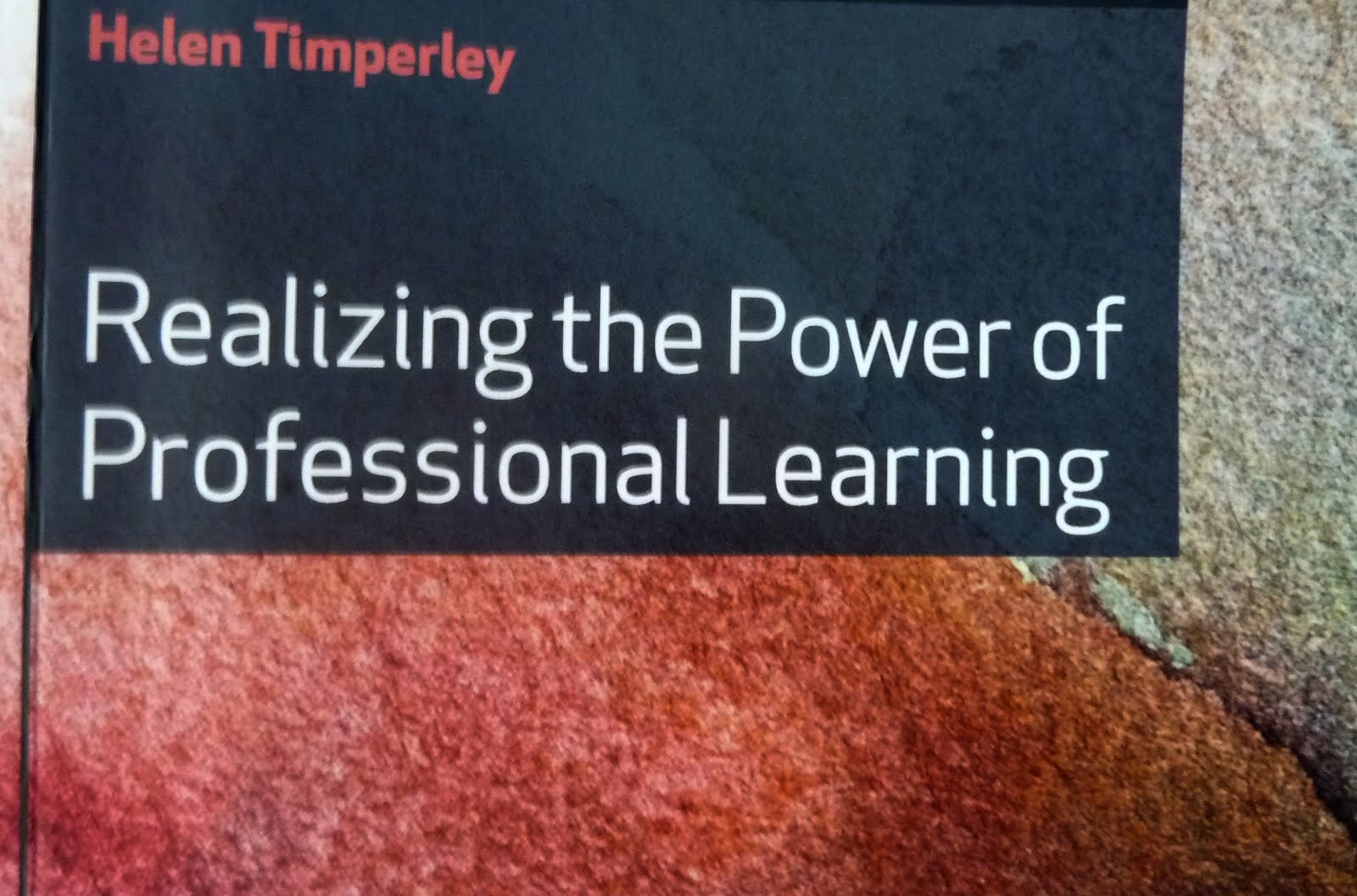
This book by educational researcher Helen Timperley published 2011, is all about tapping the power of teachers to enable all students to succeed. It is about helping teachers learn rather than telling them what to do; about putting student learning at the heart of the educational process; about developing a explicit inquiry approach to learning for teachers, students and principals;  about engagement not compliance. It seems like common sense -  but well researched common sense.

It seems their is a new consensus emerging - one that places empowering teachers as central to educational change. For many Timperley's book simply confirms beliefs many of us have held for years -  that it is the teachers professionalism that counts.  Developing teacher capacity to make informed judgements using an inquiry learning model  has underpinned the writings of Gwen Gawith ( Action learning) and Dr John Edwards, David Perkins,  Guy Claxton, Dean Fink and, more recently, even Michael Fullan who now writes that creating conditions to develop teacher confidence and ability is the key rather than imposing national agendas.  For those with a longer memory the excellent research of the Learning In Science Project ( 1980s) fits in with this 'new' constructivist thinking an approcah that values the prior ideas of students but with  a greater emphasis on teachers' thinking.

Creative principals and teachers have aways believed this although Timperley's book certainly outlines the inquiry cycle in endless detail. It is a shame the government is not following this capacity building approach instead of their obsession with imposing National Standards. This is a book that sees teachers as reflective professional judging success by evidence  not technicians complying to top down demands.

I am sure this will be a popular book for principals who want to  develop 'their' schools as inquiry learning communities where 'self regulated learners'  are able to demonstrate 'deep learning'.

In the introduction the editors of the series write that  education's mission  is 'enable everyone, without exception, to develops all their talents to the full and to realize their creative potential'.

To me this is the point of a modern education system .

The editors write that education has not 'aways kept up with the times'  and 'still seems in the past century'.  They continue that 'tinkering around the endless will not help' and that 'a bold and imaginative re-orientation to educational purposes' is required ; 'about what education could be; not what it has been'.

Unless school leaders appreciate that current thinking is the problem, that there is a need for a 'step change' in professional development,  they will continue to be 'tinkering'.

The book challenges school leaders to develop the 'conditions teachers need to learn in order to make a difference' and that these conditions reflect those needed by their students.

The book is about how teachers learn and why certain approaches to professional development work - an approach valuing and  engaging teachers prior conceptions. It is about appreciating the importance  of what teachers think about their studentsabout teachers  believing all students can learn rather than having a fixed innate intelligence.

The book is premised on the need for teachers to be engaged actively in practical  activities rather than just sitting and receiving knowledge from those who claim to know more than the teachers themselves.

And that the key to any success is teachers seeing their students improve as a result of their actions

Such ideas challenge school leaders and learning facilitators to create the learning conditions to empower teachers and to ensure student progress results. 'For far too many teachers...staff development is a demeaning mind numbing process and they passively sit and git"'

The various chapters of the book outlines in detail an inquiry process that actively involves teachers and implications for school leadership.

The  teacher inquiry model and knowledge building cycle is as follows:


What knowledge and skills do students need to meet important goals.

What knowledge and skills do we as teachers need to meet the needs of their students.

Opportunities to deepen and refine professional skills.

Engaging students in new learning experiences.

Evaluating the impact of changed actions?

( As mentioned in the introduction the editors of the series write that  education's mission  is 'enable everyone, without exception, to develops all their talents to the full and to realize their creative potential'. Imagine if the inquiry learning cycle was based around teachers working to realize this?)

The book makes it clear that this inquiry mindset  is an ongoing iterative process  resulting , if successful, in adaptive practitioners who are aways on the alert for opportunities to improve their teaching. It is also a process that is the default mode that humans are born with and one that underpins scientific and artistic innovations - all forms of 'enlightened trial and error'.

The cycle begins and ends with students and is sited in the real life circumstances individual teachers work in . The process is highly dependent on teachers assessing what students already know and what they can do - their prior experiences, and what they need to do, and how will they know if successful.

The second part of the cycles is determining what teachers need to know and be able to do to ensure all students achieve identifiable success. Students success depends on what teachers  do.  Teacher skill is the single most important influence on students learning so deepening teacher professional knowledge is vital and this is best learned through the inquiry process by trying out and evaluating  new ideas.

It is obvious that the school leaders role is to ensure conditions are in place for teachers to learn and to challenge and support their teachers - teachers are, in this respect, the leaders class. And, as with any class, it is not possible to believe all teachers are equally skilled. And also, as with teacher, leaders cannot choose to work with only those willing if a difference is to be made for all teachers. No teacher can be 'let of the hook.'

The remainder of the book details the various stages and implications of the learning inquiry process.

If I have a criticism, in contrast to the fine words in the preface about developing full range of talents of all students most examples refer to literacy programmes and the author writes that  some feel ( as I do) that  'has been at the cost of a wider and richer curriculum'. It is obviously easier for schools to use fit for purpose assessments of literacy and numeracy but a 21stC education requires a broader view of learning.

One example I enjoyed was  how one secondary teacher developed new knowledge to deal with misbehaving students.Another excellent example was the outlining of the research of Russell Bishop's Kotahitanga research which  illustrated the importance of relationships and cultural differences - and the negative impact of deficit theories of learning.

My favourite example was that of a UK secondary school exploring the development of the six personal learning and thinking skills to develop students as 'independent inquirers, creative thinker, reflective learners, team workers, self managers and effective particpators', to ensure students were prepared for a more challenging curriculum. The staff at this school developed a set of indicators to be considered as evidence of students being more reflective and independent.

If I were a principal this would be the area I would want to develop, along with a focus on developing all students gifts and talents, as they reflect the essence of the 2007 New Zealand Curriculum.

The key to develop engaged learners requires a rich inquiry based programmes across the curriculum and it would be  shame to see inquiry cycles limited to literacy and numeracy.

The book discusses the value of outside catalysts  to bring in a 'new lens' and to challenge 'existing social norms where these norms are directed to reinforcing rather than challenging the status quo'. Respectful relationships (  'relational trust') are required in all situations to promote inquiry habits of mind throughout the school. The importance of coaching, scaffolding of help, that leaves responsibility with the teacher is also an issue.  This of course applies to teachers and their students as well as between leaders,  facilitators and teachers.

The inquiry approach, if implemented,  will uncover teacher beliefs that will be problematic particularly if teachers hold traditional transmission view, or beliefs about innate fixed ability in contrast to growth mindsets. To ensure success  prior views  of teacher must be valued - the evidence of student success needs to be seen as the final arbiter. Uncovering teacher views is vital for any development to occur or for conflicts to be revolved.

The importance of school wide coherence is important but the author writes it 'can conjure up images of alignment with everything looking the same....Coherence  in a learning system, in fact, requites high levels of energy and innovation with studnts'. 'In reality, if leader wish teachers to become responsive to students, then adaptations should be expected'. ' The question is not about faithful implementation - 'adaptive experts are disciplined innovators who monitor their effectiveness in terms of the engagements, learning and well being of all students in their care'.

Adaptive students, adaptive teachers and adaptive schools is  the point of powerful professional learning.To be successful requires the collective will of all involved.

Monday, January 2, 2012

Educational quotes 1: general philosophy


The is the first of  A series of educational quotes from Leading-Learning website which is to be discontinued. The quotes were the most visited pages on the website.

General Philosophy.


It is important that a school be 'led' by a set of agreed shared beliefs. To achieve this the staff and community need to enter into a series of 'learning conversations' to define and articulate such a philosophy. As it is said: If you stand for nothing you will fall for anything' or 'Control your own destiny or someone else will'.
 
 
'What the best and wisest parent wants for his own child, that must the community want for all its children. Any other ideal for our schools is narrow and unlovely; acted upon it destroys our democracy.' John Dewey

'The vitality of thought is an adventure.Ideas won't keep.Something must be done about them'. Alfred North Whitehead.
 
'We need a metamorphosis of education - from the cocoon a butterfly should emerge. Improvement does not give us a butterfly only a faster caterpillar.' Learning to Learn http://www.learningtolearn.sa.edu.au/
 
'No problem can be solved by the same consciousness that created it. We need to see the world anew.' Albert Einstein
 
'Insanity is doing the same things over and over again and expecting the different results' Albert Einstein.
 
'Some people would rather die than think'.  Bertrand Russell
 
'If we always do what we've always done, we will get what we've always got.' Adam Urbanski
 
'One can never consent to creep when one feels the compulsion to soar'. Helen Keller
 
'Man's mind stretched to a new idea never goes back to its original dimensions.' Oliver Wendell Holmes Jnr
 
'Ten geographers who think the world is flat will tend to reinforce each others errors….Only a sailor can set them straight'. John Ralston Saul, 'Voltaire's Bastards'.
 
'The faithful witness, like…Socrates, Voltaire, and Swift and Christ himself, is at his best when he is questioning and clarifying and avoiding the specialists obsession with solution. He betrays society when he is silent…He is true to himself and to people when his clarity causes disquiet.' John Ralston Saul 'Voltaire's Bastards'
 
'Anecdotes, personal stories, reminiscences, like biblical parables, are the medium through which faith is restored. Stories are a form of poetry, and give us a saving image to personally relate to.' Peter Block Business Philosopher
 
'Wordsmiths who serve established power…castrate the public imagination by subjecting language to a complexity which renders it private. Elitism is always their aim.' John Ralston Paul, 'Voltaire's Bastards.'
 
'It is today we must create the world of the future.' Eleanor Roosevelt
 
'The human mind treats a new idea the way a body treats a strange problem it rejects it.' Sir Peter Medawar
 
'Some folks are wise, some are otherwise'. Tobies George Smollett
 
To arrive at the simplest truth requires years of contemplation.' Isaac Newton
 
'Those who do nothing are never wrong.' Theodore de Bouville
 
'The past is a foreign country, they do things differently there.' J P Harltley From the Go -Between
 
'We are natural mind changing entities until we are 10 or so. But as we get older…then it is very hard to change our minds'. Howard Gardner
 
'Fundamentalism is a kind of decision not to change your mind about something…Many of us are fundamentalists…because it worked pretty well for us.' Howard Gardner
 
'Do not go where the path may lead; go instead where there is no path and leave a trail'. Ralph Waldo Emerson
 
'The world by and large has to be reinvented.' Charles Handy in 'Beyond Certainty'.
 
'There is no end. There is no beginning. There is only the infinite passion of life.' Frederico Fellini Film Director
 
'Out of intense complexities intense simplicities emerge'. Winston Churchill
 
'There is nothing as useless as doing efficiently that which should not be done at all.' Peter Drucker Business Philosopher.
 
'Don't try to innovate for the future. Innovate for the present.' Peter Drucker
 
'I believe that revolutionary chaos may yet crystallize into new life forms.' M Gorbachev
 
'Chaos breeds life, where order breeds habit,' Henry Brooks US Historian
 
'Is anybody alive out there?' Bruce Springsteen to the crowd.
 
'It is impossible to soar like an eagle if you are surrounded by turkeys' Anon
 
'Every actual state is corrupt. Good men must not obey the laws too well.' Ralph Waldo Emerson
 
'Complexity creates confusion, simplicity focus.' Edward de Bono
 
'To simplify you have to clarify. Simplification is the new competitive advantage' Jack Trout 'Simplicity'
 
'Our life is frittered away by detail.. simplicity simplicity, simplicity.' Henry Thoreau
 
'We need to be the authors of our own life.' Peter Senge
 
'We have banished our artists to the fringe of society and tell them to eat cake. It is our artists who choose freedom over safety and use their talents to question and confront the culture.' Peter Block, Philosopher
 
'We can lick gravity, but sometimes the paperwork is overwhelming'. Verner von Braun
 
'First define, then refine'. Bill Guild NZ Pioneer teacher
 
'Everything of importance has been said by someone who didn't invent it.' Alfred North Whitehead.
 
'How has the world of the child changed in the last 150 years?' … the answer is. 'It's hard to imagine any way in which it hasn't changed….they're' immersed in all kinds of stuff that was unheard of 150years ago, and yet if you look at schools today versus 100 years ago, they are more similar than dissimilar'. Peter Senge
 
''Educating the masses was intended only to improve the relationship between the top and the bottom of society. Not for changing the nature of the relationship.' John Ralston Paul 'Voltaire's Bastards.'
 
'The conduct of schools, based upon a new order of conception, is so much more difficult than is the management of schools which walk the beaten path.' John Dewey
 
'Much educational change is akin to rearranging the deck chairs on the Titanic to get a better view'. Anon
 
Being on tightrope is living; everything else is waiting.' Karl 'The Great' Wallenda
 
'A pessimist is a person who looks both ways before crossing a one way road.' L Peters
 
Shoot for the moon. Even if you miss it you will land among the stars.' Les Brown
 
In the end we will have had enough of cynicism and skepticism and humbug and we shall want to live more musically.' Vincent van Gogh
 
'It is difficult to know what a fish talk about but you can be sure it isn't about water'. Anon 
 
'We can make the trains run on time but if they are not going where we want them to go, why bother?' Neil Postman
 
'The development of a tree depends on where it is planted.' Edward Joyner Yale Univ. School
 
'We each create our world by what we choose to notice, creating a world of distinction that makes sense to us. We then 'see' the world through the self we have created.' Margaret Wheatley and Kellner Rogers
 
Unlike puppets we have the possibility of stopping in our movements, looking up and perceiving the machinery by which we have been moved. In this act lies the first steps towards freedom.' Peter Berger Sociologist
 
'It is always the minorities who aren't part of a mainstream who define what the limits…of the majority are going to be.' Rose Elizabeth Bird, US Chief Justice, California
 
'The East contemplated the forest the West counted the trees…the mind that knows that trees and the forest is a new mind.' Marilyn Ferguson
 
Bureaucracies are beautiful mechanisms for the evasion of responsibilities and guilt.' Warren Bennis Leadership expert
 
' I know of no other safe depository of the ultimate power of society but the people themselves and if we think ( the people) not enlightened enough to exercise that control with a wholesome discretion the remedy is not to take it from them , but to inform their discretion by education'. Thomas Jefferson 1820
 
'A little revolution now and then is a good thing.' Thomas Jefferson
 
'Slow down you are going too fast'. Simon and Garfunkle
 
'The world is crazier, and more of it than we think, incorrigibly plural.' Louis MacNeice Author
 
'You may feel like a voice in the wilderness, but it is your voice we are waiting to hear…you are the determining factor.' Neale Donald Walsh Author
 
'Courage is the first of human virtues because it makes all others possible.' Aristotle
 
'Teach us to walk the soft Earth as relatives to all that live there.' Sioux Indian saying
 
'Everything important is already known, the only thing is to rediscover it.' Anon
 
'Every reform was once private opinion.' Ralph Waldo Emerson
 
'Those of us who are old can afford to live dangerously. We have less to lose.' Maggie Kuhn Grey Panthers
 
'Age is compulsory, wisdom is optional'. Anon
 
'The most potent force for change …is the growing recognition of millions of adults that there own impoverishment came from a large measure, from their schooling.'  Marilyn Fergussen Aquarian Conspiracy.
 
'Some of us are just less damaged than others.' ( by schooling) Buckminster Fuller
 
'An impressive proportion of great, original thinkers were educated at home…stimulated (and) born up by high expectations' Aquarian Conspiracy
 
'Home is the first school for us all, a school with no fixed curriculum, no quality control, no examinations, no teacher training' Charles Handy
 
'When the spirit of people is strong focused and vibrant, wonderful things happen'. Harrison Owen
 
'Present thinking people kill the future.' Ken Blanchard ,Business Consultant
 
'If you can change your mind, you can change the world.' Joey Reimer Creativity Guru
 
'When I was young I thought that people at the top really understood what the hell was happening…now I know they don't know.' David Mahoney
 
'The first people had the questions, and they were free. The second people had answers, and they became enslaved.' Wind Eagle Modern Indian Medicine Woman
 
'I imagine a school system that recognizes learning is natural, that a love of learning is normal, and that real learning is passionate learning. A school curriculum that values questions above answers…creativity above fact regurgitation…individuality above conformity.. and excellence above standardized performance….. And we must reject all notions of 'reform' that serve up more of the same: more testing, more 'standards', more uniformity, more conformity, more bureaucracy. Tom Peters Author 'Re-imagine' http://www.tompeters.com/
 
'We are all carriers of our own stories. We have never trusted our own voices. Reforms came, but we don't make them. They were presented by people removed from schools, by 'experts'. Such changes bi passes school. School by school changes, however slow, could make a powerful difference.' Deborah Meier, 'Good Schools are Still Possible'
 
'The future is here. It's just not widely distributed yet.' William Gibson
 
'Reformation comes from the bottom up - a transformation demanded by the people.' Religious writer
 
'Laws and institutions must go hand in hand with the progress of the human mind' Thomas Jefferson
 
'Life can only be understood backwards but you have to live it forward. You can only do that by stepping into uncertainty and by trying, within this uncertainty, to create your own islands of security….The new security will be a belief that …if this doesn't work out you could do something else'. You are your own security'. Charles Handy Business Philosopher.
 
'The homogenization of cultural diversity and the destruction of cultural history are central forces underlying societal breakdown worldwide'…… what is the deepest and most profound force driving change , I'd say it is the awareness, however dim and ill formed , that we are in deep trouble…The first step is to realize everything is interrelated.' Peter Senge 'Through the Eye of the Needle'
 
'The slick houses and holiday homes of the rich hiding the despair of the poor.' Anon
 
'We have been through a period when knowledge was fragmented, but dreams of coherence survived….. the expanding edges of fields…are closer to each other than are the central cores.' Carnegie Foundation/Teaching 77.
 
'We have been the benefactors of our cultural heritage and the victims of our cultural narrowness.' Stanley Kripper Psychologist
 
'What we thought was the horizon of our potential turns out to be only the foreground.' Tom Roberts Educator
 
'We will not cease from exploration
And the end of all our exploring
Will be to arrive where we started
And know the place for the first time.' T S Eliot 'Little Gidding'
 
'The centre falls about. The centre cannot hold.' W B Yeats
 
'Chaos breeds life, while order breeds success.' Franklin P Adams
 
'Human solidarity is the necessary condition for the unfolding of any one individual' Erich Fromm
 
'What is to give life must endure burning.' Victor Frankl
 
'Those who have most at stake in the old culture, or are most rigid in their beliefs, try to summon people back to the old ideas.' Marilyn Ferguson
 
'The map is not the territory.' Alfred Korzybski /Semanticist
 
'We are told not to cross a bridges until we come to it, but this world is owned by men who have crossed bridges far ahead of the crowd,' Anon
 
'If I knew what was going to happen in ten years I would do it now. I just follow my nose.' Stephen Hawkins Physicist
 
'Fall in love with your life's work again, my fiend, or your energy will wane, your voice will falter and there will be nothing to prove but the fact that you are taking up valuable space.' Anon
 
'Carpenters bend wood fletchers bend arrows; wise men fashion themselves.' Buddha
 
'In the end we shall have had enough cynicism and skepticism and humbug, and we shall want to live life more musically.' Vincent van Gogh
 
'Do not go where the path may lead; go where there is no path and leave a trail.' Ralph Waldo Emerson
 
'If you are looking for a big opportunity, find a big problem.' Anon
 
'Choices in life are rarely pure, but to understand the middle ground it is helpful to imagine the extremes.' Peter Berger, Sociologist
Lost causes are the only causes worth fighting for.' Fullan and Hargreaves

Lucy: 'Charlie Brown on the cruise ship of life which way is your deck chair facing?' Charlie Brown ponders and replies, 'I don't know, I've never been able to get one open'. Charles Schultz
'After you understand the about the sun and the stars and the rotation of the earth, you may still miss the radiance of the sunset.' Alfred North Whitehead
 
'Whatever you can dream, begin to do it. Boldness has the power and magic in it.' Goethe
 
'As a child lives today he will live tomorrow' John Dewey
 
If you plan is for one year, plant rice;
If you plan is for ten years, plant trees;
If your plan is for a hundred years,
Educate children.' Confucius
 
If you know where you want to go, you have a better chance of getting there' Anon
 
Destiny is not a matter of chance it is a matter of choice.' Anon
 
' There is a road to the heart and it doesn't go through the intellect.' G K Chesterton
 
'Nothing is ever achieved without enthusiasm.' Ralph Waldo Emerson
 
Chaos breeds life while order breeds habits' Henry Adams.
 
'Where all think alike no-one thinks much.' Walter Lipman
 
'It is easier to beg forgiveness than ask for permission.' Jesuit saying
 
'It takes a whole village to raise a child.' African saying
 
'Schools should be a mirror of a future society.' Anon
 
'How do we recapture the magic and myth of education? ... to enable teachers to believe in their importance...so teachers and the public can rediscovers the hope schools once held?' Deal and Peterson
 
'We make realities out of our dreams and dreams out of our realities. We are the dreamers of the dream.' Roald Dahl
 
'Education is at a turning point' Howard Gardner
 
'All great truths begin as blasphemies.' George Bernard Shaw
 
'If people did not do silly things, nothing intelligent would ever get done.' Ludwig Wittgenstein

Friday, December 30, 2011

Elwyn Richardson: NewZealand's pioneer creative teacher.


Elwyn Richardson with Margaret MacDonald. Margaret has just completed a thesis on Elwyn Richardson's place in creative teaching in New Zealand.

Take 15 minutes to view this U -Tube video of Elwyn's work and pass it on to others.

I was reading in an art book I was given for Christmas about all the influences that had contributed to the development to the artists personal style.

Everybody has people who have contributed to the beliefs they currently hold and I got to thinking who had made the greatest contribution to my own views about education.

In one way I was was rather privileged because most of my time in teaching, since the 60s, has been as an itinerant specialist teacher, first in nature study, later as an adviser in science and for a short time an art adviser. I say privileged because the various advisory roles enabled me to come across number of teachers whose approach to teaching and learning stood out from other teachers.

I have aways believed that the best professional development is to be gained by observing other teachers - particularly those who have the ability to draw the best out of their students. Teachers have a  profound respect for the advice from those who do the real work.Unfortunately, in recent decades, 'experts' from outside the classroom have become the sources of 'official'  knowledge and this has led to a reduction in the importance of those creative teachers. This is is a shame.

In my early years the most innovative teachers I was lucky to visit were principals of small rural schools.Bigger urban school were very traditional places in those days.  There isn't much point in mentioning names as all have long since retired but they, I realised later, were aware of the creative ideas that were in the air, in all areas of life, after the World War Two. In New Zealand progressive child centred ideas were being encouraged under the guidance of Dr Beeby the then Director of Education.

During the sixties I became involved with local art advisers ( who were under the guidance of National Art Director Gordon Tovey. With Gordon's encouragement the art advisers involved teachers to explore integrated  or related art studies.  With most classrooms having every part of the day timetables this was a revolutionary approach and suited those teachers in multi-age small schools who had the freedom to experiment.  Unfortunately such advisers, in a range of fields , are now history and  leaving an important inspirational gap that has never been filled.

Also during this time I became aware of the UK Junior Nuffield Science approach and worked with a number of local teachers to implement such ideas. This approach encouraged open ended inquiries based on children question making use of the immediate environment. This  dovetailed nicely with the ecological approaches that were being encouraged by nature study and later science advisers.

It was during this time I learnt about the exciting work of Elwyn Richardson  in his small school in the far North written up in his book 'In The Early World'.

Another important influence to my beliefs came from my visit to the UK to learn more about Nuffield Science and English child centred learning. The most important aspect was working in a very progressive school King Farm School Gravesend Kent.

Returning to New Zealand I worked with a small group of Taranaki teachers to develop what came to be known as the Taranaki Environmental Education Approach (the environment referred to the importance of stimulating classroom environments and making use of the rich local environment). This group combined ideas from the related art approaches,   English progressive teaching and the ideas of Elwyn Richardson ( who we had made contact with).

At this point my ideas about teaching and learning had become clear. Going teaching for a few years in the 70s  enabled me to put them into practice as did being a principal in the late 80s.

Since then lots of ideas from a range of educationalists have added to the mix.

Unfortunately sine 1986 the winds of change worldwide have sent school off in another direction towards standardised education -an approach that undermines the very creativity and diversity that New Zealand educators had gained world wide respect for

It is time for  schools to return to believing in the importance of creative teachers as the source of lasting changeTeachers will need to work together ( they now have the technology to do so) to articulate a set of beliefs for the new century - one thing that they could do is get behind the  almost side tracked 2007  New Zealand National Curriculum.

Elwyn remains as an inspiration of what can be achieved if we want to develop the talents and gifts of all students

Wednesday, December 28, 2011

Extreme views on Education -I think not!


In a comment to my  Christmas blog Mr and Mrs Symonds , formally of Auckland and now living in Sydney, wrote that it was 'because of people like you we have taken our children to be educated in Australia'.  'Your views on education', they wrote, 'are extreme' and 'out of touch with what parents want of a modern education system'.

They began their comment by saying they were 'glad I was going from New Zealand education' and concluded with the phrase 'weird and creepy' - I presume they were referring to themselves? And I have no idea who they  include in the 'people like you' comment nor what they define as a 'modern education system' that parents like them want.

Below is a comment from a New Zealand teacher now working  in Australia. Is this the  'modern system' that parents like the Symonds want? It certainly reflects the agenda of the current government in New Zealand.

'We are right into national testing over here. There is now national testing of all year 3, 5, 7, and 9 students. It just used to be in the other states. Victoria used to be told that we were lagging behind the other states but now, low and behold, after national teaching we are one of the top states. We also have online testing in Numeracy and Maths with the results going to the Department. This is done 3x a year. Our reports are also put directly into the Department. Accountability is everything, don't worry about the teaching. We are told that it does not matter where the students start our job is to get them up to national average and they are trying to bring in performance based pay as well. Also pay incentives for expert teachers and principals to work in disadvantaged areas.’

Sounds very Eastern European to me - something Joseph Stalin would have been proud of or right-wing political American thinkers today. Hardly modern.

Here is what one American educationalist has written ( Glickman 2006)

Today, measuring the accomplishments of students, teachers, and schools by standardised test scores and handing out rewards and punishments for reaching or failing to reach state and federal standards has become commonplace.

In such a climate, we typically err too much on the side of avoiding failure by relying on externally approved " research based" programmes, teaching methods, and assessments that are officially prompted by state and federal governments ( through their agencies).

What we lose in the process is imagination.Failure cannot go unchallenged, but what we have today is our own failure to imagine new possibilities and the worth of what has already worked well*. There is no tragedy in reaching for the stars and falling short; the greatest tragedy in never reaching at all.'

*added

Anyway the below are the 'extreme views' on learning I have been sharing (and will continue to do so) over the years.  I will leave it over to anyone who reads the blog to decide if they are  'weird and creepy' or 'not what parents want for a modern education'.

It is important to appreciate that students are  entering a new age of creativity ; an  era of knowledge creation - where the ability to continue learning, to  develop new ideas, even when confused, will be an important attribute.

I believe that a modern education system ought to focus on developing the talents and gifts of all students and not to judge their success on their test scores only in literacy and numeracy.

I believe that students future success depends on the power of their personal motivation realised :through making choices; achieving mastery; and in the process developing a powerful sense of personal autonomy. As part of gaining success students need to value personal effort and focused practice. These ideas are ignored by standardised testing. Effort and practice sound old fashioned but if neglected little learning will stick.

I believe that learning ought to based on helping students answer questions that engage them in realistic studies; studies that  call on whatever learning areas are necessary to solve the problem. And students also need to appreciate the power of collaborating with others by working in teams.

I believe that the role of the teachers is that of a creative learning coach who follow the advice of educationalist Jerome Bruner who said. 'teaching is the  canny art of intellectual temptation'. Teachers should help students construct their own learning  - and learning should be personalised to suit each learner.

I believe that teachers should ensure all  the various strategies and skills are in place ( including literacy and numeracy)  so students have every chance of success. This includes integrating modern information technology.

To achieve quality learning it is important for students to dig deeply into any learning challenge - to do fewer things well so as to develop the importance of personal excellence.

Can't see what is not 'modern' or is 'weird' in the above.

Saturday, December 24, 2011

Merry Christmas to All!


Our family father Christmas manufacturing last minute gifts for our 2010 Christmas - another bloody cheeseboard! Only joking Graeme


It is the night before Christmas and it's a beautiful still hot night

After some last minute shopping I spent the day out at my good friends Sarah and Wayne's drinking wine, eating, and enjoying conversation - now sun burnt and tired! Fished up having coffee at the beach and a restful meal with some old friends.

Tomorrow I am having family around for drinks in the morning before going off to eat more food and drink more wine with one branch of our extended family. The weather promises to be superb - the only downer is news of more earthquakes in Christchurch. It doesn't seem fair !

2012 is a 'tipping point' for me - to use an in phrase.

The last few years I have had my house painted and it is now fit for the 21stC. At the same time I have developed my hectare of swamp and bush into a garden of sorts by building bridges and walkways so that it is all now assessable. It is more a nature trail than a garden but my piece of bush ( thanks to owners of the land in the 1930s) has almost every native tree you an think of - including a half dozen 80 year old kauris. While in England I visited Charles Darwin's house ( I am a great fan of Charles Darwin) and he had a walk he used to stroll around thinking up his ideas - I have made a similar walk but not so many ideas!

So the garden has become a new obsession for me.

Towards the end of the year my brother  ( Father Christmas above) and I had a small art exhibition in our home town of Waverley in the local library - a fitting place since our mother was a mainstay of the library in her time. I have to admit my contributions were painted in the 1960s but it has motivated me to take up painting again - in the new year!

After a highly successful birthday party last January I gave a keynote presentation at an Inspired Impact Conference in Palmerston North to over 1400 people. They didn't really come to hear me - the main attraction was creativity guru Sir Ken Robinson. Actually he didn't show because of illnesses but gave his presentation via a satellite link - even took questions from the floor. Brilliant but wasted on our current government and Ministry who seem hell bent on destroying all that is good in primary education.

I saw my keynote as my final performance in education; with the current directions of the government it is no longer a place to be talking about personalising learning or creativity. So that one past obsession out of the way. I even got a big bin a chucked out two cubic metres of educational notes - a mental clean out of sorts. I kept some good bits of course - just in case. And now I have a lot tidier house - for me!

Perhaps the highlight of my year  was visiting old friends in England  ( they had come out to New Zealand for 'our' party - I  have a twin brother.The party was his idea and I am pleased he bullied me into having one. I taught with my English friends in 1969 and 'we' have kept in touch. We all went out for a pub meal with our old headteacher who is now 94!

I have other very important things on my mind but they haven't been sorted yet.

I intend to keep reading and blogging but I am going to wind up the website I started with my friend Wayne a long time ago. I am planning to capture some of the material and use it as blogs so not all will be lost. And , if asked, I will continue to contribute to the Education Today magazine edited by Doug Hislop. Looking back our best fun articles were: New Zealand's 'top schools' ( schools from the far north geographically in New Zealand!) and the articles written after our educational odyssey around  the East Coast.

So Merry Christmas to everyone.

I hope some of my blogs have been of use to you and I hope there are younger people around to take up the fight for creative education while I get on and explore new territory.

Watch this space!

Thursday, December 22, 2011

A message from Australia


I think it is worth sharing the below posting by Australian educator Phil Cullen ( Phil used to be Director Primary Education Queensland ) .Thankfully he hasn't lost his belief in creative education. Australia has moved further along the downhill  accountability track than New Zealand but we are rushing to catch up - a race to the bottom!

To access Phil's site click here.
IS 2012 THE YEAR FOR AN EDUCATIONAL R/EVOLUTION?

On Wednesday, 21 December, the ASIDE blog commented upon the TIME magazine choice of The Protestor as the person of the year. ‘Frustrations felt by millions nationally and internationally reached breaking point ... in 2011...by teachers as well.’

http://theasideblog.blogspot.com/2011/12/is-2012-year-for-educational-reform.htm

“To top it off, we have a growing number of disgruntled youth, who drop out of an education system that sees them as a number and fails to see the ensuing impact on society as a whole...Conformity and measurement are being used to define students, yet we constantly talk about differentiation, multiple learning styles, and the whole child....This leads us to ask the question, how many teachers will ‘dropout’ from conformity and measurement?”

“Just think how much more we could engage students if we were not so close to the edge of the cliff.”

There were protests everywhere in 2011 about the branding of schools with numbers. This week, also [Monday, 19 December] 1046 New York principals signed a petition opposing the linking of their own evaluation [ A score out of 100] with the results of their students’ testing scores. Such number branding is coming down here.

On July 30, you will remember how the many thousands of teachers marched on the White House chanting “No Testing. No Testing. 1-2-3”. They were supported by famous people – film stars, professors, legislators. Major cities around the country conducted their own protests at the time. No change yet, however. The school-bashing ideology is very strong. Teachers are very compliant.

Protests, however, are growing in size and number. Protestors now Occupy. It’s all coming to a town near you in Australia, for sure, if political parties don’t start caring for kids. There is a limit to the patience of parents and teachers down-under and up-over.

On January 7, 2012 the United Opt-out National in the U.S. is encouraging everybody to send a card or letter to their educational superordinates and legislators [our Minister for Education and Federal Minister for Education in our case] telling them ‘to end standardized testing.’ Check this out on http://unitedoptout.com With determined organisation and parent support, this movement could become world wide. Although schools in the southern hemisphere are closed, we parents and grand-parents can still have our say. Post offices aren’t closed.

Why be an Australia ( or a Kiwi) who has trouble grasping the significance of these movements?

Saturday, December 17, 2011

Advice for 2009!!!!!


From a NZ teacher teaching in Melbourne – is this is what is in the future for us? Not so much the ‘nanny state’ but the ‘big brother’ state!

‘We are right into national testing over here. There is now national testing of all year 3, 5, 7, and 9 students. It just used to be in the other states. Victoria used to be told that we were lagging behind the other states but now, low and behold, after national teaching we are one of the top states. We also have online testing in Numeracy and Maths with the results going to the Department. This is done 3x a year. Our reports are also put directly into the Department. Accountability is everything, don't worry about the teaching. We are told that it does not matter where the students start our job is to get them up to national average and they are trying to bring in performance based pay as well. Also pay incentives for expert teachers and principals to work in disadvantaged areas.’

Read what Kelvin Smythe is on to - urgent


My good friend Paul Tegg recently send the below out to a number of schools he works with. I had forgotten I had written it and thought it worth repeating -even if to see what 'we' didn't achieve!

On more positive note an emphasis for 2009?

Developing Schools as ‘Communities of Inquiry’.

Challenge for 2009: To make the ‘Inquiry’ disposition central to all learning

The ‘new’ New Zealand Curriculum is all about students being: creative energetic and enterprising’ able to ‘make sense of their information, experiences and ideas’ so as to become ‘ confident , connected and actively involved life long learners.’

It asks schools to develop students who ‘are competent thinkers and problem solvers who actively seek, use, and create knowledge’. This involves giving students more choice and responsibility over their learning leading to a more ‘personalized’ approach.

The NZC is asking schools to develop an inquiry approach to all learning; to develop schools as ‘communities of inquiry’. An inquiry approach is about engaging students in difficult questions and issues that are meaningful to them. It is about placing ‘learnacy’ above literacy and numeracy.

This would be a major change of focus for schools. (And one few schiools took)

The need is to present learning contexts to challenge students (‘rich topics’) to be able to research and ‘reflect on their own learning, draw on personal knowledge and intuitions, ask questions and challenge the basis of assumptions and perceptions.’

Schools need to sort out an inquiry model for students to make use of. This model needs to move beyond the mere gathering of information to the deep construction of thoughtful understandings and, at the same time, develop the ‘key competencies’ or future attributes, or attitudes, or dispositions, required for ‘life long learning’.

Class inquiries ought to provide the ‘energy’ to focus the greater part of the school day and include the teaching of information research and presentation as part of the literacy programme as well as mathematical ideas that maybe required as part of any inquiries. The NZC suggests ‘doing fewer topics in greater depth’.

Such inquiries may feature one Learning Area in particular but will most likely involve aspects (strands) of other learning Areas as well. The curriculum is to be seen as ‘deep’ ‘connected’ and integrated. Teachers may need to plan collaboratively.

Teachers will need to develop focused independent group work in all learning blocks including dedicated inquiry time. Groups, or individuals, may research individual aspects and then to share findings, with a wider audience through exhibitions, publications, demonstrations, performances, information media, or posting on web. Such findings are powerful means of assessing depth of understanding and knowledge of process.

By covering a range of inquiry topics (covering the full range of learning Areas Strands) students will also be given the opportunity to uncover hidden gifts, talents and interests that might become life-long passions, or vocations.

Lack of dedicated inquiry time is an issue so the idea of ‘reframing’ the literacy and numeracy blocks to develop appropriate research skills would seem an obvious answer. This would also include integrating use of ICT

Somehow we never realized shools as 'communities of inquiry' - instead we are getting 'schools of compliance and conformity' -except for Charter Schools who are getting the freedom that all state schools ought to have. We didn't fight hard enough - we didn't really fight at all! We didn't defend the 2007 National Curriculum!! I wouldn't want principals on my side in a battle!


So what is the agenda for schools in 2012 - is there life beyond compliance . Or are we heading to a Medieval Dark Ages in education? Maybe all schools ought to become Charter Schools?

Tuesday, December 13, 2011

Monday, December 12, 2011

A new sense of direction for the Labour Party -and New Zealand


Today the New Zealand Labour Party will select a new leader.  This new leader must work with the people to develop a shared sense of direction for our country - one that all feel part of - or at least enough people to win the election in2014. Some how the party has to connect with over a million voters who couldn't be bothered voting - more people than those who actually voted for the winning National Government.

The question is where do we go to next?  To succeed as a nation we need a vision, a destination, a point of view about the future, a direction in which to channel the efforts of the people we work with and for.  Like early explorers there are no maps to assist us as we journey into ‘terra incognito’.

The new leader must begin such a journey and give courage for others to join the adventure.

This is no time for timid thinking.  The future calls for new mindsets that can thrive in a future based on evolutionary and discontinuous change.  To develop such mindsets we first have to let go of the past and rethink unexamined fundamental assumptions.  Most of all we have to give up our desire to control things from the top.  The future will be driven by human imagination and creativity.  As business philosopher Peter Drucker has written, ‘every organisation has to prepare for the abandonment of everything it does.’  Industrial aged bureaucracy is dead.  .

Worldwide, politicians are running out of ideas to cope with the deepening economic, social and environmental crisis looming ahead. 
Problems are deepening in our society, unemployment is rising, institutions are increasingly failing, and national and individual debt is rising, yet there is little dialogue from politicians about possible alternatives for us to consider.

As problems deepen worldwide countries such as New Zealand will be forced to seek out new solutions.  In the future innovation will be driven far more often from bottom up.  That’s how new ideas will increasingly ‘emerge’. 

New ideas will have to emerge through dialogue with the people from the people as current politicians seem  more concerned with short term thinking, popularity polls and retaining power.  As the situations worsens internationally and within New Zealand, new ideas will be required beyond extremes of individualistic market forces capitalism and deadening socialism.

For far too long we have relied on our leaders to solve our problems.  However as recent events show leaders worldwide have little idea of how to thrive in a rapidly changing climate.

It is now time for leaders to widen the pool of ideas and to tap the collective intelligence of all people to contribute to the solution.  Such leaders must take notice of what creative people and creative organisations  are currently doing to see what it is that we could learn from them and to their share their ideas with others.

Leaders need to instigate a series of national conversations about what kind of society we want to be and what we must change to achieve such a vision.  And then there will be a need to consider how all our institutions need to be transformed so they are flexible enough to thrive in such unpredictable times. It would  be valuable if those conversations  made use the power of all forms of information technology that are now an  integral part of our current culture.

Such a series of conversations would develop a greater collective understanding of the problems facing us and begin the process of empowering all to take responsibility for creative action and not, as is the case now, leaving it to ‘experts’ and politicians.  In this new environment the role of politicians, and leaders in any organisation, would be to create the conditions for new ideas to emerge.

Margaret Wheatley, a business philosopher, has written change doesn’t happen from a leader announcing the plan.  Change begins from deep inside a system, when a few people notice something they can no longer tolerate or respond to a dream of what is possible.  We just have to find a few others who care about the same thing….we don’t have to start with plans only with passion.  One only has to think of Martin Luther King or Nelson Mandela.

For those who feel that ordinary people are not capable of such thinking it is worth noting the words of Thomas Jefferson, who wrote in 1820, ‘if people are not enlightened enough to understand what is required of them the answer is not to dictate solutions but to inform their discretion by education’.

Stephen Carden’s book ‘New Zealand Unleashed’, subtitled ‘the country, it’s future and the people who will get it there’, is worth reading by all those who are serious about the future of our country and who want to become involved in a critical debate about where we are heading. 

Carden writes that ‘the future is coming. The question is: are we ready for it?’  He argues that New Zealand, being small and vulnerable, needs to think about what kind of country we want to become.  The question he asks is important for us all.  He believes that the current uncertain and unpredictable environment we find ourselves in provides a great opportunity for a ‘small agile, flexible nation to excel’.  ‘The idea of setting top down plans and targets,’ he writes, ‘are not helpful and that what is required of leaders is to create the conditions for creativity to occur.’ 

These are the issues that ought to be exercising the minds of those electing a new Labour party leader today.

Thursday, December 8, 2011

Something all principals ought to have written to their students' parents


A principal and his website posting to parents

Where are we heading, and what have we lost to get there?

Danny Nicholls is principal of St Patrick’s Catholic School, Taupo. He runs a website intended for the school community and other interested readers. The beliefs and opinion expressed are his personal ones. Danny's blog is a well balanced description of the current environment schools find themselves in - if only more school principals ( or better still groups of principals) had written, or even shared similar newsletters.


One of the big building blocks of any school is curriculum delivery. Here in New Zealand we have a fantastic national curriculum which gives sufficient breadth for schools to develop and deliver really exciting and innovative programmes that meet local needs.

The New Zealand Curriculum has been bedded in over a few years now and replaced the more ‘tick the box’ style approach of the previous document.

In particular, the promotion of Key Competencies was a really exciting move towards developing what we want and most value for our students. This curriculum went through extensive consultation and trial/error periods before being accepted and used. I can recall many hours spent getting to understand the intent of this new curriculum and being very excited about its potential.

Sadly, it looks like we are not going to get the most out of this new curriculum, which has been hailed as a world leader by educational experts. The mood at the moment in New Zealand is one of accountability and narrow test scores which inevitably will mean schools not spending so much time on developing the Arts/Health and PE/Languages, as any gains made in those areas will not be directly reflected in national standards data. That to me is one of the most disappointing aspects of the forced imposition of the standards – not the accountability, because that's important to have, and what ERO do already – but what we have lost along the way.

I think back five years to the support my school received. We were a well performing school who were accepted on to a Health and PE contract. This enabled us to have a specialist teacher/consultant working in the school at regular intervals during the year developing teacher capability and confidence in teaching Health and PE. We also hosted a cluster Arts contract, which meant that the regional Arts adviser would run after school workshops once a term at our place, and teachers from around the region would come for a staff meeting in which they developed new skills in teaching an aspect of the Arts curriculum. I also had access to a Leadership adviser who visited once a term to meet with us to give advice or direction we may have needed and to keep us in the loop of the latest developments out of Massey University which was where we drew most of our PD from.

The landscape has changed dramatically and we work in a tighter economic environment, so there are no more Arts, Health, and PE or Leadership advisory positions available to schools. Any professional development or support offered by the Ministry of Education is solely focused on supporting the goals of national standards and is only accessible to those who can prove that they are failing their students. The message is that if you are doing a good job then you are on your own. At another level the message is also that the national focus is on the tail of achievement not extending the brighter children – there is literally nothing available to assist schools to challenge and extend brighter students.

The model being offered now is ‘contestable’ or ‘targeted’ meaning that schools, as of right, do not have access to advisory support but must either pay for it or prove that they are failing their communities and require external support. I find it sad to receive pamphlets from Waikato and Massey (geographically we are in the middle so get both institution’s mailings) touting for business at ‘competitive’ or ‘tailored’ rates – for services that schools used to receive as of right. Money that should be going on school based resources now needs to be spent on providing teachers with the ongoing professional development they require. I imagine both universities are working in difficult times and am saddened to see what we now have to work with. It is well known that the investment by government in education is significantly less than in other comparable nations – our system does have that ‘run on the smell of an oily rag’ ethos, and always has done – yet internationally our results are well above what could be reasonably expected. Not that you would know it if your only source of information on school performance came from those who really should know better.

We continue to hear about the ‘1 in 5’ are failing school’ from the government – as if this is solely a school failing and there are no other social issues in the mix. What about ‘1 in 5 came to school without breakfast today’, or ‘1 in 5 spend their schooling life bouncing from school to school with no stability or opportunity to cement learning patterns’, or even ‘1 in 5 who take 1 in 5 days off school regularly’ – not so catchy or vote grabbing. Anyone who understands a bell curve knows that there will always be those who do not achieve as well as others in particular areas. That is reality. I am not suggesting for a minute that we should not be concerned about raising achievement for the most vulnerable – we always should be, and I know in my school a disproportionate amount of time, money, energy and resources goes into just that – but where is the conversation about high achievers? Or even the ‘average joe or jill’ – do they get a look in?

Remember that summit/think tank held just after National were elected three years ago, investigating how to promote our nation and make it even better? There was a real focus on innovation and doing things differently. Nurturing the tall poppies to make them really blossom was a sound-bite I can recall. Sadly it seems that optimistic start to National's tenure has all but gone. They’ve governed through a tough patch with global financial problems and two national tragedies, so I don't begrudge them the decisions they've had to make in that sense – I just wish it wasn’t at the expense of our high achieving children.

My concern is that post election this narrowing will only get worse. Shonky, unreliable tables comparing schools to one another will begin appearing in newspapers. Schools will begin to be tagged as ‘excellent, ‘failing’ or anywhere in between based on manipulation of data and/or differing assessment practices. Teachers will continue to get bashed in the media despite 95% of them being dedicated, caring and effective professionals. There are a few bad eggs like in any profession yet from what you read in the media (and it will only get worse) it seems all teachers are ineffective. There is already a mini-exodus of school principals as the reality of what we are being charged with overseeing and implementing in our schools begins to take effect. This will only get worse over the next few years. The whispers about how our roles and employment conditions will change post-election will have dire consequences if realized.

National standards on their own will not make a difference to any child’s achievement. Parents who are engaged and work positively with schools already know or can easily find out how their child is doing. The ethos of partnership is eroding and being replaced by one of reporting and suspicion. So much money being invested in a scheme which has little if any benefit to children. And in the meantime a world leading curriculum is abandoned ...

I hope that whether through school/parent pressure, or just common sense, we will see the re-promotion of the NZ Curriculum as our guiding document. This should be the cornerstone of student improvement for our children not a narrow Literacy and Numeracy focus. Those areas are foundational and absolutely at the core of what a school does but we can be so much more than that.

Last night at our teacher meeting we did some preliminary work on our inquiry learning approaches for 2012. That was intended as the posting for today, but clearly I got sidetracked. My biggest concern is that such staff meetings in the current climate may become a luxury as we will need to spend the majority of our time on national standards compliance matters. This isn’t what I want for my children and I know parents in our community don’t want that either.

Unfortunately the debate and decision making on educational direction and policy shifted out of the hands of those actually doing the work some time ago. It is up to us instead to determine what is best at a local level as the national direction is already fixed.

Danny Nicholls

Principal


St Patrick's Catholic School, Taupo


Tuesday, December 6, 2011

Whose agenda ought we be following in education?


While  schools are increasingly being constrained by the imposition of National Standards right wing politicians introduce another failing idea from the USA (and the UK) -  Charter Schools' -  which are to be given considerable freedom.

I made use of 'The Most Important Speech' posting - based on Diane Ravitch's for my blog below. The linked blog is well worth a read by all principals and BOTs - as is the PDF file it refers to.


When politicians interfere with educational provision without democratic consultation we are in trouble. All too often such ideas have popular appeal until they are given more thought. Without time to consider implications the ideas develop a life of their own.

These politicians are undermining education for their own political ends. The idea that our schools are failing is a cynically crafted myth by those who want to privatise 'our' schools.

American educational philosopher Horace Mann wisely said, many years ago,  that when partisan politicians introduce their ideas the result is that public education is demeaned as is respect for professional judgement.  Educational consultant Michael Fullan  has written more recently that politicians always get it wrong; he should know because he has wrongly advised politicians in the UK and Canada!

Educational critics start off by stating that schools have let too many children fail -in New Zealand Ruth Richardson, Bill English, John Key, and now, New Zealand's answer to the American Tea party, - John Banks.

Three things are ignored in the lack of debate.

Firstly the troublesome home circumstances created by poverty is ignored. This poverty has been escalated by failing market forces policies which had at their premise the belief that wealth would 'trickle down'. New Zealand is now one of the countries with the widest 'rich/ poor gap' in the Western World. Conservative politicians fail to acknowledge that the so called 'achievement tail' correlates to the 'one in five students' living in poverty and prefer to spread the more simplistic 'schools are failing 'one in five students.' What is ignored is that even before the first day at school there is an achievement gap.

There is a story of two doctors waiting by a river who see a somebody drowning and the rescue the person.Then another drowning body appears and they pull him out, then another , and another. finally one of the doctors runs up stream and the other calls out, 'where are you going?' The running doctor calls back, 'I am going to see why they are falling in!'

Are we looking upstream to see the causes of school failure?

Politicians like John Key and John Banks say that teachers are using poverty as an excuse yet lack of equality and opportunity can't be that simply ignored.

Secondly while choice is trumpeted as the reason for charter schools the public school system is increasingly being constrained by the politicians imposition of standards- another simplistic political idea with appeal until the consequences are thought through. The ideas of standards come to us from the USA and UK where they result in narrowing of the curriculum, league tables and teaching to the tests. Ironically the most successful American Charter schools are those that have the tightest accountability requirements - so much for choice and diversity.

Thirdly New Zealand schools score highly ( in the first four or so) in the International Tests in Literacy , Numeracy  and other curriculum areas. Both the UK and the USA are seen as failing systems in this respect yet they are the countries our politicians want to follow! Politicians are blind to the more liberal approaches of such countries as Finland. Top achieving countries, like Finland, do not test every child every year. And those that do ignore creativity, innovation and imagination.

Both National Standards and Charter Schools, no matter their superficial appeal, are not silver bullets - raising children achievement is not as simple as their proponents think. Such ideas contribute to a poisonous narrative that colours the minds of the public and destabilizes  the reputation of public education and will add to the gap between so called 'winners and loser' schools.

The sad thing in all this is that the enlightened New Zealand Curriculum, the vital role schools play in creating a democracy, and innovative ideas that creative schools are implementing will be ignored .

Already most primary schools have , for their survival and reputation, have already distorted their programmes to focus on literacy and numeracy - and an obsession with testing -  resulting in students with talents and passion  in other areas  being ignored.

National Standards and Charter Schools ( if they are to be  tied to tight accountability requirements) are no answer. If Charter Schools are to be given given greater flexibility and choice then this also ought to be given to all schools.

There is no argument about the importance of literacy and numeracy but if New Zealand is to become a creative and innovative country then developing every students gifts and talents ought to be the driver for all school change. What is missing by current reformers is the neglect of imagination, creativity and imagination.

For this we need to re-imagine schools completely. We need to move out of  a standardised  'one size fits all'  schooling and move towards personalising education.

Educators understand that children develop in different ways and at different paces and respond differently to different experiences - they cannot be seen as a easily defined product or measured outcome.

What we need is a new narrative for a 21stC education system  one that promotes critical thinking and innovative ideas required for the future.

Creative teachers have always known this.

This ought to be the focus for anyone involved in education.  History will not look kindly on politicians ( and schools) that support such retrogressive ideas. Until this happens how many students will learn to see themselves as failures. How many good teachers will lose hope and leave? Who will want to be a principal in such a managerial, uncreative and technocratic environment?

We have to fight for a different narrative - one that makes sense to parents and the wider community once they have been give the time to consider the faults of the current bunch of self serving conservative politicians.


Thursday, December 1, 2011

Let's not lose the point of school now we have 'the standards'!


Just as we need creativity the government imposes standardisation. Not that schools haven't been there before.

I have just discovered, in my tidy up, a copy of Guy Claxton's ' Whats the Point of School - Rediscovering the Heart of Education'. Claxton's book provides inspiration for a real 'step change' in education to cope with the demands of a dynamic new century that is already a decade old.

Our current system fails too many children but the answer is not to go back to the failed standardisation of the past.

The trouble with the standards is that the cure may be worse than the problem as school are pressurised to focus more on more on ensuring students succeed they will neglect more important things such as attitudes and individual students' talents and gifts. It is these qualities that are the heart of a future orientated education. I am reminded of the old saying:  ' when you are up to your backside in alligators it is hard to remember you came to drain the swamp'! It is not that I am against literacy and numeracy it is just that these need to be seen as very important 'foundation skills'  - skills best learnt when students see the point of them.

There is no doubt that Claxton is one of the most important writers of our time. Claxton is one of the UK's foremost thinkers on creativity, learning, and the brain.  All schools should have a copy and make efforts to implement his ideas - somehow, in the present environment in New Zealand, I can't see this happening - quite the opposite.

Claxton begins his book by writing: 'The purpose of education is to prepare young people for the future. Schools should be helping young people develop the capacities they will need to thrive. What they need, and want, is the confidence to talk to strangers, to try things out, to handle tricky situations, to stand up for themselves, to ask for help, to think new thoughts.'

'But, he says, 'they are not getting it'.

'Education' he continues, 'has lost the plot and it urgently needs to recover its core purpose'. Politicians claim to put education at the heart of their concerns but they are wrong if they think imposing regressive standards will do it they are mistaken - they will only act as  intellectual straight jackets. Politicians need, Claxton says, 'the courage to go deeper'.

Albert Einstein wrote that 'education is what remains after one has forgotten everything one has learnt at school' - and Claxton reminds us that Einstein was referring to those lifelong skills and attitudes that mark out a true learner.

The key to develop such qualities are gained by students working in groups researching engaging projects involving skills of collaboration, discussion and attitudes of self organisation. This of course involves in depth content and quality outcomes but it is , Claxton says, 'not the immediate performance so much as the cumulative development that is going on behind the specific tasks' that is more important. It is these attitudes and skills that matter in the long run.They are the core confidences young people need,Claxton calls them 'learning muscles.These are curiosity, courage, investigation, imagination, reasoning, sociability and reflection' .'These , Claxton calls ' qualities of mind'. And all these are are 'perfectly capable of being strengthened and cultivated by education' - but the 'pressure to push up literacy rates' subverts their development. The quest for results undermines student's confidence and contributes to their 'losing their capacity for wonder and critical thinking'.

Claxton quotes John Dewey who wrote: 'How many students for example, were rendered callous to ideas and how many have lost the impetus to learn by the way in which learning was experienced by them?' The new standards come to mind!

In this desire to focus on literacy and numeracy, Claxton writes, 'we  have forgotten the deeper purpose of education.'

'To effect a thorough change' he says, 'we have to start by seeing how bad things are.We have to understand what it is young people really need, what schools are actually providing, and acknowledging the gulf between the two. And then we have to establish, beyond all possible doubt, that the kind of educational reform for more than a hundred years is not going to work'.

Only when this is understood that a different kind of change is both necessary and possible. 'With a little bit of imagination, and a modicum of courage, education can rediscover its heart and soul.'

Claxton wants to inspire teachers to see  students as 'brave and confident explorers, tough enough in spirit,and flexible enough in mind, to pursue their dreams and ambitions.'

So did the New Zealand Curriculum until the government sidetracked it!

'We need a new narrative for education that can engage and inspire chidren'. Lets fire kids up with the deep satisfaction of discovery and exploration. They are born with learning zeal; lets recognise, celebrate and protect it, but also stretch, strengthen and diversify it.'

Schools have , as Claxton says,   'lost the plot'!

 
Design by Free Wordpress Themes | Bloggerized by Lasantha - Premium Blogger Templates