Showing posts with label change. Show all posts

Saturday, January 14, 2012

Education - still firmly stuck in the 20th C ( or 19th)!


This small picture book points out the futility of trying to 'tinker' education into the 21stC - after trying several well known reforms it suggests what is required is a total transformation - 'a new horse' ( in the book a car!) -  not improving a faulty/failing system.

The other day I was talking to a young teacher who was starting to think what she might do with her class when the term starts.

We had a good discussion but it was soon clear to me that the advice I wanted to give would clash with what it was expected she would have to do. There is not much room for my thoughts these days and so my decision to keep clear of schools a good one. All the more sensible as schools will increasingly focused  on collecting data to prove their students are achieving appropriate standards in literacy and numeracy -and all the intended , or unintended , consequences that will eventuate from such a reactionary approach.

Most of my difficulty revolves around school expectation for literacy and numeracy - areas that have been highlighted by political pressure the past decades particularly the National StandardsIn literacy and numeracy most teachers (and principals) have very traditional, hard to change,  views.

As a result, as one UK commentator has written , 'the evil twins of literacy and numeracy have all but gobbled up the entire curriculum'.

Until new perspectives are developed education change will remain 'tinkering'; 'reararnging the deck chairs on the Titanic to get a better view'. As business philosopher Peter Drucker says, 'every organisation has to abandon almost everything if they are to thrive in the future' , he also wrote that 'the first countries to develop a 21st C education system will win the future'. New Zealand had such an opportunity  with the , now sidelined, with the 2007  New Zealand Curriculum.

Back to the school scene.

The key question to consider is what is the purpose, or point of, school in the 21st C? What attitudes, competencies, attributes or dispositions will students need  to thrive? What aspects of schooling do we need to keep and what new thinking is required? The answers to all these questions are available - one only has to read Sir Ken Robinson, Guy Claxton, or any number of insightful educationalists.

All their advice is most ignored - the status quo has an amazing power to ignore the need for change. Throw in the fear of the unknown, the views of populist  politicians, and pressure from conservative elements in society, and it seems all but impossible.

So what can schools do?

First, for all teachers to believe all students can learn given the right opportunities, and  appropriate help. This requires a personalised approach to learning - an approach premised on students being helped to construct their own meaning through guided experiences.

For all students to succeed it is important to tap into  every students particular gifts and talents  and that a curriculum active realistic enquiry is the way to achieve this. In earlier days, before political ideology took control of curriculum, many teachers were moving towards a creative education system.

These beliefs applied to literacy ( I prefer language arts) are not that difficult.

The literacy programme needs to be focused on developing all the skills required for students to make sense of, or comprehend, the material they are exposed in their cross curriculum inquiries. Language activities simply need to be 're framed' and determined by need required to complete deep learning in other areas.

I personally would be careful of ability grouping ( mental apartheid) and would not countenance streaming students into various ability classes  - both are techniques of outdated educational thinking.  The second is destructive to purposeful integrated learning- the first reinforces unnecessary attitudes.

As the ideas above  are part of the mindsets of most schools my thoughts find no room to be developed.
If literacy seems possible to integrate, or 'reframe',  into a a talent based inquiry curriculum mathematics seems even  more traditional and  problematic. Most primary teachers are not confident in this area - they have inherited the negative attitudes from traditional ability grouped programmes they themselves experienced.

So 'reframing' maths seems a bigger challenge.

Ironically all the current thinking in mathematics is about developing maths in real contexts and there are resources available to assist once mindsets are changed.

How students see maths is important ( their prior views). To change minds students need to be helped to develop positive attitudes - given leadership most teachers would be able to think of lots of positive ideas. A piece of good advice is to tell students that when they are doing exploratory maths that this is 'real maths' and that when using texts or developing algorithms it is 'practice' maths. And, if this distinction is made, for teachers to relate as much maths as they can to their current  inquiry study, to inject maths into their studies,  or to develop rich mathematical themes. 'Real' maths requires students working in groups rather than as individuals which is current practice.

As students are involved in realistic literacy and mathematical situations teachers are continually diagnosing progress. Students with special needs can be brought together to be given focused assistance in missing skills so they can return to 'playing the maths game'.

It is my belief that once teachers develop answers to the purpose of school in the 21stC then they can develop programmes with their students to develop the appropriate literacy and numeracy programmes that contribute to the development of every students gifts and talents and  required dispositions and attitudes.

Trouble is today political pressure is being placed on schools pushing school to 'stick to riding horses' into the twenty first century.

No place for me in such a failing system.

Thursday, January 12, 2012

Education to realize the talents of all - students and teachers.


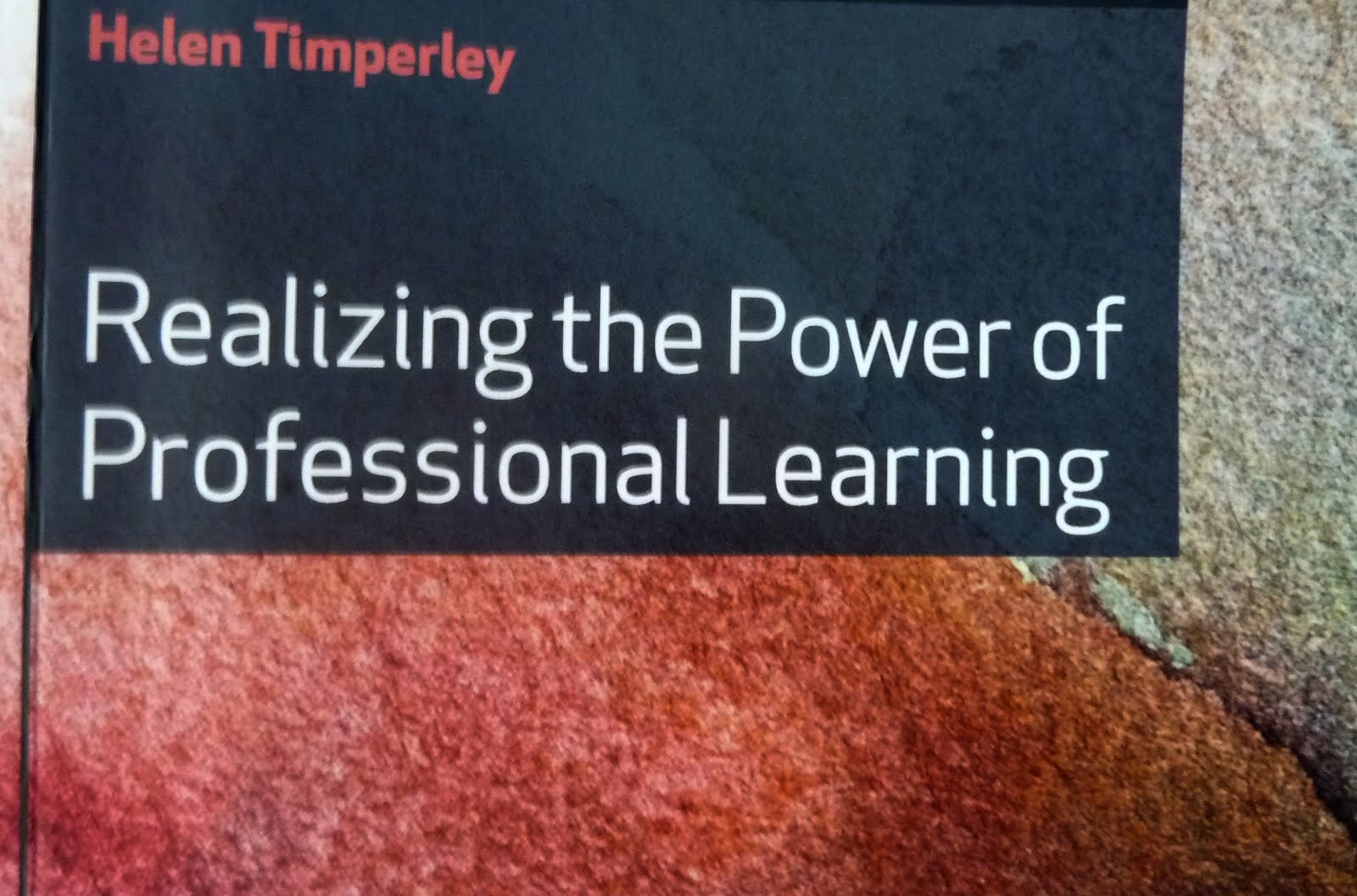
This book by educational researcher Helen Timperley published 2011, is all about tapping the power of teachers to enable all students to succeed. It is about helping teachers learn rather than telling them what to do; about putting student learning at the heart of the educational process; about developing a explicit inquiry approach to learning for teachers, students and principals;  about engagement not compliance. It seems like common sense -  but well researched common sense.

It seems their is a new consensus emerging - one that places empowering teachers as central to educational change. For many Timperley's book simply confirms beliefs many of us have held for years -  that it is the teachers professionalism that counts.  Developing teacher capacity to make informed judgements using an inquiry learning model  has underpinned the writings of Gwen Gawith ( Action learning) and Dr John Edwards, David Perkins,  Guy Claxton, Dean Fink and, more recently, even Michael Fullan who now writes that creating conditions to develop teacher confidence and ability is the key rather than imposing national agendas.  For those with a longer memory the excellent research of the Learning In Science Project ( 1980s) fits in with this 'new' constructivist thinking an approcah that values the prior ideas of students but with  a greater emphasis on teachers' thinking.

Creative principals and teachers have aways believed this although Timperley's book certainly outlines the inquiry cycle in endless detail. It is a shame the government is not following this capacity building approach instead of their obsession with imposing National Standards. This is a book that sees teachers as reflective professional judging success by evidence  not technicians complying to top down demands.

I am sure this will be a popular book for principals who want to  develop 'their' schools as inquiry learning communities where 'self regulated learners'  are able to demonstrate 'deep learning'.

In the introduction the editors of the series write that  education's mission  is 'enable everyone, without exception, to develops all their talents to the full and to realize their creative potential'.

To me this is the point of a modern education system .

The editors write that education has not 'aways kept up with the times'  and 'still seems in the past century'.  They continue that 'tinkering around the endless will not help' and that 'a bold and imaginative re-orientation to educational purposes' is required ; 'about what education could be; not what it has been'.

Unless school leaders appreciate that current thinking is the problem, that there is a need for a 'step change' in professional development,  they will continue to be 'tinkering'.

The book challenges school leaders to develop the 'conditions teachers need to learn in order to make a difference' and that these conditions reflect those needed by their students.

The book is about how teachers learn and why certain approaches to professional development work - an approach valuing and  engaging teachers prior conceptions. It is about appreciating the importance  of what teachers think about their studentsabout teachers  believing all students can learn rather than having a fixed innate intelligence.

The book is premised on the need for teachers to be engaged actively in practical  activities rather than just sitting and receiving knowledge from those who claim to know more than the teachers themselves.

And that the key to any success is teachers seeing their students improve as a result of their actions

Such ideas challenge school leaders and learning facilitators to create the learning conditions to empower teachers and to ensure student progress results. 'For far too many teachers...staff development is a demeaning mind numbing process and they passively sit and git"'

The various chapters of the book outlines in detail an inquiry process that actively involves teachers and implications for school leadership.

The  teacher inquiry model and knowledge building cycle is as follows:


What knowledge and skills do students need to meet important goals.

What knowledge and skills do we as teachers need to meet the needs of their students.

Opportunities to deepen and refine professional skills.

Engaging students in new learning experiences.

Evaluating the impact of changed actions?

( As mentioned in the introduction the editors of the series write that  education's mission  is 'enable everyone, without exception, to develops all their talents to the full and to realize their creative potential'. Imagine if the inquiry learning cycle was based around teachers working to realize this?)

The book makes it clear that this inquiry mindset  is an ongoing iterative process  resulting , if successful, in adaptive practitioners who are aways on the alert for opportunities to improve their teaching. It is also a process that is the default mode that humans are born with and one that underpins scientific and artistic innovations - all forms of 'enlightened trial and error'.

The cycle begins and ends with students and is sited in the real life circumstances individual teachers work in . The process is highly dependent on teachers assessing what students already know and what they can do - their prior experiences, and what they need to do, and how will they know if successful.

The second part of the cycles is determining what teachers need to know and be able to do to ensure all students achieve identifiable success. Students success depends on what teachers  do.  Teacher skill is the single most important influence on students learning so deepening teacher professional knowledge is vital and this is best learned through the inquiry process by trying out and evaluating  new ideas.

It is obvious that the school leaders role is to ensure conditions are in place for teachers to learn and to challenge and support their teachers - teachers are, in this respect, the leaders class. And, as with any class, it is not possible to believe all teachers are equally skilled. And also, as with teacher, leaders cannot choose to work with only those willing if a difference is to be made for all teachers. No teacher can be 'let of the hook.'

The remainder of the book details the various stages and implications of the learning inquiry process.

If I have a criticism, in contrast to the fine words in the preface about developing full range of talents of all students most examples refer to literacy programmes and the author writes that  some feel ( as I do) that  'has been at the cost of a wider and richer curriculum'. It is obviously easier for schools to use fit for purpose assessments of literacy and numeracy but a 21stC education requires a broader view of learning.

One example I enjoyed was  how one secondary teacher developed new knowledge to deal with misbehaving students.Another excellent example was the outlining of the research of Russell Bishop's Kotahitanga research which  illustrated the importance of relationships and cultural differences - and the negative impact of deficit theories of learning.

My favourite example was that of a UK secondary school exploring the development of the six personal learning and thinking skills to develop students as 'independent inquirers, creative thinker, reflective learners, team workers, self managers and effective particpators', to ensure students were prepared for a more challenging curriculum. The staff at this school developed a set of indicators to be considered as evidence of students being more reflective and independent.

If I were a principal this would be the area I would want to develop, along with a focus on developing all students gifts and talents, as they reflect the essence of the 2007 New Zealand Curriculum.

The key to develop engaged learners requires a rich inquiry based programmes across the curriculum and it would be  shame to see inquiry cycles limited to literacy and numeracy.

The book discusses the value of outside catalysts  to bring in a 'new lens' and to challenge 'existing social norms where these norms are directed to reinforcing rather than challenging the status quo'. Respectful relationships (  'relational trust') are required in all situations to promote inquiry habits of mind throughout the school. The importance of coaching, scaffolding of help, that leaves responsibility with the teacher is also an issue.  This of course applies to teachers and their students as well as between leaders,  facilitators and teachers.

The inquiry approach, if implemented,  will uncover teacher beliefs that will be problematic particularly if teachers hold traditional transmission view, or beliefs about innate fixed ability in contrast to growth mindsets. To ensure success  prior views  of teacher must be valued - the evidence of student success needs to be seen as the final arbiter. Uncovering teacher views is vital for any development to occur or for conflicts to be revolved.

The importance of school wide coherence is important but the author writes it 'can conjure up images of alignment with everything looking the same....Coherence  in a learning system, in fact, requites high levels of energy and innovation with studnts'. 'In reality, if leader wish teachers to become responsive to students, then adaptations should be expected'. ' The question is not about faithful implementation - 'adaptive experts are disciplined innovators who monitor their effectiveness in terms of the engagements, learning and well being of all students in their care'.

Adaptive students, adaptive teachers and adaptive schools is  the point of powerful professional learning.To be successful requires the collective will of all involved.

Thursday, January 5, 2012

Educational quotes 4 :The Change Process


'Rosy the Riviter' - a USA poster from WW2 to encourage woman into the workforce. When the GIs came home woman had changed their minds about their role in a modern society.

In reality 'learning' and 'change' are synonymous. Change is not an issue if it makes sense to and is 'owned' by those involved, rather than being arbitrarily imposed. An appreciation that change is a continual process, involving confusion and difficulty, is vital for future learners. 'It is not change that kills it is the transitions'

'Change is like dancing with a gorilla you can't stop because you're tired'. Anon

'Men are not afraid of things but of how they view them.' Epictetus

Every change process that I've seen that was sustained and spread started small.'
Fast Company
 
'There can be little doubt that. an untapped source of human intelligence and creativity is found among the vast number of individuals in the lower socio-economic levels...the bi- products of this waste are evident.. in unemployment ...in rising crime, delinquency rates, and most important in human despair.' Renzulli
 
'Here is Edward Bear, coming downstairs, now, bump, bump, bump, on the back of his head behind Christopher Robin. It is as far as he knows the only way of coming downstairs, but somewhere he feels there is another way, if only he could stop for a moment and think of it.' A A Milne

'Route and destination must be discovered through the journey if you wish to travel to new lands... the key to success lies in the creative activity of making new maps.' Stacy
 
'It isn't the changes that kill you its the transitions' William Bridges
 
'The times are a-changing and if we don't we will sink like a stone.'Bob Dylan

 Lucy: 'Charlie Brown on the cruise ship of life which way is your deck chair facing?' Charlie Brown ponders and replies, 'I don't know, I've never been able to get one open'. Schultz

'Too much educational reform and restructuring is destroying teachers confidence, draining their energy, eating up their time and taking away their hope.' Fullan and Hargreaves
 
'Schools are among the very few institutions that have remained almost entirely unchanged for most of this century.' Judith Aitken 99
 
No other organisation institution faces challenges as radical as those that will transform the school'. Peter Drucker
 
'We need to help the majority unlearn what has been learnt and then help them learn what needs to unfold. Futurists believe that educational and community leaders must be 'disorientated' before they are orientated. That they must unlearn to learn.' Anon
 
'Every organisation has to prepare for the abandonment of every thing it does. Be prepared to abandon everything, lest we have to abandon the ship.Peter Drucker

'Our schools are OK if were 1965!' Stoll and Fink
 
'Half a revolution is worse than none.' Anon
 
' Teachers have been virtually shell shocked by barrages of 'semi- changes' that sap the energy while making few substantial differences - and the sounds of imminent changes are almost deafening.' Joyce and Showers
 
Between the idea and the reality, Between the notion and the act Falls the shadow'. T S Eliot
 
'The crew of the caravel Nina also saw the signs of land and a small branch covered with berries. Everyone breathed afresh and rejoiced at these signs.' Christopher Columbus

'The starting point for strategic planning is not the present but the future - a vision of where you want to be.... It is essential too that the vision is based on the guiding philosophy, core beliefs, and purpose of the organisation', ERO Report 95
 
Simplicity is the new competitive advantage.' Bill Jenson
 
'If a thing is not worth doing it is worth doing badly.' G K Chesterton
 
'Our lives are frittered away with detail ...simplify! simplify! simplify!' Henry Thoreau
 
'This bridge will take you halfway there- the last few steps you will have to take yourself.'  Shel Siverstein
 
'Today's Schools are not Tomorrows Schools. That's a fundamental misconception.'
David Lange
 
'Rarely do outside of school remedies work their way into the fabric of the schools or into the teachers lives, and more rarely into the classrooms. Therefore they only offer a modest hope of influencing the basic culture of the school' Roland Barth
 
'The best we educational planners can do is to create the conditions for teachers and students to flourish and get out of their way.' Theodore Sizer
 
'The main thing is to keep the main thing the main thing!' Steven Covey
 
'Be in charge of your own destiny or some one else will.' Jack Welch CEO
 
'All life is an experiment.' Oliver Wendell Holmes
 
'Life is the path you beat while you walk it.' Antonio Machado/Poet
 
'It takes more than one person to make a path.' African saying
 
'School should be the best party in town.' Peter Kline
 
To much emphasis has been placed on reforming school from the outside through policies and mandates. Too little has been paid to how schools can be shaped from within.' Roland Barth
 
'What is worth fighting for out there is ultimately about developing life lines of hope ...for all those desperately seeking a way forward.' Fullan and Hargreaves

'Some people think you are strong when you hold on. Others think it is when you let go'. Sylvia Robinson
 
'Too many decisions about changes are made by people untouched by the change process.' Peter Block, Business philosopher.
 
'How many times have we brought in an outsider to tell us what we already knew .' Peter Block
 
'Why follow the steps of another to find out where our dreams will lead us.' Peter Block
 
'To see the future you have to travel on the rough edge of experience.' Harriet Rubin Fast Company writer
 
'Things do not change; we change.' Thoreau
 
'Most people (by the time they have become adults ) can't change their minds because their neural pathways have become set... the longer neural pathways have been running one way the harder it is to rewire them.' Howard Gardner
 
'To the blind all things are sudden.' Old saying.
 
'Coming, ready or not!' Childhood game
 
'What worked yesterday is the gilded cage of tomorrow.' Peter Block Business, Philosopher Author of 'The Answer to No is Yes'
 
'You can plan events, but if they go according to plan they are not events.' John Berger Art Critic
 
'You can't jump a chasm in two bounds.' Chinese saying
 
'As the prostitute said, 'It's not the job it's the stairs.' Anon
 
'To travel hopefully is better than to arrive.' R L Stevenson
 
'In a world of infinite choice people are struggling to figure out what to do.' Ralph Waldo Emerson
 
'Nothing was ever achieved without enthusiasm.' Ralph Waldo Emerson
 
'Innovation never happens as planned.' Gifford Pinchot Environmentalist
 
'Form follows function' Louis  Sullivan Architect
 
'Great spirits have always encountered opposition from mediocre minds.' Einstein
 
'If a torrent sweeps a man against a boulder, you must expect him to scream, and you need not be surprised if the scream is sometimes a new theory.' R L Stevenson
 
'The price of change is measured by our will and courage, our persistence, in the face of difficulty.' Peter Block Business Philosopher
 
'If you believe that saying no will get you shot, well, what a fine way to go.' Peter Block
 
'You must be the change you want to see in the world. If blood is to be spilled to do it. Let it be our own.'. Mahatma Gandhi
 
'It is not necessary to change. Survival is not mandatory.' W Edward Deming
 
'If life is like a stage I want better lighting.' Anon
 
'It is our belief that schools in the main are entering the twenty-first century with structures and more importantly, underlying assumptions which are nineteenth century in origins, or relating to the world of the 1950 or 1960s.' Bowring -Carr and Burnham West UK Educators
 
'To cope with a challenging world, any entity must develop the capacity of shifting and changing - of developing new skills and attitudes; in short the capacity of learning.' A De Guess: 'The Living Company'.
 
'You cannot carry out fundamental changes without a certain amount of madness. In any case it comes from non - conformity, the courage to turn your back on the old formulas, the courage to invent the future. It took madmen of yesterday for us to be able to act with extreme clarity today. I want to be one of those madmen.' Thomas Sankarra African Congress.
 
In schools the main problem is not the absence of innovations but the presence of too many disconnected... piecemeal, superficially adorned projects... We are over our heads'. Fullan 2001
 
'Every change you see hides something else we want to do.' Rene Magritte ( Artist)
 
'Familiarity reduces the greatness of things.' Seneca 4BC-65BC
 
'Nothing evades our attention as persistently as that which we take for granted... the decades roll on without even a suggestion that perhaps the whole matter must be rethought' Marion Brady US Educator
 
'You can't force commitment, what you can do... You nudge a little here, inspire a little there, and provide a role model. Your primary influence is the environment you create.' Peter Senge
 
'It doesn't happen all at once. You become. It takes a long time'. Margery Williams
 
'Life is like playing a violin in public and learning the instrument as one goes along.' Samuel Butler
 
'Life is like a box of chocolates. You never know what you are going to get.' Forest Gump's Mother
 
'We are like eggs at present. And you cannot go on indefinitely being just an ordinary egg. We must hatch or go bad.' C S Lewis
 
'Passion mutates into procedures, into rules and roles. Instead of purpose, we focus on policies. Instead of being free to create, we impose constraints that squeeze the life out of us.' Margaret Wheatley and Kellner Rogers
 
'The future cannot be determined. It can only be experienced as it occurring. Life doesn't know what it will be until it notices what it has become.' Margaret Wheatley and Kellner - Rogers
 
'Age is a high price to pay for maturity.' Anon
 
'In order to transform schools successfully, educators need to navigate the difficult space between letting go of old patterns and grabbing on to new ones.' Deal 1990
 
'There is no risk less way to the future, we must choose which set of risks we wish to run.' Jay Ogilvy
 
'I have a feeling we are not in Kansas anymore.' Dorothy/ Wizard of Oz
 
'Men are asleep, they must die before they awake.' The Koran
 
'Custom lies on us heavy as frost'. William Wordsworth
 
'It takes less energy to be free and flowing than locked up in stress ... we learn by releasing and letting go, not by adding on.' William Bates Editor
 
'The road is better than the inn.' Cervantes
 
'The goal of strategic planning is to produce a stream of wise decisions... it also accepts the possibility that the final product may not resemble what was initially intended'. Patterson, Purkey and Parker
 
'I may have not got where I intended to go, but I think I have ended up where I intended to be.' Douglas Adams
 
'Evolution is the most popular way we have for dealing with change.' Seth Godin Business Philosopher
 
'Evolution favors the survival of the wisest.' Jonas Salk
 
'Life is what happens when you are making other plans' John Lennon
 
'People don't want to feel stuck, they want to be able to change.' M C Richards Poet
 
'It is necessary; therefore it is possible.' C A Borghese
 
'Plan to be better tomorrow than today, but don't plan to be finished'. Carol Ann Tomlinson US Educator
 
'Crossing this river is difficult: it means leaving behind some of your own ideas' Dick Raymond
 
'When you start to abandoning your old beliefs or values... you may be stuck at the threshold for two or three years. Before moving on, you have to clear away your cherished beliefs.' Dick Raymond
 
'Start with the spirit of the rule- bending it to shape best practice. If the system tightens up, go to the letter of the rule and efficiently do what is necessary with as little energy as possible in a way that minimizes impact.' Keith Goldhammer Author. 'Characteristics of successful Principals.
 
'If a things not worth doing do it badly and get on with the important things.' Bruce Hammonds ( adapted from G K Chesterton)
 
'If a thing is worth doing it is worth doing it badly.' G K Chesterton.
 
'Sometimes a thing worth doing is worth overdoing'. David Letterman TV Host

Saturday, December 24, 2011

Merry Christmas to All!


Our family father Christmas manufacturing last minute gifts for our 2010 Christmas - another bloody cheeseboard! Only joking Graeme


It is the night before Christmas and it's a beautiful still hot night

After some last minute shopping I spent the day out at my good friends Sarah and Wayne's drinking wine, eating, and enjoying conversation - now sun burnt and tired! Fished up having coffee at the beach and a restful meal with some old friends.

Tomorrow I am having family around for drinks in the morning before going off to eat more food and drink more wine with one branch of our extended family. The weather promises to be superb - the only downer is news of more earthquakes in Christchurch. It doesn't seem fair !

2012 is a 'tipping point' for me - to use an in phrase.

The last few years I have had my house painted and it is now fit for the 21stC. At the same time I have developed my hectare of swamp and bush into a garden of sorts by building bridges and walkways so that it is all now assessable. It is more a nature trail than a garden but my piece of bush ( thanks to owners of the land in the 1930s) has almost every native tree you an think of - including a half dozen 80 year old kauris. While in England I visited Charles Darwin's house ( I am a great fan of Charles Darwin) and he had a walk he used to stroll around thinking up his ideas - I have made a similar walk but not so many ideas!

So the garden has become a new obsession for me.

Towards the end of the year my brother  ( Father Christmas above) and I had a small art exhibition in our home town of Waverley in the local library - a fitting place since our mother was a mainstay of the library in her time. I have to admit my contributions were painted in the 1960s but it has motivated me to take up painting again - in the new year!

After a highly successful birthday party last January I gave a keynote presentation at an Inspired Impact Conference in Palmerston North to over 1400 people. They didn't really come to hear me - the main attraction was creativity guru Sir Ken Robinson. Actually he didn't show because of illnesses but gave his presentation via a satellite link - even took questions from the floor. Brilliant but wasted on our current government and Ministry who seem hell bent on destroying all that is good in primary education.

I saw my keynote as my final performance in education; with the current directions of the government it is no longer a place to be talking about personalising learning or creativity. So that one past obsession out of the way. I even got a big bin a chucked out two cubic metres of educational notes - a mental clean out of sorts. I kept some good bits of course - just in case. And now I have a lot tidier house - for me!

Perhaps the highlight of my year  was visiting old friends in England  ( they had come out to New Zealand for 'our' party - I  have a twin brother.The party was his idea and I am pleased he bullied me into having one. I taught with my English friends in 1969 and 'we' have kept in touch. We all went out for a pub meal with our old headteacher who is now 94!

I have other very important things on my mind but they haven't been sorted yet.

I intend to keep reading and blogging but I am going to wind up the website I started with my friend Wayne a long time ago. I am planning to capture some of the material and use it as blogs so not all will be lost. And , if asked, I will continue to contribute to the Education Today magazine edited by Doug Hislop. Looking back our best fun articles were: New Zealand's 'top schools' ( schools from the far north geographically in New Zealand!) and the articles written after our educational odyssey around  the East Coast.

So Merry Christmas to everyone.

I hope some of my blogs have been of use to you and I hope there are younger people around to take up the fight for creative education while I get on and explore new territory.

Watch this space!

Saturday, December 17, 2011

Advice for 2009!!!!!


From a NZ teacher teaching in Melbourne – is this is what is in the future for us? Not so much the ‘nanny state’ but the ‘big brother’ state!

‘We are right into national testing over here. There is now national testing of all year 3, 5, 7, and 9 students. It just used to be in the other states. Victoria used to be told that we were lagging behind the other states but now, low and behold, after national teaching we are one of the top states. We also have online testing in Numeracy and Maths with the results going to the Department. This is done 3x a year. Our reports are also put directly into the Department. Accountability is everything, don't worry about the teaching. We are told that it does not matter where the students start our job is to get them up to national average and they are trying to bring in performance based pay as well. Also pay incentives for expert teachers and principals to work in disadvantaged areas.’

Read what Kelvin Smythe is on to - urgent


My good friend Paul Tegg recently send the below out to a number of schools he works with. I had forgotten I had written it and thought it worth repeating -even if to see what 'we' didn't achieve!

On more positive note an emphasis for 2009?

Developing Schools as ‘Communities of Inquiry’.

Challenge for 2009: To make the ‘Inquiry’ disposition central to all learning

The ‘new’ New Zealand Curriculum is all about students being: creative energetic and enterprising’ able to ‘make sense of their information, experiences and ideas’ so as to become ‘ confident , connected and actively involved life long learners.’

It asks schools to develop students who ‘are competent thinkers and problem solvers who actively seek, use, and create knowledge’. This involves giving students more choice and responsibility over their learning leading to a more ‘personalized’ approach.

The NZC is asking schools to develop an inquiry approach to all learning; to develop schools as ‘communities of inquiry’. An inquiry approach is about engaging students in difficult questions and issues that are meaningful to them. It is about placing ‘learnacy’ above literacy and numeracy.

This would be a major change of focus for schools. (And one few schiools took)

The need is to present learning contexts to challenge students (‘rich topics’) to be able to research and ‘reflect on their own learning, draw on personal knowledge and intuitions, ask questions and challenge the basis of assumptions and perceptions.’

Schools need to sort out an inquiry model for students to make use of. This model needs to move beyond the mere gathering of information to the deep construction of thoughtful understandings and, at the same time, develop the ‘key competencies’ or future attributes, or attitudes, or dispositions, required for ‘life long learning’.

Class inquiries ought to provide the ‘energy’ to focus the greater part of the school day and include the teaching of information research and presentation as part of the literacy programme as well as mathematical ideas that maybe required as part of any inquiries. The NZC suggests ‘doing fewer topics in greater depth’.

Such inquiries may feature one Learning Area in particular but will most likely involve aspects (strands) of other learning Areas as well. The curriculum is to be seen as ‘deep’ ‘connected’ and integrated. Teachers may need to plan collaboratively.

Teachers will need to develop focused independent group work in all learning blocks including dedicated inquiry time. Groups, or individuals, may research individual aspects and then to share findings, with a wider audience through exhibitions, publications, demonstrations, performances, information media, or posting on web. Such findings are powerful means of assessing depth of understanding and knowledge of process.

By covering a range of inquiry topics (covering the full range of learning Areas Strands) students will also be given the opportunity to uncover hidden gifts, talents and interests that might become life-long passions, or vocations.

Lack of dedicated inquiry time is an issue so the idea of ‘reframing’ the literacy and numeracy blocks to develop appropriate research skills would seem an obvious answer. This would also include integrating use of ICT

Somehow we never realized shools as 'communities of inquiry' - instead we are getting 'schools of compliance and conformity' -except for Charter Schools who are getting the freedom that all state schools ought to have. We didn't fight hard enough - we didn't really fight at all! We didn't defend the 2007 National Curriculum!! I wouldn't want principals on my side in a battle!


So what is the agenda for schools in 2012 - is there life beyond compliance . Or are we heading to a Medieval Dark Ages in education? Maybe all schools ought to become Charter Schools?

Monday, December 12, 2011

A new sense of direction for the Labour Party -and New Zealand


Today the New Zealand Labour Party will select a new leader.  This new leader must work with the people to develop a shared sense of direction for our country - one that all feel part of - or at least enough people to win the election in2014. Some how the party has to connect with over a million voters who couldn't be bothered voting - more people than those who actually voted for the winning National Government.

The question is where do we go to next?  To succeed as a nation we need a vision, a destination, a point of view about the future, a direction in which to channel the efforts of the people we work with and for.  Like early explorers there are no maps to assist us as we journey into ‘terra incognito’.

The new leader must begin such a journey and give courage for others to join the adventure.

This is no time for timid thinking.  The future calls for new mindsets that can thrive in a future based on evolutionary and discontinuous change.  To develop such mindsets we first have to let go of the past and rethink unexamined fundamental assumptions.  Most of all we have to give up our desire to control things from the top.  The future will be driven by human imagination and creativity.  As business philosopher Peter Drucker has written, ‘every organisation has to prepare for the abandonment of everything it does.’  Industrial aged bureaucracy is dead.  .

Worldwide, politicians are running out of ideas to cope with the deepening economic, social and environmental crisis looming ahead. 
Problems are deepening in our society, unemployment is rising, institutions are increasingly failing, and national and individual debt is rising, yet there is little dialogue from politicians about possible alternatives for us to consider.

As problems deepen worldwide countries such as New Zealand will be forced to seek out new solutions.  In the future innovation will be driven far more often from bottom up.  That’s how new ideas will increasingly ‘emerge’. 

New ideas will have to emerge through dialogue with the people from the people as current politicians seem  more concerned with short term thinking, popularity polls and retaining power.  As the situations worsens internationally and within New Zealand, new ideas will be required beyond extremes of individualistic market forces capitalism and deadening socialism.

For far too long we have relied on our leaders to solve our problems.  However as recent events show leaders worldwide have little idea of how to thrive in a rapidly changing climate.

It is now time for leaders to widen the pool of ideas and to tap the collective intelligence of all people to contribute to the solution.  Such leaders must take notice of what creative people and creative organisations  are currently doing to see what it is that we could learn from them and to their share their ideas with others.

Leaders need to instigate a series of national conversations about what kind of society we want to be and what we must change to achieve such a vision.  And then there will be a need to consider how all our institutions need to be transformed so they are flexible enough to thrive in such unpredictable times. It would  be valuable if those conversations  made use the power of all forms of information technology that are now an  integral part of our current culture.

Such a series of conversations would develop a greater collective understanding of the problems facing us and begin the process of empowering all to take responsibility for creative action and not, as is the case now, leaving it to ‘experts’ and politicians.  In this new environment the role of politicians, and leaders in any organisation, would be to create the conditions for new ideas to emerge.

Margaret Wheatley, a business philosopher, has written change doesn’t happen from a leader announcing the plan.  Change begins from deep inside a system, when a few people notice something they can no longer tolerate or respond to a dream of what is possible.  We just have to find a few others who care about the same thing….we don’t have to start with plans only with passion.  One only has to think of Martin Luther King or Nelson Mandela.

For those who feel that ordinary people are not capable of such thinking it is worth noting the words of Thomas Jefferson, who wrote in 1820, ‘if people are not enlightened enough to understand what is required of them the answer is not to dictate solutions but to inform their discretion by education’.

Stephen Carden’s book ‘New Zealand Unleashed’, subtitled ‘the country, it’s future and the people who will get it there’, is worth reading by all those who are serious about the future of our country and who want to become involved in a critical debate about where we are heading. 

Carden writes that ‘the future is coming. The question is: are we ready for it?’  He argues that New Zealand, being small and vulnerable, needs to think about what kind of country we want to become.  The question he asks is important for us all.  He believes that the current uncertain and unpredictable environment we find ourselves in provides a great opportunity for a ‘small agile, flexible nation to excel’.  ‘The idea of setting top down plans and targets,’ he writes, ‘are not helpful and that what is required of leaders is to create the conditions for creativity to occur.’ 

These are the issues that ought to be exercising the minds of those electing a new Labour party leader today.

Thursday, December 1, 2011

Let's not lose the point of school now we have 'the standards'!


Just as we need creativity the government imposes standardisation. Not that schools haven't been there before.

I have just discovered, in my tidy up, a copy of Guy Claxton's ' Whats the Point of School - Rediscovering the Heart of Education'. Claxton's book provides inspiration for a real 'step change' in education to cope with the demands of a dynamic new century that is already a decade old.

Our current system fails too many children but the answer is not to go back to the failed standardisation of the past.

The trouble with the standards is that the cure may be worse than the problem as school are pressurised to focus more on more on ensuring students succeed they will neglect more important things such as attitudes and individual students' talents and gifts. It is these qualities that are the heart of a future orientated education. I am reminded of the old saying:  ' when you are up to your backside in alligators it is hard to remember you came to drain the swamp'! It is not that I am against literacy and numeracy it is just that these need to be seen as very important 'foundation skills'  - skills best learnt when students see the point of them.

There is no doubt that Claxton is one of the most important writers of our time. Claxton is one of the UK's foremost thinkers on creativity, learning, and the brain.  All schools should have a copy and make efforts to implement his ideas - somehow, in the present environment in New Zealand, I can't see this happening - quite the opposite.

Claxton begins his book by writing: 'The purpose of education is to prepare young people for the future. Schools should be helping young people develop the capacities they will need to thrive. What they need, and want, is the confidence to talk to strangers, to try things out, to handle tricky situations, to stand up for themselves, to ask for help, to think new thoughts.'

'But, he says, 'they are not getting it'.

'Education' he continues, 'has lost the plot and it urgently needs to recover its core purpose'. Politicians claim to put education at the heart of their concerns but they are wrong if they think imposing regressive standards will do it they are mistaken - they will only act as  intellectual straight jackets. Politicians need, Claxton says, 'the courage to go deeper'.

Albert Einstein wrote that 'education is what remains after one has forgotten everything one has learnt at school' - and Claxton reminds us that Einstein was referring to those lifelong skills and attitudes that mark out a true learner.

The key to develop such qualities are gained by students working in groups researching engaging projects involving skills of collaboration, discussion and attitudes of self organisation. This of course involves in depth content and quality outcomes but it is , Claxton says, 'not the immediate performance so much as the cumulative development that is going on behind the specific tasks' that is more important. It is these attitudes and skills that matter in the long run.They are the core confidences young people need,Claxton calls them 'learning muscles.These are curiosity, courage, investigation, imagination, reasoning, sociability and reflection' .'These , Claxton calls ' qualities of mind'. And all these are are 'perfectly capable of being strengthened and cultivated by education' - but the 'pressure to push up literacy rates' subverts their development. The quest for results undermines student's confidence and contributes to their 'losing their capacity for wonder and critical thinking'.

Claxton quotes John Dewey who wrote: 'How many students for example, were rendered callous to ideas and how many have lost the impetus to learn by the way in which learning was experienced by them?' The new standards come to mind!

In this desire to focus on literacy and numeracy, Claxton writes, 'we  have forgotten the deeper purpose of education.'

'To effect a thorough change' he says, 'we have to start by seeing how bad things are.We have to understand what it is young people really need, what schools are actually providing, and acknowledging the gulf between the two. And then we have to establish, beyond all possible doubt, that the kind of educational reform for more than a hundred years is not going to work'.

Only when this is understood that a different kind of change is both necessary and possible. 'With a little bit of imagination, and a modicum of courage, education can rediscover its heart and soul.'

Claxton wants to inspire teachers to see  students as 'brave and confident explorers, tough enough in spirit,and flexible enough in mind, to pursue their dreams and ambitions.'

So did the New Zealand Curriculum until the government sidetracked it!

'We need a new narrative for education that can engage and inspire chidren'. Lets fire kids up with the deep satisfaction of discovery and exploration. They are born with learning zeal; lets recognise, celebrate and protect it, but also stretch, strengthen and diversify it.'

Schools have , as Claxton says,   'lost the plot'!

Monday, November 28, 2011

Where has that Aussie confidence gone from their teachers -and a look at where New Zealand is about to go!


A little bit of Ned Kelly spirit is required to combat the technocrats in charge in Aussie (and now in New Zealand).

Guest blog by Phil Cullen
Ex Director Primary Education Queensland.

Check out Phil's website.


ORWELL IS HERE!

The year of Orwell and  the introduction of Orwellism has been delayed.

 In the 1950s when we first read about a future manipulated, dysfunctional society, 1984 seemed to be so far away. ‘1984’ didn’t happen when it should have. Society was fairly comfortable in 1984, except for Queensland. The leader there had been appointed by divine authority, he had suggested; and made some curious judgements about schooling on moral grounds.
None could even imagine, then, a future where the country was run by a focussed control-pedant , who preferred to rule by fear-based, heavy-handed distrust and make decisions about  schooling just to illustrate his/her authoritative control. 
By the 1960s, the western world was on the cusp of creating a school culture of learning that would have had no equal in history. These years produced the greatest thinkers and writers of the 20th century; and teachers of the time, straining to shatter the shackles of colonial styles of teaching-learning were about to break loose. They read and they observed and they talked and they listened and they shared. The mood of the late sixties and seventies with its Deweys, Goodlads, Bassetts, Parrys, Postmann & Weingartners, Holts, Plowdens, Cleggs...such a long list of child-oriented scholars and writers...was one of hope
Every state Australian state bureaucracy appointed visionaries to important positions [e.g. Guymer in Q’ld, Swan in NSW, Jones in S.A., Shears in Vic., Beare in ACT] irrespective of the local political power base. Schooling was on the up and up - despite one or two attacks [e.g Back to Basics, M:ACOS] that the press enjoyed featuring.
The dystopic political arrangements for an Orwell-1984-style-Australia were put on hold for a quarter-of-a-century. It was destined to happen as soon as despotic managerialists and measurers introduced euphemisms as articles of faith [e.g. ‘outsource’ = don’t trust your own; ‘down-size’= sack those you fear] circa 1990. The public learned to tolerate this inconsistent square-peg  ruddism [in Q‘ld. in particular] without dissent; and ‘orewellism’ entered the language as a suitable descriptor for what eventually happened in 2009. Big Brother showed himself.
Turn back to the real 1984.
 The year itself, might have been considered a fizzer for those who had trusted  George Orwell’s predictions, but child-oriented schooling itself was well under way and schools were happily optimistic at that time. Big Brothers were not necessary. Teachers believed in themselves. They felt proud of what they were doing.
I could open a Principals Conference in 1984 by sayingThere is no task so demanding, no occupation [apart from that of religious minister or priest] so ethically professional than that of a primary or secondary teacher. Its impact on the welfare of the world, the care for people as people, the influence that it has on the achievements of each person and subsequently of each nation places the profession as something apart from all other occupations. It is concerned about a nation’s most precious commodity and its richest resource – children. It is a self-monitoring, self-improving profession ...and it is in this context that we have foregathered. We hope to make a determined and realistic commitment to enlivening classroom practices because they are the base-line of what we are all on about.”
The conference was about ‘Excellence in Teaching’. Attenders talked about teaching and learning and on how to improve both.  They could say that and do that in 1984 and believe in solid, immovable professional ethics. No jumped-up politician, lawyer or sciolist would dare to tell teachers what to do and how to do it. The force felt solidly professional from top to bottom and remained so until 1990 or thereabouts.
We can’t make those sort of statements that I made, anymore. The political Darleks, ‘utterly without pity, compassion or remorse with every emotion removed except hate’ have moved in. Professional schooling principles have backed off.
A 2011 national conference for principals [that I ‘attended’ on-line] was about improving scores on national blanket tests. Schooling by numbers. Pupil welfare and progress did not get much of a mention. Ethics had travelled a long way .
It was another sign that Orwellism was well entrenched. It had twenty-five years to arrive and it had infected all parts quickly.
What is orwellism? 
 Described as oligarchical dictatorship,  based on a nonsensical, peculiar thought process that manipulates social structures on behalf of the most powerful,  participants can indulge in double-thinking by holding two contradictory beliefs and believing in both. Teachers can believe in freedom to learn and use fear-driven practice techniques to prepare for Big Brother’s NAPLAN tests.
Thus, by embracing inconsistent concepts, school principals can acquiesce to the decadent political view that low test scores indicate poor teaching and shabbily-run schools; and their professional conscience won't worry them. Professionally neutered, they are unable to dissent from or offer ethical advice to political masters. The work-force generally is on the same wave-length. The school-tardy, both pupils and teachers,  must be punished; and all adults generally subscribe to this notion.
With ethical principles in suspension through political mandate, this further entrenches the style of Orwellian oligarchical dictatorship that decries individuality and teaching ethics.
Teachers are told what to do and what to think. School leaders acquiesce as it is easier to do do so. Double-think prevails. True-blue professional codes are trashed with organizational approval. The sycophants feel even more secure and comfortable; and the ultimate victims are not taken into account at any stage. .
Whereas politicians kept out of –perhaps avoided -  serious curriculum considerations in the real 1984, there has been a change of social climate since then. As George O himself said in the other ‘1984’, “ In our age, there is no such thing as ‘keeping out of politics’ ; and politics itself is a mass of lies, evasion, folly, hatred and schizophrenia.”  So its welcome to that sort of world for all 2011 school personnel and clients. 
Teachers probably sense the outrageously camouflaged intentions of our fat controllers, but cannot do anything about it. If the playing field was level, their organizations would be able to say to Her Overbearance, “We won't give your tests to our pupils.  We love them and want them to learn. It is unworthy of you to ask us to do so and a serious breach of schooling ethics.”
The field is very steep. The ball gets away from you if you don’t try to stop it. Orwellism is in full swing in dystopic Australia

Sunday, November 27, 2011

Now the elections are over time to think of the 'big picture' - only the Greens had real focus on sustainablity!


The earth's climate was changed dramatically by a meteor in dinosaur times, and of course over time there are natural variations, but today it is humankind that is creating a crisis of its own that will effect all nations. So far world wide efforts to face up to this crisis has run up against national interests.


I have just read 'Here on Earth' by Tim Flannery ( author of the 'Future Eaters' and the 'Weather Makers' and Australian of the year in 2007) and his new book is an argument for hope.

The book is a provocative and visionary read providing solutions to the crisis facing us all.

Politics , as exemplified in our recent election, is still locked into selfish and destructive practices that place self interest about the common good - the market still rules although it is obvious world wide it's 'trickle down' theory gas failed - it is more a 'trickle up' - the rich get richer and the poor poorer. Flannery's book is  a warning about worshiping self interest if we wish to live in a fair and equitable society -a warning ignored by National voters in our recent election!

Flannery writes that there are two fundamental sentiments that decide an election - hope for the future , and fear of it. If hope prevails we elect more generous governments but if fear prevails we look inwards to a 'me first' mentality -  Darwinian 'survival of the fittest' ( or the rich). Our future depends , he writes, on which of these ideas prevail. It is worth thinking about the  self destructive fate of the Easter Islanders!

When it comes to surviving we need a sustainable 'win win'  co-evolutionary  cooperative scenario - the Greens best represent this and their followers are growing. Growth at all costs ( Nationals programme it seems)  creates pollution if only by apathy. Farmers and industry spoiling our rivers a good example - our  rivers are like canaries in coal mines. Competition and 'bottom line' rule supreme while cooperation is neglected. James Lovelock developed the Gaia theory describing the earth as a living interconnected self regulating world but , in contrast to Flannery, because of human change is pessimistic about survival of life as we know it.

Flannery's 'History of the Earth'  illustrates we just can't keep shifting our waste from one place to another and tells us that if we wish to keep our planet fit for life then the most humble and routine things we do must change.

We have escaped from co-evolutions grip  and broken free of environmental restraints that protect our fragile eco systems. Since the evolution of humans from Africa  human history has been a tale of destruction but as cultures evolve co-evolution slowly drew them into balance with the ecosystems they created. The problem is humans are evolving so quickly the fate of the environment has been forgotten in the search for growth and personal wealth. Modern humans live their lives, Flannery writes, without the slightest thought about the consequences.

Thankfully their are a growing number of people who who are beginning to realise it this understanding of relationships, rather than our technology, that will determine our fate. Flannery believes that after population the greatest obstacle in our path is lack of sustainability.

Flannery introduces the idea of people who act 'discounting' future consequences of their actions by using unwisely valuable resources and at the same time developing grinding poverty through greatly unequal societies; the rich reaping rewards while destroying other areas of the world in the process. This is a world of greed and markets of unrestrained top down systems - a selfishness that erodes common bonds and futures , and that erodes the value we place on understanding complex relationships.

Future successful countries  will embrace  business strategies with sustainable technology  and social accountability for the benefit of all - policies pushed by both the Greens and Labour in our elections. New Zealand should lead in this development not avoid this responsibility as the almost defunct ACT party was asking voters to do. And poverty should be everyone's enemy in a global world. Countries like Sweden leave New Zealand in shame when it comes to looking after their young - and in Sweden the rich do not mind paying taxes for social cohesion unlike National voters who believe in 'conspicious consumption'.

Well regulated markets build sustainable wealth - poverty is not inevitable. Flannery quotes John F Kennedy who said, 'if a free country cannot help the many who are poor, it cannot save the few who are rich' -advice ignored in the USA and New Zealand. New generations, those  currently protesting against the rich world wide,  may develop new ways of thinking about the challenges.

Flannery envisages the day when international governance of our environment will be so complete that we will be able to avoid ecological disasters by providing adequate warnings -   worldwide environmental forecasts  to assist in sustaining life.

Flannery believes we are poised between destruction of our life supporting systems and and our ability to unite to secure our common wealth. He believes that through human history we have shown an ability to cooperate and live in successful communities by sacrificing for some individual wealth.

The climate challenge  is humankind's first test and Flannery believes we now have the technology to develop a sustainable  world. We , he writes, are just beginning to develop this planetary consciousness and if we do then, unlike the doomsayers, he believes the world will be healed and a sustainable life lifestyle established.

Flannery concludes his book saying, 'if we do not strive to love one another, and love our planet as much as we love ourselves then no further human progress is possible here on earth'.

A great read - a great Australian.

World wide politics is the future challenge.


Thursday, November 24, 2011

John Key and Mrs Tolley turn education into a McDonalds - principals will now become managers complying to franchise regulations.


Early this week National finally showed its hand about National Standards testing and 'league tables.

After months of weasel words Nationals agenda becomes painfully clear.

And on TV John Key happily blamed failing children on poor teaching - he evidently didn't see the programme shown the same week about the effects of poverty, poorly heated housing was creating for 1 in 5 children in such areas. And in housing managed by the government . Funny how the 1in 5 failing children fits the same data as Mrs Tolley's - this time the data is correct; not  simplistic political dogma spread by both Tolley and Key. I think we could correctly call it propaganda. The figures for failing children in these areas are greater than 1 in 5  due to poor housing resulting in health problems that civilised countries like Sweden have long since solved through integrated humanitarian policies. In New Zealand we still rely on the 'trickle down' theory that has failed wherever it has been tried - but the theory does save the self satisfied National voters facing up to reality. After all it is the poors own fault. All they need to get is job and all will be well - ignoring that there are no jobs to get!

Time will show John Key and Mrs Tolley to be the simplistic wreckers they are. In the meantime creative teachers will have to cope by going underground  and if the remainder can't see the problem then they will be seen as complying with the destruction of an education system once held in high esteem  by educators ( if not politicians and technocrats) around the world.

Principals who meekly went along with National Standards  will be seen as Judas Sheep or the Vichy ( who worked with the Germans) in France. Too few principals had the courage to stand up to such destructive polices and too few got together to make  a  group stand - I can only think of one group who did so led by Perry Rush. NZEI and NZPPF opposition was in itself not enough to make it clear to teachers and principals the need for action. 

To get an idea of what is about to rain on their heads teachers and principals need to read the Joe Stalin's approach to education and also click the  to Kelvin Smythe uncovering of the future agenda before it was announced.

Probably the best metaphor for the future direction of education is a comparison with McDonalds- and Ronald their clone like icon.

McDonalds is all about efficiency and standards - and each franchise can easily be reported on and help from the central office sent if necessary or the franchise removed.

Now I don't mind the odd McDonalds meal when in a hurry but as a diet it results in poor health. The biggest difference between a school and MacDonalds  will be that McDonald only takes in standardised potatoes and meat. Schools will have to take whichever students turn up -although students attending high decile schools, of course, will have the advantage of their parents 'social capital'. And the rich will simply avoid going to McDonalds school as they do now.

The McDonald story is quite interesting. By the 1950s one company was responsible for the the change in the American diet as fast food became the craze. One little restaurant in California sold more than any other in America. This was run by two brothers  - the McDonalds. The brothers were a success and opened others unfortunately for them they didn't like flying and Ray Croc bought the business and sold franchise  throughout America -  and the world. Standardised food had arrived.

The McDonald brothers originally started with a vision. They got rid of all the china, silverware and waitresses and reopened with customers coming to collect their own food - and they cut their menu to seven items. Customers only could specify the meal they wanted -  McDonald's became a success.

Every thing was standardised. The process was made into an assembly line. Kroc was obsessive that everything should be followed exactly -even down to the bun having 178 sesame seeds!

This all led a culture that was successful but dazzlingly unsympathetic to innovation; the formula worked.  A fifth of all meals eaten in the USA eaten in a McDonalds. This might account for obesity problems!

And if you think of it this can all be applied to schools.

The Ministry will determine the educational standards and 'best practice' processes to be followed.

Schools will report to the Ministry and the Ministry will ( Kroc like ) ensure any diversions from the standards are sorted out, or schools will be 'helped' by Ministry 'officials' - 'we are here to help you'.

Schools  will have to comply and to achieve fidelity to Ministry goals they will inevitably  cut back on areas of the curriculum not tested. As much as Mrs Tolley says this will not happen it has already has happened in the UK and the US.

Ministry 'helpers' will be  contracted to assist in the designated targeted standardised areas. ERO will complement the surveillance culture.

It will be  all about accountability, measurement, targets, efficiency and recorded progress -and sticks and carrots.

Innovation, diversity and creativity  -once the hallmark of our highly regarded system will go out the window.

Tough times for the creative.

No need for leadership ( what little there was) the future will be all about management.

I am pleased  I am out of it!

Only Ronald McDonalds (teachers, principals and students) will thrive -  the  different, the creative, and  those from different cultures will all be forced into a Procrustean curriculum bed  with only three slats - reading, writing and arithmetic.

We will have returned to Victorian days just as we need to encourage all the creativity and talent we can.

At least our future failure will be documented!


Design by Free Wordpress Themes | Bloggerized by Lasantha - Premium Blogger Templates