Showing posts with label Leadership. Show all posts

Thursday, January 12, 2012

Education to realize the talents of all - students and teachers.


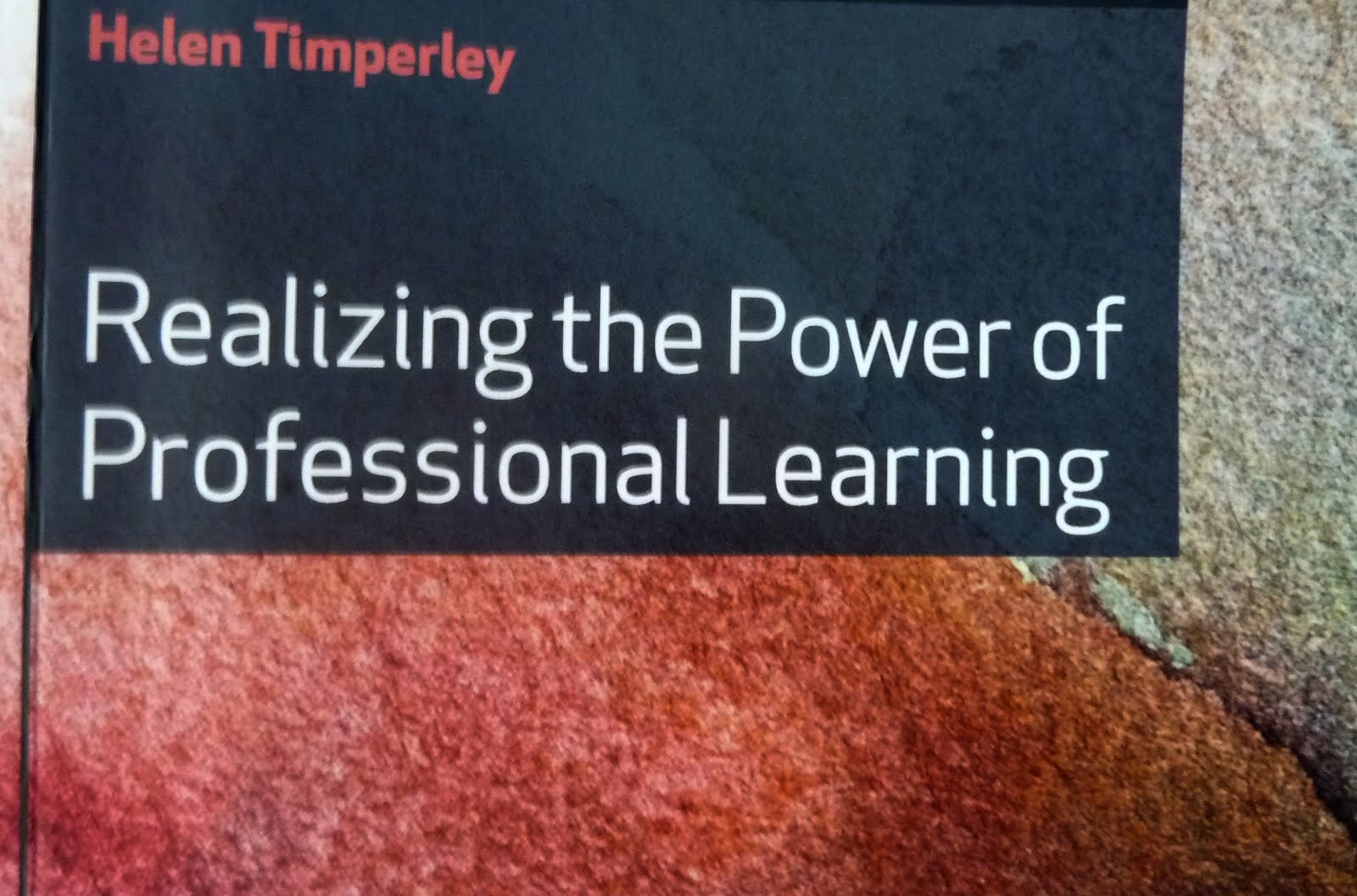
This book by educational researcher Helen Timperley published 2011, is all about tapping the power of teachers to enable all students to succeed. It is about helping teachers learn rather than telling them what to do; about putting student learning at the heart of the educational process; about developing a explicit inquiry approach to learning for teachers, students and principals;  about engagement not compliance. It seems like common sense -  but well researched common sense.

It seems their is a new consensus emerging - one that places empowering teachers as central to educational change. For many Timperley's book simply confirms beliefs many of us have held for years -  that it is the teachers professionalism that counts.  Developing teacher capacity to make informed judgements using an inquiry learning model  has underpinned the writings of Gwen Gawith ( Action learning) and Dr John Edwards, David Perkins,  Guy Claxton, Dean Fink and, more recently, even Michael Fullan who now writes that creating conditions to develop teacher confidence and ability is the key rather than imposing national agendas.  For those with a longer memory the excellent research of the Learning In Science Project ( 1980s) fits in with this 'new' constructivist thinking an approcah that values the prior ideas of students but with  a greater emphasis on teachers' thinking.

Creative principals and teachers have aways believed this although Timperley's book certainly outlines the inquiry cycle in endless detail. It is a shame the government is not following this capacity building approach instead of their obsession with imposing National Standards. This is a book that sees teachers as reflective professional judging success by evidence  not technicians complying to top down demands.

I am sure this will be a popular book for principals who want to  develop 'their' schools as inquiry learning communities where 'self regulated learners'  are able to demonstrate 'deep learning'.

In the introduction the editors of the series write that  education's mission  is 'enable everyone, without exception, to develops all their talents to the full and to realize their creative potential'.

To me this is the point of a modern education system .

The editors write that education has not 'aways kept up with the times'  and 'still seems in the past century'.  They continue that 'tinkering around the endless will not help' and that 'a bold and imaginative re-orientation to educational purposes' is required ; 'about what education could be; not what it has been'.

Unless school leaders appreciate that current thinking is the problem, that there is a need for a 'step change' in professional development,  they will continue to be 'tinkering'.

The book challenges school leaders to develop the 'conditions teachers need to learn in order to make a difference' and that these conditions reflect those needed by their students.

The book is about how teachers learn and why certain approaches to professional development work - an approach valuing and  engaging teachers prior conceptions. It is about appreciating the importance  of what teachers think about their studentsabout teachers  believing all students can learn rather than having a fixed innate intelligence.

The book is premised on the need for teachers to be engaged actively in practical  activities rather than just sitting and receiving knowledge from those who claim to know more than the teachers themselves.

And that the key to any success is teachers seeing their students improve as a result of their actions

Such ideas challenge school leaders and learning facilitators to create the learning conditions to empower teachers and to ensure student progress results. 'For far too many teachers...staff development is a demeaning mind numbing process and they passively sit and git"'

The various chapters of the book outlines in detail an inquiry process that actively involves teachers and implications for school leadership.

The  teacher inquiry model and knowledge building cycle is as follows:


What knowledge and skills do students need to meet important goals.

What knowledge and skills do we as teachers need to meet the needs of their students.

Opportunities to deepen and refine professional skills.

Engaging students in new learning experiences.

Evaluating the impact of changed actions?

( As mentioned in the introduction the editors of the series write that  education's mission  is 'enable everyone, without exception, to develops all their talents to the full and to realize their creative potential'. Imagine if the inquiry learning cycle was based around teachers working to realize this?)

The book makes it clear that this inquiry mindset  is an ongoing iterative process  resulting , if successful, in adaptive practitioners who are aways on the alert for opportunities to improve their teaching. It is also a process that is the default mode that humans are born with and one that underpins scientific and artistic innovations - all forms of 'enlightened trial and error'.

The cycle begins and ends with students and is sited in the real life circumstances individual teachers work in . The process is highly dependent on teachers assessing what students already know and what they can do - their prior experiences, and what they need to do, and how will they know if successful.

The second part of the cycles is determining what teachers need to know and be able to do to ensure all students achieve identifiable success. Students success depends on what teachers  do.  Teacher skill is the single most important influence on students learning so deepening teacher professional knowledge is vital and this is best learned through the inquiry process by trying out and evaluating  new ideas.

It is obvious that the school leaders role is to ensure conditions are in place for teachers to learn and to challenge and support their teachers - teachers are, in this respect, the leaders class. And, as with any class, it is not possible to believe all teachers are equally skilled. And also, as with teacher, leaders cannot choose to work with only those willing if a difference is to be made for all teachers. No teacher can be 'let of the hook.'

The remainder of the book details the various stages and implications of the learning inquiry process.

If I have a criticism, in contrast to the fine words in the preface about developing full range of talents of all students most examples refer to literacy programmes and the author writes that  some feel ( as I do) that  'has been at the cost of a wider and richer curriculum'. It is obviously easier for schools to use fit for purpose assessments of literacy and numeracy but a 21stC education requires a broader view of learning.

One example I enjoyed was  how one secondary teacher developed new knowledge to deal with misbehaving students.Another excellent example was the outlining of the research of Russell Bishop's Kotahitanga research which  illustrated the importance of relationships and cultural differences - and the negative impact of deficit theories of learning.

My favourite example was that of a UK secondary school exploring the development of the six personal learning and thinking skills to develop students as 'independent inquirers, creative thinker, reflective learners, team workers, self managers and effective particpators', to ensure students were prepared for a more challenging curriculum. The staff at this school developed a set of indicators to be considered as evidence of students being more reflective and independent.

If I were a principal this would be the area I would want to develop, along with a focus on developing all students gifts and talents, as they reflect the essence of the 2007 New Zealand Curriculum.

The key to develop engaged learners requires a rich inquiry based programmes across the curriculum and it would be  shame to see inquiry cycles limited to literacy and numeracy.

The book discusses the value of outside catalysts  to bring in a 'new lens' and to challenge 'existing social norms where these norms are directed to reinforcing rather than challenging the status quo'. Respectful relationships (  'relational trust') are required in all situations to promote inquiry habits of mind throughout the school. The importance of coaching, scaffolding of help, that leaves responsibility with the teacher is also an issue.  This of course applies to teachers and their students as well as between leaders,  facilitators and teachers.

The inquiry approach, if implemented,  will uncover teacher beliefs that will be problematic particularly if teachers hold traditional transmission view, or beliefs about innate fixed ability in contrast to growth mindsets. To ensure success  prior views  of teacher must be valued - the evidence of student success needs to be seen as the final arbiter. Uncovering teacher views is vital for any development to occur or for conflicts to be revolved.

The importance of school wide coherence is important but the author writes it 'can conjure up images of alignment with everything looking the same....Coherence  in a learning system, in fact, requites high levels of energy and innovation with studnts'. 'In reality, if leader wish teachers to become responsive to students, then adaptations should be expected'. ' The question is not about faithful implementation - 'adaptive experts are disciplined innovators who monitor their effectiveness in terms of the engagements, learning and well being of all students in their care'.

Adaptive students, adaptive teachers and adaptive schools is  the point of powerful professional learning.To be successful requires the collective will of all involved.

Saturday, January 7, 2012

Educational Quotes 5: Leadership and Teamwork


'You can't blow an uncertain trumpet' Mark Twain


Imposed bureaucratic 'top down' changes have resulted in school being 'over managed and under led.' Now is the time for courageous leaders, at all levels, to emerge and add their 'voices' to the debate. There are no experts with 'the answer' - we will have to invent the future ourselves together as we go along.
 
Shared leadership... is less like a an orchestra, where the conductor is always in charge, and more like a jazz band, where leadership is passed around ... depending on what the music demands at the moment and who feels most moved by the spirit to express the music.' Schlechy 2001
 
'Leaders... will be explorers, adventurers, trailblazers... leaders of leaders... They will gather around them people who have the future in their bones.' Rowan Gibson 'Re Thinking the Future.'
 
'The key to leadership is having people willing to follow you if only out curiosity to see what's going to happen.' Marc Anderson Founder of Netscape
 
'Systems of schooling are over managed and under led'. Thomas Sergiovanni
 
'We need to decide whether to give full service or lip service.' Peter Block
 
'My friends, you never need to bow to no one' Gandalf to the Hobbits
 
(In schools) 'There is an emphasis on doing things right rather on doing the right things.' Thomas Sergiovanni
 
'It is hard to remember that you came to drain the swamp when you are up to your backside in crocodiles.' Saying
 
'The more faithfully you listen to the voice within you, the better you hear what is sounding outside. And only he who listens can speak..' Dag Hammarskjold UN
 
'Comparison, a great teacher told me, is the cardinal sin of modern life. It traps us in a game we can't win. Once we define ourselves in terms of others we lose the freedom to shape our own lives.' Jim Collins, Author 'Built to Last'
 
'Believe nothing, no matter where you read it, or who said it, no matter if I have said it, unless it agrees with your own reason and your own common sense.' Buddha 53 BC -483 BC
 
'Self doubt combined with dignity is central to competent leadership... ( a leader)is able to recognize when he... is on the wrong track and perhaps identify the error by giving in to the need for complete reevaluation.' John Ralston Saul 'Voltaire's Bastards.
 
'The essence of good strategy is what has always been - insecurity and uncertainty.' John Ralston Saul 'Voltaire's Bastards
 
'There are two mistakes one can make along the road to truth - not going all the way, and not starting.' Buddna
 
' the challenge ( for leadership) is to initiate a conversation about what's purpose and what's just practice. Preserve the best, reinvent the rest'... Hold your company hostage, declare your vision in a public way... Make decisions right or wrong .There is nothing worse than waffling'. Keith Yamashira US Business Consultant
 
'Education can change culture but only in so far as educators are transformed.' Parent School Board USA
 
'My job is creating an environment where teachers continually learn'. US Innovative Principal
 
'The question of 'How?' - more than any other question - looks for answers outside of us. It is an individual expression of our doubt.' Peter Block Business Philosopher
 
'Choosing to act on what matters is the choice to live a passionate existence, which is anything but controlled and predictable.' Peter Block Author 'Stewardship.'
 
'Leadership is a personal quest you undertake, based on mission that troubles your heart.' Harriet Rubin. 'Fast Company' Writer
 
'We have all worked with people who are entirely lacking in energy or are the walking black holes of human existence; they suck energy out of whoever they walk into. So the litmus test for all of is, 'Do I generate more energy when I walk into a room or when I walk out of it?'' Steve Farber, President of Extreme Leadership
 
'I think it is important for leaders to answer the question 'What's exciting about the work I /we really do here?' ..to expand it out to the higher meaning and purpose... To really articulate what we really do here, and why this place is cool.'' Steve Farber , President 'Extreme Leadership'.
 
'Leadership is a scary thing. That's why few people want to stand up to the plate.'... 'There are many people who want to be matadors, only to find themselves in the ring with 2,000 pounds of bull bearing down on them, and then discover that what they really wanted was to wear tight pants and hear the crowd roar' Steve Farber.
 
'Good directors, playwrights and leaders are enablers who make it possible for others to succeed by providing the means and opportunities for actions.' Anon
 
'Faced with the choice of buckling under by complying or 'doing a bit of rule bending' successful leaders get on with the latter.' Thomas Sergiovanni
 
'To be a leader is to be awake and alert, to be dissatisfied at all times.' Peter Koestenbaum Philosopher
 
'Remember a dead fish can float downstream but it takes a live one to swim upstream'. W C Fields
 
'It is easier to follow the leader than to lead the follower.' Anon
 
'All bottlenecks occur at the top.' Anon
 
'Be who you are
and say what you feel
because those who mind don't matter
and those who matter don't mind.' Dr Suess

'Leaders are 'canny outlaws', system benders, creative and responsible rule benders. They have to succeed because... the deck is stacked against creative, imaginative and entrepreneurial teachers.' Thomas Sergiovanni
 
'Most of what institutional leadership does today comes from what they thought we wanted and needed yesterday.' Peter Block, Author 'The Answer to How is Yes'.
 
'Win small, win early, win often.' Gary Hamel Leadership 'guru'.
 
'Life shrinks or expands in proportion to ones courage.' Anais Nin
 
'In fact, leaders... that go from good to great start not with 'where' but with 'who'. They start by getting the right people on the bus, the wrong people off the bus, and the right people in the right seats... first the people, then the direction'. Jim Collins
 
'We need to make hope practical and despair less convincing as a central contribution from adults to young people.' Jaon Kenwg
 
'The human being is a walking paradox. We want to be free, completely individual on one hand, and we want to belong on the other hand. We want to be part of a flock but at the same time, you want to be you,' Kjell and Jonas
 
'Leaders... appeal to the heart... with people's deepest, heartfelt hopes. What are these hopes? Humans have a fundamental longing to believe we are successful in what we do - our need to achieve. Educators are typically denied this sense of success. Bombarded with too many state, national, and district standards for students to master... teachers are often unclear as to what they are supposed to accomplish'. Rick Dufor 2004
 
'This is a dreary era. Those who know about education have no power; those who have the power know little or nothing about education' Marion Brady US Educator
 
'The aim of public education is not to spread enlightenment at all, it is simply to reduce as many individuals as possible to the same safe level, to breed a standard citizen, to put down dissent.' H L Menken
 
'It is one of life's great ironies: schools are in the business of teaching and learning, yet they are terrible at learning from one another. If they ever discover how to do this, their future is assured.' Fullan 2001
 
'I will release you to be creatively crazy and wonderful for these students... We will do whatever it takes.' Lorraine Monro Author 'Nothings Impossible'
 
'Hire Rembrandt to do the painting and don't tell him how to paint.' Anon
 
'The leader lays down the melody line and encourages individual band members to improvise around them.' Bradley Porten US Educationalist
 
'If you are going to skate on thin ice, tap dance, and go down in style.' Bryce Courtenay
 
'Leaders need to have clear answer to the question 'What do we believe in? and be equally clear about... 'How do you translate your beliefs into actions?' Bowring Carr and Burnham West
 
'Do not follow where the path may lead. Go instead where there is no path and leave a trail.' Anon
 
'Alice came to a fork in the road. 'Which one will I take?' she asked. 'Where do you want to go?' responded the Cheshire Cat. 'I don't know Alice answered. 'Then', said the cat, 'It doesn't matter.'' Alice in Wonderland
 
'Power can be taken, but not given. The process of taking is empowerment itself.' Gloria Steinem US Feminist
 
( We need) 'leadership that is tough enough to demand a great deal from everyone, and leadership that is tender enough to encourage the heart.' Thomas Sergiovanni Leadership for the Schoolhouse
 
'It is an injustice, a grave evil and disturbance of the right order for a large and higher organization to abrogate to itself functions which can be performed more efficiently by smaller and lower bodies.' Papal Encyclical
 
'Make no little plans. They have no magic to stir man's blood... make big plans. Aim high in hope and work.' Daniel H Burnham
 
'It is time for us to release ourselves from simplistic and ineffective prescriptions; the time to dream is upon us.' Carl Glickman
 
There comes a time in the affairs of man when he must take the bull by the tail and face the situation.' W C Fields
 
'The true leader senses and transforms the needs of followers.' James McGregor Burns
 
If we want to help people change, I s important that we don't push or pull them - just walk together.' 'Aquarian Conspiracy.'
 
'A team is a mosaic' Charles Williams
 
'Any intelligent fool can make things bigger, more complex and more violent. It takes a genius- and a lot of courage - to move in the opposite direction,' E E Schumacher
 
'The best leaders are like outstanding samurai warriors in the sense that they engage themselves fully in the tasks at hand without being distracted by what might go wrong. Warren Bennis called this 'The Wallenda Factor' - putting ones energy into walking life's various wires without concern for the outcome'. Farson and Keyes.
 
'Decisions of the head rather than the heart are then ones we come to regret.' Patricia Weenolsen Psychologist
 
'When we are doing something we're passionate about, failure becomes a non-issue... Pursuit of a dream rarely leads to regrets... Too many of those with unrealized aspirations have set them aside due to fear of failure' Farson and Keyes.
 
'Nothing happens until someone does something.' Steve Farke Leadership Guru
 
No more prizes for building the ark .Prizes only for predicting rain.' Anon
 
Leadership is needed to assemble a team of renegades- people with the right mix of passion and courage to be willing to do things that haven't been done before.' Scott Lutz, CEO
 
'Never look down to test the ground before taking the next step; only he who keeps his eye on the far horizon will find the right road.' Dag Hammarskjold UN

'Briefly, leaders challenge the process because they are risk takers who capitalise on opportunities. As idealists they inspire a shared vision. They... instinctively nurture the talents and energy of colleagues. Leaders enable others to act. ...by serving as coaches and cheerleaders they encourage the heart.' Bennis
 
'Lead, follow or get out of the way' Anon
 
'I set myself as the goal the maximum capacity that people have - I settle for no less. I make myself a relentless architect of the possibilities of human beings.'
Benjamen Zander Conductor Boston
 
'You cannot carry out fundamental change without a certain amount of madness. In this case, it comes from non-conformity, the ability to turn your back on old formulas, the courage to invent the future. It took the madmen of yesteryear for us to be able to act with extreme clarity today. I want to be one of those madmen. We mist dare to invent the future.'Thomas Sankara African leader
 
'Who shall kindle others must himself glow.' Italian Proverb
 
'The only thing of real importance leaders do is to create and manage cultures.' Edgar Schein
'Our schools are over-managed and under-led.' Maurice Gionotti
 
'The best principals are not heroes; they are hero makers'. Roland Barth
 
'The art of leadership is keeping the herd roughly pointed west!' Anon
 
'Imagine that you would become a better teacher just by virtue of being on a the staff of a particular school - just from that one fact alone.' Michael Fullan
 
'Schools must forge greater relationships with the wider community, parents and other schools. Too many schools are working insolation. Schools need to share their power with students and the wider community.'. Fullan and Hargreaves
 
'The best leaders...almost without exception and at every level, are master users of stories.' Tom Peters

Wednesday, December 28, 2011

Extreme views on Education -I think not!


In a comment to my  Christmas blog Mr and Mrs Symonds , formally of Auckland and now living in Sydney, wrote that it was 'because of people like you we have taken our children to be educated in Australia'.  'Your views on education', they wrote, 'are extreme' and 'out of touch with what parents want of a modern education system'.

They began their comment by saying they were 'glad I was going from New Zealand education' and concluded with the phrase 'weird and creepy' - I presume they were referring to themselves? And I have no idea who they  include in the 'people like you' comment nor what they define as a 'modern education system' that parents like them want.

Below is a comment from a New Zealand teacher now working  in Australia. Is this the  'modern system' that parents like the Symonds want? It certainly reflects the agenda of the current government in New Zealand.

'We are right into national testing over here. There is now national testing of all year 3, 5, 7, and 9 students. It just used to be in the other states. Victoria used to be told that we were lagging behind the other states but now, low and behold, after national teaching we are one of the top states. We also have online testing in Numeracy and Maths with the results going to the Department. This is done 3x a year. Our reports are also put directly into the Department. Accountability is everything, don't worry about the teaching. We are told that it does not matter where the students start our job is to get them up to national average and they are trying to bring in performance based pay as well. Also pay incentives for expert teachers and principals to work in disadvantaged areas.’

Sounds very Eastern European to me - something Joseph Stalin would have been proud of or right-wing political American thinkers today. Hardly modern.

Here is what one American educationalist has written ( Glickman 2006)

Today, measuring the accomplishments of students, teachers, and schools by standardised test scores and handing out rewards and punishments for reaching or failing to reach state and federal standards has become commonplace.

In such a climate, we typically err too much on the side of avoiding failure by relying on externally approved " research based" programmes, teaching methods, and assessments that are officially prompted by state and federal governments ( through their agencies).

What we lose in the process is imagination.Failure cannot go unchallenged, but what we have today is our own failure to imagine new possibilities and the worth of what has already worked well*. There is no tragedy in reaching for the stars and falling short; the greatest tragedy in never reaching at all.'

*added

Anyway the below are the 'extreme views' on learning I have been sharing (and will continue to do so) over the years.  I will leave it over to anyone who reads the blog to decide if they are  'weird and creepy' or 'not what parents want for a modern education'.

It is important to appreciate that students are  entering a new age of creativity ; an  era of knowledge creation - where the ability to continue learning, to  develop new ideas, even when confused, will be an important attribute.

I believe that a modern education system ought to focus on developing the talents and gifts of all students and not to judge their success on their test scores only in literacy and numeracy.

I believe that students future success depends on the power of their personal motivation realised :through making choices; achieving mastery; and in the process developing a powerful sense of personal autonomy. As part of gaining success students need to value personal effort and focused practice. These ideas are ignored by standardised testing. Effort and practice sound old fashioned but if neglected little learning will stick.

I believe that learning ought to based on helping students answer questions that engage them in realistic studies; studies that  call on whatever learning areas are necessary to solve the problem. And students also need to appreciate the power of collaborating with others by working in teams.

I believe that the role of the teachers is that of a creative learning coach who follow the advice of educationalist Jerome Bruner who said. 'teaching is the  canny art of intellectual temptation'. Teachers should help students construct their own learning  - and learning should be personalised to suit each learner.

I believe that teachers should ensure all  the various strategies and skills are in place ( including literacy and numeracy)  so students have every chance of success. This includes integrating modern information technology.

To achieve quality learning it is important for students to dig deeply into any learning challenge - to do fewer things well so as to develop the importance of personal excellence.

Can't see what is not 'modern' or is 'weird' in the above.

Saturday, December 17, 2011

Advice for 2009!!!!!


From a NZ teacher teaching in Melbourne – is this is what is in the future for us? Not so much the ‘nanny state’ but the ‘big brother’ state!

‘We are right into national testing over here. There is now national testing of all year 3, 5, 7, and 9 students. It just used to be in the other states. Victoria used to be told that we were lagging behind the other states but now, low and behold, after national teaching we are one of the top states. We also have online testing in Numeracy and Maths with the results going to the Department. This is done 3x a year. Our reports are also put directly into the Department. Accountability is everything, don't worry about the teaching. We are told that it does not matter where the students start our job is to get them up to national average and they are trying to bring in performance based pay as well. Also pay incentives for expert teachers and principals to work in disadvantaged areas.’

Read what Kelvin Smythe is on to - urgent


My good friend Paul Tegg recently send the below out to a number of schools he works with. I had forgotten I had written it and thought it worth repeating -even if to see what 'we' didn't achieve!

On more positive note an emphasis for 2009?

Developing Schools as ‘Communities of Inquiry’.

Challenge for 2009: To make the ‘Inquiry’ disposition central to all learning

The ‘new’ New Zealand Curriculum is all about students being: creative energetic and enterprising’ able to ‘make sense of their information, experiences and ideas’ so as to become ‘ confident , connected and actively involved life long learners.’

It asks schools to develop students who ‘are competent thinkers and problem solvers who actively seek, use, and create knowledge’. This involves giving students more choice and responsibility over their learning leading to a more ‘personalized’ approach.

The NZC is asking schools to develop an inquiry approach to all learning; to develop schools as ‘communities of inquiry’. An inquiry approach is about engaging students in difficult questions and issues that are meaningful to them. It is about placing ‘learnacy’ above literacy and numeracy.

This would be a major change of focus for schools. (And one few schiools took)

The need is to present learning contexts to challenge students (‘rich topics’) to be able to research and ‘reflect on their own learning, draw on personal knowledge and intuitions, ask questions and challenge the basis of assumptions and perceptions.’

Schools need to sort out an inquiry model for students to make use of. This model needs to move beyond the mere gathering of information to the deep construction of thoughtful understandings and, at the same time, develop the ‘key competencies’ or future attributes, or attitudes, or dispositions, required for ‘life long learning’.

Class inquiries ought to provide the ‘energy’ to focus the greater part of the school day and include the teaching of information research and presentation as part of the literacy programme as well as mathematical ideas that maybe required as part of any inquiries. The NZC suggests ‘doing fewer topics in greater depth’.

Such inquiries may feature one Learning Area in particular but will most likely involve aspects (strands) of other learning Areas as well. The curriculum is to be seen as ‘deep’ ‘connected’ and integrated. Teachers may need to plan collaboratively.

Teachers will need to develop focused independent group work in all learning blocks including dedicated inquiry time. Groups, or individuals, may research individual aspects and then to share findings, with a wider audience through exhibitions, publications, demonstrations, performances, information media, or posting on web. Such findings are powerful means of assessing depth of understanding and knowledge of process.

By covering a range of inquiry topics (covering the full range of learning Areas Strands) students will also be given the opportunity to uncover hidden gifts, talents and interests that might become life-long passions, or vocations.

Lack of dedicated inquiry time is an issue so the idea of ‘reframing’ the literacy and numeracy blocks to develop appropriate research skills would seem an obvious answer. This would also include integrating use of ICT

Somehow we never realized shools as 'communities of inquiry' - instead we are getting 'schools of compliance and conformity' -except for Charter Schools who are getting the freedom that all state schools ought to have. We didn't fight hard enough - we didn't really fight at all! We didn't defend the 2007 National Curriculum!! I wouldn't want principals on my side in a battle!


So what is the agenda for schools in 2012 - is there life beyond compliance . Or are we heading to a Medieval Dark Ages in education? Maybe all schools ought to become Charter Schools?

Monday, December 12, 2011

A new sense of direction for the Labour Party -and New Zealand


Today the New Zealand Labour Party will select a new leader.  This new leader must work with the people to develop a shared sense of direction for our country - one that all feel part of - or at least enough people to win the election in2014. Some how the party has to connect with over a million voters who couldn't be bothered voting - more people than those who actually voted for the winning National Government.

The question is where do we go to next?  To succeed as a nation we need a vision, a destination, a point of view about the future, a direction in which to channel the efforts of the people we work with and for.  Like early explorers there are no maps to assist us as we journey into ‘terra incognito’.

The new leader must begin such a journey and give courage for others to join the adventure.

This is no time for timid thinking.  The future calls for new mindsets that can thrive in a future based on evolutionary and discontinuous change.  To develop such mindsets we first have to let go of the past and rethink unexamined fundamental assumptions.  Most of all we have to give up our desire to control things from the top.  The future will be driven by human imagination and creativity.  As business philosopher Peter Drucker has written, ‘every organisation has to prepare for the abandonment of everything it does.’  Industrial aged bureaucracy is dead.  .

Worldwide, politicians are running out of ideas to cope with the deepening economic, social and environmental crisis looming ahead. 
Problems are deepening in our society, unemployment is rising, institutions are increasingly failing, and national and individual debt is rising, yet there is little dialogue from politicians about possible alternatives for us to consider.

As problems deepen worldwide countries such as New Zealand will be forced to seek out new solutions.  In the future innovation will be driven far more often from bottom up.  That’s how new ideas will increasingly ‘emerge’. 

New ideas will have to emerge through dialogue with the people from the people as current politicians seem  more concerned with short term thinking, popularity polls and retaining power.  As the situations worsens internationally and within New Zealand, new ideas will be required beyond extremes of individualistic market forces capitalism and deadening socialism.

For far too long we have relied on our leaders to solve our problems.  However as recent events show leaders worldwide have little idea of how to thrive in a rapidly changing climate.

It is now time for leaders to widen the pool of ideas and to tap the collective intelligence of all people to contribute to the solution.  Such leaders must take notice of what creative people and creative organisations  are currently doing to see what it is that we could learn from them and to their share their ideas with others.

Leaders need to instigate a series of national conversations about what kind of society we want to be and what we must change to achieve such a vision.  And then there will be a need to consider how all our institutions need to be transformed so they are flexible enough to thrive in such unpredictable times. It would  be valuable if those conversations  made use the power of all forms of information technology that are now an  integral part of our current culture.

Such a series of conversations would develop a greater collective understanding of the problems facing us and begin the process of empowering all to take responsibility for creative action and not, as is the case now, leaving it to ‘experts’ and politicians.  In this new environment the role of politicians, and leaders in any organisation, would be to create the conditions for new ideas to emerge.

Margaret Wheatley, a business philosopher, has written change doesn’t happen from a leader announcing the plan.  Change begins from deep inside a system, when a few people notice something they can no longer tolerate or respond to a dream of what is possible.  We just have to find a few others who care about the same thing….we don’t have to start with plans only with passion.  One only has to think of Martin Luther King or Nelson Mandela.

For those who feel that ordinary people are not capable of such thinking it is worth noting the words of Thomas Jefferson, who wrote in 1820, ‘if people are not enlightened enough to understand what is required of them the answer is not to dictate solutions but to inform their discretion by education’.

Stephen Carden’s book ‘New Zealand Unleashed’, subtitled ‘the country, it’s future and the people who will get it there’, is worth reading by all those who are serious about the future of our country and who want to become involved in a critical debate about where we are heading. 

Carden writes that ‘the future is coming. The question is: are we ready for it?’  He argues that New Zealand, being small and vulnerable, needs to think about what kind of country we want to become.  The question he asks is important for us all.  He believes that the current uncertain and unpredictable environment we find ourselves in provides a great opportunity for a ‘small agile, flexible nation to excel’.  ‘The idea of setting top down plans and targets,’ he writes, ‘are not helpful and that what is required of leaders is to create the conditions for creativity to occur.’ 

These are the issues that ought to be exercising the minds of those electing a new Labour party leader today.

Thursday, December 8, 2011

Something all principals ought to have written to their students' parents


A principal and his website posting to parents

Where are we heading, and what have we lost to get there?

Danny Nicholls is principal of St Patrick’s Catholic School, Taupo. He runs a website intended for the school community and other interested readers. The beliefs and opinion expressed are his personal ones. Danny's blog is a well balanced description of the current environment schools find themselves in - if only more school principals ( or better still groups of principals) had written, or even shared similar newsletters.


One of the big building blocks of any school is curriculum delivery. Here in New Zealand we have a fantastic national curriculum which gives sufficient breadth for schools to develop and deliver really exciting and innovative programmes that meet local needs.

The New Zealand Curriculum has been bedded in over a few years now and replaced the more ‘tick the box’ style approach of the previous document.

In particular, the promotion of Key Competencies was a really exciting move towards developing what we want and most value for our students. This curriculum went through extensive consultation and trial/error periods before being accepted and used. I can recall many hours spent getting to understand the intent of this new curriculum and being very excited about its potential.

Sadly, it looks like we are not going to get the most out of this new curriculum, which has been hailed as a world leader by educational experts. The mood at the moment in New Zealand is one of accountability and narrow test scores which inevitably will mean schools not spending so much time on developing the Arts/Health and PE/Languages, as any gains made in those areas will not be directly reflected in national standards data. That to me is one of the most disappointing aspects of the forced imposition of the standards – not the accountability, because that's important to have, and what ERO do already – but what we have lost along the way.

I think back five years to the support my school received. We were a well performing school who were accepted on to a Health and PE contract. This enabled us to have a specialist teacher/consultant working in the school at regular intervals during the year developing teacher capability and confidence in teaching Health and PE. We also hosted a cluster Arts contract, which meant that the regional Arts adviser would run after school workshops once a term at our place, and teachers from around the region would come for a staff meeting in which they developed new skills in teaching an aspect of the Arts curriculum. I also had access to a Leadership adviser who visited once a term to meet with us to give advice or direction we may have needed and to keep us in the loop of the latest developments out of Massey University which was where we drew most of our PD from.

The landscape has changed dramatically and we work in a tighter economic environment, so there are no more Arts, Health, and PE or Leadership advisory positions available to schools. Any professional development or support offered by the Ministry of Education is solely focused on supporting the goals of national standards and is only accessible to those who can prove that they are failing their students. The message is that if you are doing a good job then you are on your own. At another level the message is also that the national focus is on the tail of achievement not extending the brighter children – there is literally nothing available to assist schools to challenge and extend brighter students.

The model being offered now is ‘contestable’ or ‘targeted’ meaning that schools, as of right, do not have access to advisory support but must either pay for it or prove that they are failing their communities and require external support. I find it sad to receive pamphlets from Waikato and Massey (geographically we are in the middle so get both institution’s mailings) touting for business at ‘competitive’ or ‘tailored’ rates – for services that schools used to receive as of right. Money that should be going on school based resources now needs to be spent on providing teachers with the ongoing professional development they require. I imagine both universities are working in difficult times and am saddened to see what we now have to work with. It is well known that the investment by government in education is significantly less than in other comparable nations – our system does have that ‘run on the smell of an oily rag’ ethos, and always has done – yet internationally our results are well above what could be reasonably expected. Not that you would know it if your only source of information on school performance came from those who really should know better.

We continue to hear about the ‘1 in 5’ are failing school’ from the government – as if this is solely a school failing and there are no other social issues in the mix. What about ‘1 in 5 came to school without breakfast today’, or ‘1 in 5 spend their schooling life bouncing from school to school with no stability or opportunity to cement learning patterns’, or even ‘1 in 5 who take 1 in 5 days off school regularly’ – not so catchy or vote grabbing. Anyone who understands a bell curve knows that there will always be those who do not achieve as well as others in particular areas. That is reality. I am not suggesting for a minute that we should not be concerned about raising achievement for the most vulnerable – we always should be, and I know in my school a disproportionate amount of time, money, energy and resources goes into just that – but where is the conversation about high achievers? Or even the ‘average joe or jill’ – do they get a look in?

Remember that summit/think tank held just after National were elected three years ago, investigating how to promote our nation and make it even better? There was a real focus on innovation and doing things differently. Nurturing the tall poppies to make them really blossom was a sound-bite I can recall. Sadly it seems that optimistic start to National's tenure has all but gone. They’ve governed through a tough patch with global financial problems and two national tragedies, so I don't begrudge them the decisions they've had to make in that sense – I just wish it wasn’t at the expense of our high achieving children.

My concern is that post election this narrowing will only get worse. Shonky, unreliable tables comparing schools to one another will begin appearing in newspapers. Schools will begin to be tagged as ‘excellent, ‘failing’ or anywhere in between based on manipulation of data and/or differing assessment practices. Teachers will continue to get bashed in the media despite 95% of them being dedicated, caring and effective professionals. There are a few bad eggs like in any profession yet from what you read in the media (and it will only get worse) it seems all teachers are ineffective. There is already a mini-exodus of school principals as the reality of what we are being charged with overseeing and implementing in our schools begins to take effect. This will only get worse over the next few years. The whispers about how our roles and employment conditions will change post-election will have dire consequences if realized.

National standards on their own will not make a difference to any child’s achievement. Parents who are engaged and work positively with schools already know or can easily find out how their child is doing. The ethos of partnership is eroding and being replaced by one of reporting and suspicion. So much money being invested in a scheme which has little if any benefit to children. And in the meantime a world leading curriculum is abandoned ...

I hope that whether through school/parent pressure, or just common sense, we will see the re-promotion of the NZ Curriculum as our guiding document. This should be the cornerstone of student improvement for our children not a narrow Literacy and Numeracy focus. Those areas are foundational and absolutely at the core of what a school does but we can be so much more than that.

Last night at our teacher meeting we did some preliminary work on our inquiry learning approaches for 2012. That was intended as the posting for today, but clearly I got sidetracked. My biggest concern is that such staff meetings in the current climate may become a luxury as we will need to spend the majority of our time on national standards compliance matters. This isn’t what I want for my children and I know parents in our community don’t want that either.

Unfortunately the debate and decision making on educational direction and policy shifted out of the hands of those actually doing the work some time ago. It is up to us instead to determine what is best at a local level as the national direction is already fixed.

Danny Nicholls

Principal


St Patrick's Catholic School, Taupo


Tuesday, December 6, 2011

Whose agenda ought we be following in education?


While  schools are increasingly being constrained by the imposition of National Standards right wing politicians introduce another failing idea from the USA (and the UK) -  Charter Schools' -  which are to be given considerable freedom.

I made use of 'The Most Important Speech' posting - based on Diane Ravitch's for my blog below. The linked blog is well worth a read by all principals and BOTs - as is the PDF file it refers to.


When politicians interfere with educational provision without democratic consultation we are in trouble. All too often such ideas have popular appeal until they are given more thought. Without time to consider implications the ideas develop a life of their own.

These politicians are undermining education for their own political ends. The idea that our schools are failing is a cynically crafted myth by those who want to privatise 'our' schools.

American educational philosopher Horace Mann wisely said, many years ago,  that when partisan politicians introduce their ideas the result is that public education is demeaned as is respect for professional judgement.  Educational consultant Michael Fullan  has written more recently that politicians always get it wrong; he should know because he has wrongly advised politicians in the UK and Canada!

Educational critics start off by stating that schools have let too many children fail -in New Zealand Ruth Richardson, Bill English, John Key, and now, New Zealand's answer to the American Tea party, - John Banks.

Three things are ignored in the lack of debate.

Firstly the troublesome home circumstances created by poverty is ignored. This poverty has been escalated by failing market forces policies which had at their premise the belief that wealth would 'trickle down'. New Zealand is now one of the countries with the widest 'rich/ poor gap' in the Western World. Conservative politicians fail to acknowledge that the so called 'achievement tail' correlates to the 'one in five students' living in poverty and prefer to spread the more simplistic 'schools are failing 'one in five students.' What is ignored is that even before the first day at school there is an achievement gap.

There is a story of two doctors waiting by a river who see a somebody drowning and the rescue the person.Then another drowning body appears and they pull him out, then another , and another. finally one of the doctors runs up stream and the other calls out, 'where are you going?' The running doctor calls back, 'I am going to see why they are falling in!'

Are we looking upstream to see the causes of school failure?

Politicians like John Key and John Banks say that teachers are using poverty as an excuse yet lack of equality and opportunity can't be that simply ignored.

Secondly while choice is trumpeted as the reason for charter schools the public school system is increasingly being constrained by the politicians imposition of standards- another simplistic political idea with appeal until the consequences are thought through. The ideas of standards come to us from the USA and UK where they result in narrowing of the curriculum, league tables and teaching to the tests. Ironically the most successful American Charter schools are those that have the tightest accountability requirements - so much for choice and diversity.

Thirdly New Zealand schools score highly ( in the first four or so) in the International Tests in Literacy , Numeracy  and other curriculum areas. Both the UK and the USA are seen as failing systems in this respect yet they are the countries our politicians want to follow! Politicians are blind to the more liberal approaches of such countries as Finland. Top achieving countries, like Finland, do not test every child every year. And those that do ignore creativity, innovation and imagination.

Both National Standards and Charter Schools, no matter their superficial appeal, are not silver bullets - raising children achievement is not as simple as their proponents think. Such ideas contribute to a poisonous narrative that colours the minds of the public and destabilizes  the reputation of public education and will add to the gap between so called 'winners and loser' schools.

The sad thing in all this is that the enlightened New Zealand Curriculum, the vital role schools play in creating a democracy, and innovative ideas that creative schools are implementing will be ignored .

Already most primary schools have , for their survival and reputation, have already distorted their programmes to focus on literacy and numeracy - and an obsession with testing -  resulting in students with talents and passion  in other areas  being ignored.

National Standards and Charter Schools ( if they are to be  tied to tight accountability requirements) are no answer. If Charter Schools are to be given given greater flexibility and choice then this also ought to be given to all schools.

There is no argument about the importance of literacy and numeracy but if New Zealand is to become a creative and innovative country then developing every students gifts and talents ought to be the driver for all school change. What is missing by current reformers is the neglect of imagination, creativity and imagination.

For this we need to re-imagine schools completely. We need to move out of  a standardised  'one size fits all'  schooling and move towards personalising education.

Educators understand that children develop in different ways and at different paces and respond differently to different experiences - they cannot be seen as a easily defined product or measured outcome.

What we need is a new narrative for a 21stC education system  one that promotes critical thinking and innovative ideas required for the future.

Creative teachers have always known this.

This ought to be the focus for anyone involved in education.  History will not look kindly on politicians ( and schools) that support such retrogressive ideas. Until this happens how many students will learn to see themselves as failures. How many good teachers will lose hope and leave? Who will want to be a principal in such a managerial, uncreative and technocratic environment?

We have to fight for a different narrative - one that makes sense to parents and the wider community once they have been give the time to consider the faults of the current bunch of self serving conservative politicians.


Thursday, December 1, 2011

Let's not lose the point of school now we have 'the standards'!


Just as we need creativity the government imposes standardisation. Not that schools haven't been there before.

I have just discovered, in my tidy up, a copy of Guy Claxton's ' Whats the Point of School - Rediscovering the Heart of Education'. Claxton's book provides inspiration for a real 'step change' in education to cope with the demands of a dynamic new century that is already a decade old.

Our current system fails too many children but the answer is not to go back to the failed standardisation of the past.

The trouble with the standards is that the cure may be worse than the problem as school are pressurised to focus more on more on ensuring students succeed they will neglect more important things such as attitudes and individual students' talents and gifts. It is these qualities that are the heart of a future orientated education. I am reminded of the old saying:  ' when you are up to your backside in alligators it is hard to remember you came to drain the swamp'! It is not that I am against literacy and numeracy it is just that these need to be seen as very important 'foundation skills'  - skills best learnt when students see the point of them.

There is no doubt that Claxton is one of the most important writers of our time. Claxton is one of the UK's foremost thinkers on creativity, learning, and the brain.  All schools should have a copy and make efforts to implement his ideas - somehow, in the present environment in New Zealand, I can't see this happening - quite the opposite.

Claxton begins his book by writing: 'The purpose of education is to prepare young people for the future. Schools should be helping young people develop the capacities they will need to thrive. What they need, and want, is the confidence to talk to strangers, to try things out, to handle tricky situations, to stand up for themselves, to ask for help, to think new thoughts.'

'But, he says, 'they are not getting it'.

'Education' he continues, 'has lost the plot and it urgently needs to recover its core purpose'. Politicians claim to put education at the heart of their concerns but they are wrong if they think imposing regressive standards will do it they are mistaken - they will only act as  intellectual straight jackets. Politicians need, Claxton says, 'the courage to go deeper'.

Albert Einstein wrote that 'education is what remains after one has forgotten everything one has learnt at school' - and Claxton reminds us that Einstein was referring to those lifelong skills and attitudes that mark out a true learner.

The key to develop such qualities are gained by students working in groups researching engaging projects involving skills of collaboration, discussion and attitudes of self organisation. This of course involves in depth content and quality outcomes but it is , Claxton says, 'not the immediate performance so much as the cumulative development that is going on behind the specific tasks' that is more important. It is these attitudes and skills that matter in the long run.They are the core confidences young people need,Claxton calls them 'learning muscles.These are curiosity, courage, investigation, imagination, reasoning, sociability and reflection' .'These , Claxton calls ' qualities of mind'. And all these are are 'perfectly capable of being strengthened and cultivated by education' - but the 'pressure to push up literacy rates' subverts their development. The quest for results undermines student's confidence and contributes to their 'losing their capacity for wonder and critical thinking'.

Claxton quotes John Dewey who wrote: 'How many students for example, were rendered callous to ideas and how many have lost the impetus to learn by the way in which learning was experienced by them?' The new standards come to mind!

In this desire to focus on literacy and numeracy, Claxton writes, 'we  have forgotten the deeper purpose of education.'

'To effect a thorough change' he says, 'we have to start by seeing how bad things are.We have to understand what it is young people really need, what schools are actually providing, and acknowledging the gulf between the two. And then we have to establish, beyond all possible doubt, that the kind of educational reform for more than a hundred years is not going to work'.

Only when this is understood that a different kind of change is both necessary and possible. 'With a little bit of imagination, and a modicum of courage, education can rediscover its heart and soul.'

Claxton wants to inspire teachers to see  students as 'brave and confident explorers, tough enough in spirit,and flexible enough in mind, to pursue their dreams and ambitions.'

So did the New Zealand Curriculum until the government sidetracked it!

'We need a new narrative for education that can engage and inspire chidren'. Lets fire kids up with the deep satisfaction of discovery and exploration. They are born with learning zeal; lets recognise, celebrate and protect it, but also stretch, strengthen and diversify it.'

Schools have , as Claxton says,   'lost the plot'!

Monday, November 28, 2011

Where has that Aussie confidence gone from their teachers -and a look at where New Zealand is about to go!


A little bit of Ned Kelly spirit is required to combat the technocrats in charge in Aussie (and now in New Zealand).

Guest blog by Phil Cullen
Ex Director Primary Education Queensland.

Check out Phil's website.


ORWELL IS HERE!

The year of Orwell and  the introduction of Orwellism has been delayed.

 In the 1950s when we first read about a future manipulated, dysfunctional society, 1984 seemed to be so far away. ‘1984’ didn’t happen when it should have. Society was fairly comfortable in 1984, except for Queensland. The leader there had been appointed by divine authority, he had suggested; and made some curious judgements about schooling on moral grounds.
None could even imagine, then, a future where the country was run by a focussed control-pedant , who preferred to rule by fear-based, heavy-handed distrust and make decisions about  schooling just to illustrate his/her authoritative control. 
By the 1960s, the western world was on the cusp of creating a school culture of learning that would have had no equal in history. These years produced the greatest thinkers and writers of the 20th century; and teachers of the time, straining to shatter the shackles of colonial styles of teaching-learning were about to break loose. They read and they observed and they talked and they listened and they shared. The mood of the late sixties and seventies with its Deweys, Goodlads, Bassetts, Parrys, Postmann & Weingartners, Holts, Plowdens, Cleggs...such a long list of child-oriented scholars and writers...was one of hope
Every state Australian state bureaucracy appointed visionaries to important positions [e.g. Guymer in Q’ld, Swan in NSW, Jones in S.A., Shears in Vic., Beare in ACT] irrespective of the local political power base. Schooling was on the up and up - despite one or two attacks [e.g Back to Basics, M:ACOS] that the press enjoyed featuring.
The dystopic political arrangements for an Orwell-1984-style-Australia were put on hold for a quarter-of-a-century. It was destined to happen as soon as despotic managerialists and measurers introduced euphemisms as articles of faith [e.g. ‘outsource’ = don’t trust your own; ‘down-size’= sack those you fear] circa 1990. The public learned to tolerate this inconsistent square-peg  ruddism [in Q‘ld. in particular] without dissent; and ‘orewellism’ entered the language as a suitable descriptor for what eventually happened in 2009. Big Brother showed himself.
Turn back to the real 1984.
 The year itself, might have been considered a fizzer for those who had trusted  George Orwell’s predictions, but child-oriented schooling itself was well under way and schools were happily optimistic at that time. Big Brothers were not necessary. Teachers believed in themselves. They felt proud of what they were doing.
I could open a Principals Conference in 1984 by sayingThere is no task so demanding, no occupation [apart from that of religious minister or priest] so ethically professional than that of a primary or secondary teacher. Its impact on the welfare of the world, the care for people as people, the influence that it has on the achievements of each person and subsequently of each nation places the profession as something apart from all other occupations. It is concerned about a nation’s most precious commodity and its richest resource – children. It is a self-monitoring, self-improving profession ...and it is in this context that we have foregathered. We hope to make a determined and realistic commitment to enlivening classroom practices because they are the base-line of what we are all on about.”
The conference was about ‘Excellence in Teaching’. Attenders talked about teaching and learning and on how to improve both.  They could say that and do that in 1984 and believe in solid, immovable professional ethics. No jumped-up politician, lawyer or sciolist would dare to tell teachers what to do and how to do it. The force felt solidly professional from top to bottom and remained so until 1990 or thereabouts.
We can’t make those sort of statements that I made, anymore. The political Darleks, ‘utterly without pity, compassion or remorse with every emotion removed except hate’ have moved in. Professional schooling principles have backed off.
A 2011 national conference for principals [that I ‘attended’ on-line] was about improving scores on national blanket tests. Schooling by numbers. Pupil welfare and progress did not get much of a mention. Ethics had travelled a long way .
It was another sign that Orwellism was well entrenched. It had twenty-five years to arrive and it had infected all parts quickly.
What is orwellism? 
 Described as oligarchical dictatorship,  based on a nonsensical, peculiar thought process that manipulates social structures on behalf of the most powerful,  participants can indulge in double-thinking by holding two contradictory beliefs and believing in both. Teachers can believe in freedom to learn and use fear-driven practice techniques to prepare for Big Brother’s NAPLAN tests.
Thus, by embracing inconsistent concepts, school principals can acquiesce to the decadent political view that low test scores indicate poor teaching and shabbily-run schools; and their professional conscience won't worry them. Professionally neutered, they are unable to dissent from or offer ethical advice to political masters. The work-force generally is on the same wave-length. The school-tardy, both pupils and teachers,  must be punished; and all adults generally subscribe to this notion.
With ethical principles in suspension through political mandate, this further entrenches the style of Orwellian oligarchical dictatorship that decries individuality and teaching ethics.
Teachers are told what to do and what to think. School leaders acquiesce as it is easier to do do so. Double-think prevails. True-blue professional codes are trashed with organizational approval. The sycophants feel even more secure and comfortable; and the ultimate victims are not taken into account at any stage. .
Whereas politicians kept out of –perhaps avoided -  serious curriculum considerations in the real 1984, there has been a change of social climate since then. As George O himself said in the other ‘1984’, “ In our age, there is no such thing as ‘keeping out of politics’ ; and politics itself is a mass of lies, evasion, folly, hatred and schizophrenia.”  So its welcome to that sort of world for all 2011 school personnel and clients. 
Teachers probably sense the outrageously camouflaged intentions of our fat controllers, but cannot do anything about it. If the playing field was level, their organizations would be able to say to Her Overbearance, “We won't give your tests to our pupils.  We love them and want them to learn. It is unworthy of you to ask us to do so and a serious breach of schooling ethics.”
The field is very steep. The ball gets away from you if you don’t try to stop it. Orwellism is in full swing in dystopic Australia

Friday, November 25, 2011

National's 'brighter future' doesn't include the students or their teachers!


The current National Government has ignored educators worldwide and opted for an accountants view of education turning students into products and schools into factories so as to give consumers a choice - but what a choice!

What many feared has come to pass.

Populist political simplicity has won the day!If you repeat a half truth ( one in 5 students are failing) without also factoring in the effects of poverty and poor health of  unknown in other civilised countries. One fifth of our students live in distressing poverty ( that is , of course, 1 in 5)

The Government seems to admire a McDonald's approach to education and , if they knew their history, one promulgated by Joseph Stalin in the 1930s. Joseph also believed in the pseudo science of measurement as do technocrats around the world.

Read what a young teacher wisely has written - shame many principals don't have the same insight.

‘Learn from what not to do from reform in the US’.....
 
said Joe Bower from Alberta, Canada quoting from “Testing, Testing’ by Larry Bool and J.C.Couture.  They maintain that the absurd elements of the absurd US reform are largely ideological....
 
 
*market-based business methods for the running of schools;
*emphasis on standardisation and narrowing of curriculum;
*fostering choice and competition among schools;
*making judgements based on test data;
*merit pay and other incentives;
*faith that technologically mediated instruction will reduce costs;
*overwhelming top-down approach which tells everyone what to do;
*holds everyone-else accountable.
 
For New Zealand and Australia [as well as Canada] to copy such reform elements is beyond belief - where was the professional leadership - setting tests no doubt!

And read what a  wise old Director General of Queensland Primary education has to say.

And check out this warning from a great Canadian blogger!

True science , according to Brian Cox Science Adviser to the previous Ministry of Education and Science in the UK is 'being happy with the unknown' - a search to reach for the stars.

A quote from American educationalist Glickman 2006  clearly states the scenario we are moving into in New Zealand.

' Today, measuring the accomplishments of students, teachers, and schools by standardised test scores and handing out rewards and punishments for reaching or failing to reach state and federal standards has become commonplace.

In such a climate, we typically err too much on the side of avoiding failure by relying on externally approved " research based" programmes, teaching methods, and assessments that are officially prompted by state and federal governments ( through their agencies).

What we lose in the process is imagination.Failure cannot go unchallenged, but what we have today is our own failure to imagine new possibilities and the worth of what has already worked well*. There is no tragedy in reaching for the stars and falling short; the greatest tragedy in never reaching at all.'

*added.

And from the  UK  another warning ( source NZ Herald).

'Survey slams schools.

Many British adults say they did not realise their true potential until years after they had left school. A survey of 2000  people found, on average,   they cited 22 as the age they found their niche in life.  Nearly half of those surveyed felt they  were regarded as average or poor students while they were at school. Of those, 15% said they never got the chance to discover their talent in the classroom because their teachers had written them off as failures'.

It seems to me that the challenge of 21stC schools is to ensure all the talents and skills of every individual students are realised - and, according to business philosopher Peter Drucker, the first country to develop such an education system will win the future.

Some countries like Singapore are doing just this.

 It is a shame that our government looks back to failed approaches , used by failing countries, for inspiration. And it is a shame that not many schools are developing true personalised talent based programmes.

 Most schools lost the plot years ago and now the 2007 NZ Curriculum - an antidote to previous curriculum approaches, has all but  been sidelined.

For more read Larry Cuban's blog

 
Design by Free Wordpress Themes | Bloggerized by Lasantha - Premium Blogger Templates