Showing posts with label Creative teaching Educationalists. Show all posts

Thursday, January 12, 2012

Education to realize the talents of all - students and teachers.


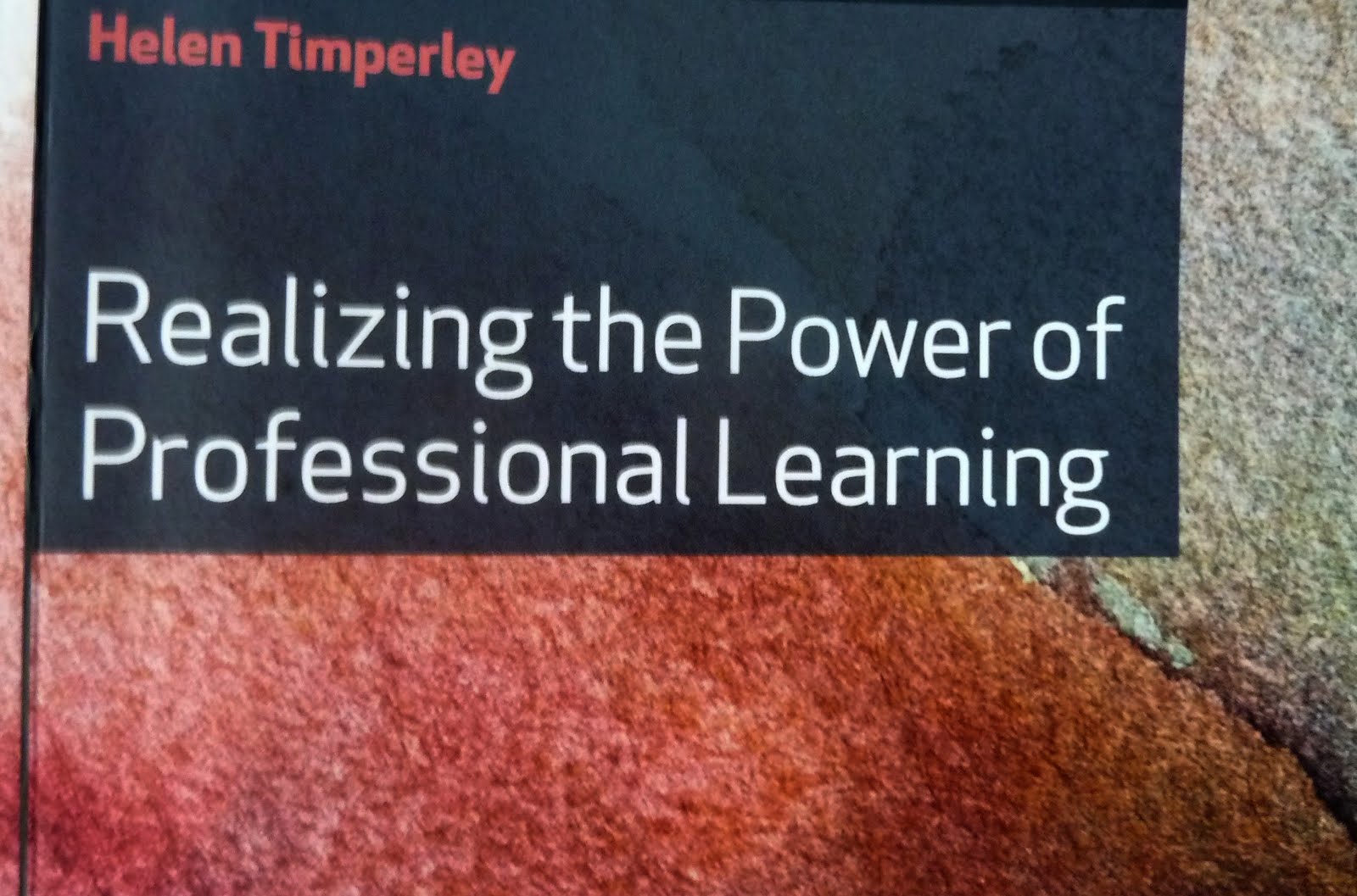
This book by educational researcher Helen Timperley published 2011, is all about tapping the power of teachers to enable all students to succeed. It is about helping teachers learn rather than telling them what to do; about putting student learning at the heart of the educational process; about developing a explicit inquiry approach to learning for teachers, students and principals;  about engagement not compliance. It seems like common sense -  but well researched common sense.

It seems their is a new consensus emerging - one that places empowering teachers as central to educational change. For many Timperley's book simply confirms beliefs many of us have held for years -  that it is the teachers professionalism that counts.  Developing teacher capacity to make informed judgements using an inquiry learning model  has underpinned the writings of Gwen Gawith ( Action learning) and Dr John Edwards, David Perkins,  Guy Claxton, Dean Fink and, more recently, even Michael Fullan who now writes that creating conditions to develop teacher confidence and ability is the key rather than imposing national agendas.  For those with a longer memory the excellent research of the Learning In Science Project ( 1980s) fits in with this 'new' constructivist thinking an approcah that values the prior ideas of students but with  a greater emphasis on teachers' thinking.

Creative principals and teachers have aways believed this although Timperley's book certainly outlines the inquiry cycle in endless detail. It is a shame the government is not following this capacity building approach instead of their obsession with imposing National Standards. This is a book that sees teachers as reflective professional judging success by evidence  not technicians complying to top down demands.

I am sure this will be a popular book for principals who want to  develop 'their' schools as inquiry learning communities where 'self regulated learners'  are able to demonstrate 'deep learning'.

In the introduction the editors of the series write that  education's mission  is 'enable everyone, without exception, to develops all their talents to the full and to realize their creative potential'.

To me this is the point of a modern education system .

The editors write that education has not 'aways kept up with the times'  and 'still seems in the past century'.  They continue that 'tinkering around the endless will not help' and that 'a bold and imaginative re-orientation to educational purposes' is required ; 'about what education could be; not what it has been'.

Unless school leaders appreciate that current thinking is the problem, that there is a need for a 'step change' in professional development,  they will continue to be 'tinkering'.

The book challenges school leaders to develop the 'conditions teachers need to learn in order to make a difference' and that these conditions reflect those needed by their students.

The book is about how teachers learn and why certain approaches to professional development work - an approach valuing and  engaging teachers prior conceptions. It is about appreciating the importance  of what teachers think about their students - about teachers  believing all students can learn rather than having a fixed innate intelligence.

The book is premised on the need for teachers to be engaged actively in practical  activities rather than just sitting and receiving knowledge from those who claim to know more than the teachers themselves.

And that the key to any success is teachers seeing their students improve as a result of their actions

Such ideas challenge school leaders and learning facilitators to create the learning conditions to empower teachers and to ensure student progress results. 'For far too many teachers...staff development is a demeaning mind numbing process and they passively sit and git"'

The various chapters of the book outlines in detail an inquiry process that actively involves teachers and implications for school leadership.

The  teacher inquiry model and knowledge building cycle is as follows:


What knowledge and skills do students need to meet important goals.

What knowledge and skills do we as teachers need to meet the needs of their students.

Opportunities to deepen and refine professional skills.

Engaging students in new learning experiences.

Evaluating the impact of changed actions?

( As mentioned in the introduction the editors of the series write that  education's mission  is 'enable everyone, without exception, to develops all their talents to the full and to realize their creative potential'. Imagine if the inquiry learning cycle was based around teachers working to realize this?)

The book makes it clear that this inquiry mindset  is an ongoing iterative process  resulting , if successful, in adaptive practitioners who are aways on the alert for opportunities to improve their teaching. It is also a process that is the default mode that humans are born with and one that underpins scientific and artistic innovations - all forms of 'enlightened trial and error'.

The cycle begins and ends with students and is sited in the real life circumstances individual teachers work in . The process is highly dependent on teachers assessing what students already know and what they can do - their prior experiences, and what they need to do, and how will they know if successful.

The second part of the cycles is determining what teachers need to know and be able to do to ensure all students achieve identifiable success. Students success depends on what teachers  do.  Teacher skill is the single most important influence on students learning so deepening teacher professional knowledge is vital and this is best learned through the inquiry process by trying out and evaluating  new ideas.

It is obvious that the school leaders role is to ensure conditions are in place for teachers to learn and to challenge and support their teachers - teachers are, in this respect, the leaders class. And, as with any class, it is not possible to believe all teachers are equally skilled. And also, as with teacher, leaders cannot choose to work with only those willing if a difference is to be made for all teachers. No teacher can be 'let of the hook.'

The remainder of the book details the various stages and implications of the learning inquiry process.

If I have a criticism, in contrast to the fine words in the preface about developing full range of talents of all students most examples refer to literacy programmes and the author writes that  some feel ( as I do) that  'has been at the cost of a wider and richer curriculum'. It is obviously easier for schools to use fit for purpose assessments of literacy and numeracy but a 21stC education requires a broader view of learning.

One example I enjoyed was  how one secondary teacher developed new knowledge to deal with misbehaving students.Another excellent example was the outlining of the research of Russell Bishop's Kotahitanga research which  illustrated the importance of relationships and cultural differences - and the negative impact of deficit theories of learning.

My favourite example was that of a UK secondary school exploring the development of the six personal learning and thinking skills to develop students as 'independent inquirers, creative thinker, reflective learners, team workers, self managers and effective particpators', to ensure students were prepared for a more challenging curriculum. The staff at this school developed a set of indicators to be considered as evidence of students being more reflective and independent.

If I were a principal this would be the area I would want to develop, along with a focus on developing all students gifts and talents, as they reflect the essence of the 2007 New Zealand Curriculum.

The key to develop engaged learners requires a rich inquiry based programmes across the curriculum and it would be  shame to see inquiry cycles limited to literacy and numeracy.

The book discusses the value of outside catalysts  to bring in a 'new lens' and to challenge 'existing social norms where these norms are directed to reinforcing rather than challenging the status quo'. Respectful relationships (  'relational trust') are required in all situations to promote inquiry habits of mind throughout the school. The importance of coaching, scaffolding of help, that leaves responsibility with the teacher is also an issue.  This of course applies to teachers and their students as well as between leaders,  facilitators and teachers.

The inquiry approach, if implemented,  will uncover teacher beliefs that will be problematic particularly if teachers hold traditional transmission view, or beliefs about innate fixed ability in contrast to growth mindsets. To ensure success  prior views  of teacher must be valued - the evidence of student success needs to be seen as the final arbiter. Uncovering teacher views is vital for any development to occur or for conflicts to be revolved.

The importance of school wide coherence is important but the author writes it 'can conjure up images of alignment with everything looking the same....Coherence  in a learning system, in fact, requites high levels of energy and innovation with studnts'. 'In reality, if leader wish teachers to become responsive to students, then adaptations should be expected'. ' The question is not about faithful implementation - 'adaptive experts are disciplined innovators who monitor their effectiveness in terms of the engagements, learning and well being of all students in their care'.

Adaptive students, adaptive teachers and adaptive schools is  the point of powerful professional learning.To be successful requires the collective will of all involved.

Friday, December 30, 2011

Elwyn Richardson: NewZealand's pioneer creative teacher.


Elwyn Richardson with Margaret MacDonald. Margaret has just completed a thesis on Elwyn Richardson's place in creative teaching in New Zealand.

Take 15 minutes to view this U -Tube video of Elwyn's work and pass it on to others.

I was reading in an art book I was given for Christmas about all the influences that had contributed to the development to the artists personal style.

Everybody has people who have contributed to the beliefs they currently hold and I got to thinking who had made the greatest contribution to my own views about education.

In one way I was was rather privileged because most of my time in teaching, since the 60s, has been as an itinerant specialist teacher, first in nature study, later as an adviser in science and for a short time an art adviser. I say privileged because the various advisory roles enabled me to come across number of teachers whose approach to teaching and learning stood out from other teachers.

I have aways believed that the best professional development is to be gained by observing other teachers - particularly those who have the ability to draw the best out of their students. Teachers have a  profound respect for the advice from those who do the real work.Unfortunately, in recent decades, 'experts' from outside the classroom have become the sources of 'official'  knowledge and this has led to a reduction in the importance of those creative teachers. This is is a shame.

In my early years the most innovative teachers I was lucky to visit were principals of small rural schools.Bigger urban school were very traditional places in those days.  There isn't much point in mentioning names as all have long since retired but they, I realised later, were aware of the creative ideas that were in the air, in all areas of life, after the World War Two. In New Zealand progressive child centred ideas were being encouraged under the guidance of Dr Beeby the then Director of Education.

During the sixties I became involved with local art advisers ( who were under the guidance of National Art Director Gordon Tovey. With Gordon's encouragement the art advisers involved teachers to explore integrated  or related art studies.  With most classrooms having every part of the day timetables this was a revolutionary approach and suited those teachers in multi-age small schools who had the freedom to experiment.  Unfortunately such advisers, in a range of fields , are now history and  leaving an important inspirational gap that has never been filled.

Also during this time I became aware of the UK Junior Nuffield Science approach and worked with a number of local teachers to implement such ideas. This approach encouraged open ended inquiries based on children question making use of the immediate environment. This  dovetailed nicely with the ecological approaches that were being encouraged by nature study and later science advisers.

It was during this time I learnt about the exciting work of Elwyn Richardson  in his small school in the far North written up in his book 'In The Early World'.

Another important influence to my beliefs came from my visit to the UK to learn more about Nuffield Science and English child centred learning. The most important aspect was working in a very progressive school King Farm School Gravesend Kent.

Returning to New Zealand I worked with a small group of Taranaki teachers to develop what came to be known as the Taranaki Environmental Education Approach (the environment referred to the importance of stimulating classroom environments and making use of the rich local environment). This group combined ideas from the related art approaches,   English progressive teaching and the ideas of Elwyn Richardson ( who we had made contact with).

At this point my ideas about teaching and learning had become clear. Going teaching for a few years in the 70s  enabled me to put them into practice as did being a principal in the late 80s.

Since then lots of ideas from a range of educationalists have added to the mix.

Unfortunately sine 1986 the winds of change worldwide have sent school off in another direction towards standardised education -an approach that undermines the very creativity and diversity that New Zealand educators had gained world wide respect for

It is time for  schools to return to believing in the importance of creative teachers as the source of lasting change.  Teachers will need to work together ( they now have the technology to do so) to articulate a set of beliefs for the new century - one thing that they could do is get behind the  almost side tracked 2007  New Zealand National Curriculum.

Elwyn remains as an inspiration of what can be achieved if we want to develop the talents and gifts of all students

Thursday, December 22, 2011

A message from Australia


I think it is worth sharing the below posting by Australian educator Phil Cullen ( Phil used to be Director Primary Education Queensland ) .Thankfully he hasn't lost his belief in creative education. Australia has moved further along the downhill  accountability track than New Zealand but we are rushing to catch up - a race to the bottom!

To access Phil's site click here.
IS 2012 THE YEAR FOR AN EDUCATIONAL R/EVOLUTION?

On Wednesday, 21 December, the ASIDE blog commented upon the TIME magazine choice of The Protestor as the person of the year. ‘Frustrations felt by millions nationally and internationally reached breaking point ... in 2011...by teachers as well.’

http://theasideblog.blogspot.com/2011/12/is-2012-year-for-educational-reform.htm

“To top it off, we have a growing number of disgruntled youth, who drop out of an education system that sees them as a number and fails to see the ensuing impact on society as a whole...Conformity and measurement are being used to define students, yet we constantly talk about differentiation, multiple learning styles, and the whole child....This leads us to ask the question, how many teachers will ‘dropout’ from conformity and measurement?”

“Just think how much more we could engage students if we were not so close to the edge of the cliff.”

There were protests everywhere in 2011 about the branding of schools with numbers. This week, also [Monday, 19 December] 1046 New York principals signed a petition opposing the linking of their own evaluation [ A score out of 100] with the results of their students’ testing scores. Such number branding is coming down here.

On July 30, you will remember how the many thousands of teachers marched on the White House chanting “No Testing. No Testing. 1-2-3”. They were supported by famous people – film stars, professors, legislators. Major cities around the country conducted their own protests at the time. No change yet, however. The school-bashing ideology is very strong. Teachers are very compliant.

Protests, however, are growing in size and number. Protestors now Occupy. It’s all coming to a town near you in Australia, for sure, if political parties don’t start caring for kids. There is a limit to the patience of parents and teachers down-under and up-over.

On January 7, 2012 the United Opt-out National in the U.S. is encouraging everybody to send a card or letter to their educational superordinates and legislators [our Minister for Education and Federal Minister for Education in our case] telling them ‘to end standardized testing.’ Check this out on http://unitedoptout.com With determined organisation and parent support, this movement could become world wide. Although schools in the southern hemisphere are closed, we parents and grand-parents can still have our say. Post offices aren’t closed.

Why be an Australia ( or a Kiwi) who has trouble grasping the significance of these movements?

Thursday, December 1, 2011

Let's not lose the point of school now we have 'the standards'!


Just as we need creativity the government imposes standardisation. Not that schools haven't been there before.

I have just discovered, in my tidy up, a copy of Guy Claxton's ' Whats the Point of School - Rediscovering the Heart of Education'. Claxton's book provides inspiration for a real 'step change' in education to cope with the demands of a dynamic new century that is already a decade old.

Our current system fails too many children but the answer is not to go back to the failed standardisation of the past.

The trouble with the standards is that the cure may be worse than the problem as school are pressurised to focus more on more on ensuring students succeed they will neglect more important things such as attitudes and individual students' talents and gifts. It is these qualities that are the heart of a future orientated education. I am reminded of the old saying:  ' when you are up to your backside in alligators it is hard to remember you came to drain the swamp'! It is not that I am against literacy and numeracy it is just that these need to be seen as very important 'foundation skills'  - skills best learnt when students see the point of them.

There is no doubt that Claxton is one of the most important writers of our time. Claxton is one of the UK's foremost thinkers on creativity, learning, and the brain.  All schools should have a copy and make efforts to implement his ideas - somehow, in the present environment in New Zealand, I can't see this happening - quite the opposite.

Claxton begins his book by writing: 'The purpose of education is to prepare young people for the future. Schools should be helping young people develop the capacities they will need to thrive. What they need, and want, is the confidence to talk to strangers, to try things out, to handle tricky situations, to stand up for themselves, to ask for help, to think new thoughts.'

'But, he says, 'they are not getting it'.

'Education' he continues, 'has lost the plot and it urgently needs to recover its core purpose'. Politicians claim to put education at the heart of their concerns but they are wrong if they think imposing regressive standards will do it they are mistaken - they will only act as  intellectual straight jackets. Politicians need, Claxton says, 'the courage to go deeper'.

Albert Einstein wrote that 'education is what remains after one has forgotten everything one has learnt at school' - and Claxton reminds us that Einstein was referring to those lifelong skills and attitudes that mark out a true learner.

The key to develop such qualities are gained by students working in groups researching engaging projects involving skills of collaboration, discussion and attitudes of self organisation. This of course involves in depth content and quality outcomes but it is , Claxton says, 'not the immediate performance so much as the cumulative development that is going on behind the specific tasks' that is more important. It is these attitudes and skills that matter in the long run.They are the core confidences young people need,Claxton calls them 'learning muscles.These are curiosity, courage, investigation, imagination, reasoning, sociability and reflection' .'These , Claxton calls ' qualities of mind'. And all these are are 'perfectly capable of being strengthened and cultivated by education' - but the 'pressure to push up literacy rates' subverts their development. The quest for results undermines student's confidence and contributes to their 'losing their capacity for wonder and critical thinking'.

Claxton quotes John Dewey who wrote: 'How many students for example, were rendered callous to ideas and how many have lost the impetus to learn by the way in which learning was experienced by them?' The new standards come to mind!

In this desire to focus on literacy and numeracy, Claxton writes, 'we  have forgotten the deeper purpose of education.'

'To effect a thorough change' he says, 'we have to start by seeing how bad things are.We have to understand what it is young people really need, what schools are actually providing, and acknowledging the gulf between the two. And then we have to establish, beyond all possible doubt, that the kind of educational reform for more than a hundred years is not going to work'.

Only when this is understood that a different kind of change is both necessary and possible. 'With a little bit of imagination, and a modicum of courage, education can rediscover its heart and soul.'

Claxton wants to inspire teachers to see  students as 'brave and confident explorers, tough enough in spirit,and flexible enough in mind, to pursue their dreams and ambitions.'

So did the New Zealand Curriculum until the government sidetracked it!

'We need a new narrative for education that can engage and inspire chidren'. Lets fire kids up with the deep satisfaction of discovery and exploration. They are born with learning zeal; lets recognise, celebrate and protect it, but also stretch, strengthen and diversify it.'

Schools have , as Claxton says,   'lost the plot'!

Monday, November 28, 2011

Where has that Aussie confidence gone from their teachers -and a look at where New Zealand is about to go!


A little bit of Ned Kelly spirit is required to combat the technocrats in charge in Aussie (and now in New Zealand).

Guest blog by Phil Cullen
Ex Director Primary Education Queensland.

Check out Phil's website.


ORWELL IS HERE!

The year of Orwell and  the introduction of Orwellism has been delayed.

 In the 1950s when we first read about a future manipulated, dysfunctional society, 1984 seemed to be so far away. ‘1984’ didn’t happen when it should have. Society was fairly comfortable in 1984, except for Queensland. The leader there had been appointed by divine authority, he had suggested; and made some curious judgements about schooling on moral grounds.
None could even imagine, then, a future where the country was run by a focussed control-pedant , who preferred to rule by fear-based, heavy-handed distrust and make decisions about  schooling just to illustrate his/her authoritative control. 
By the 1960s, the western world was on the cusp of creating a school culture of learning that would have had no equal in history. These years produced the greatest thinkers and writers of the 20th century; and teachers of the time, straining to shatter the shackles of colonial styles of teaching-learning were about to break loose. They read and they observed and they talked and they listened and they shared. The mood of the late sixties and seventies with its Deweys, Goodlads, Bassetts, Parrys, Postmann & Weingartners, Holts, Plowdens, Cleggs...such a long list of child-oriented scholars and writers...was one of hope. 
Every state Australian state bureaucracy appointed visionaries to important positions [e.g. Guymer in Q’ld, Swan in NSW, Jones in S.A., Shears in Vic., Beare in ACT] irrespective of the local political power base. Schooling was on the up and up - despite one or two attacks [e.g Back to Basics, M:ACOS] that the press enjoyed featuring.
The dystopic political arrangements for an Orwell-1984-style-Australia were put on hold for a quarter-of-a-century. It was destined to happen as soon as despotic managerialists and measurers introduced euphemisms as articles of faith [e.g. ‘outsource’ = don’t trust your own; ‘down-size’= sack those you fear] circa 1990. The public learned to tolerate this inconsistent square-peg  ruddism [in Q‘ld. in particular] without dissent; and ‘orewellism’ entered the language as a suitable descriptor for what eventually happened in 2009. Big Brother showed himself.
Turn back to the real 1984.
 The year itself, might have been considered a fizzer for those who had trusted  George Orwell’s predictions, but child-oriented schooling itself was well under way and schools were happily optimistic at that time. Big Brothers were not necessary. Teachers believed in themselves. They felt proud of what they were doing.
I could open a Principals Conference in 1984 by saying “There is no task so demanding, no occupation [apart from that of religious minister or priest] so ethically professional than that of a primary or secondary teacher. Its impact on the welfare of the world, the care for people as people, the influence that it has on the achievements of each person and subsequently of each nation places the profession as something apart from all other occupations. It is concerned about a nation’s most precious commodity and its richest resource – children. It is a self-monitoring, self-improving profession ...and it is in this context that we have foregathered. We hope to make a determined and realistic commitment to enlivening classroom practices because they are the base-line of what we are all on about.”
The conference was about ‘Excellence in Teaching’. Attenders talked about teaching and learning and on how to improve both.  They could say that and do that in 1984 and believe in solid, immovable professional ethics. No jumped-up politician, lawyer or sciolist would dare to tell teachers what to do and how to do it. The force felt solidly professional from top to bottom and remained so until 1990 or thereabouts.
We can’t make those sort of statements that I made, anymore. The political Darleks, ‘utterly without pity, compassion or remorse with every emotion removed except hate’ have moved in. Professional schooling principles have backed off.
A 2011 national conference for principals [that I ‘attended’ on-line] was about improving scores on national blanket tests. Schooling by numbers. Pupil welfare and progress did not get much of a mention. Ethics had travelled a long way .
It was another sign that Orwellism was well entrenched. It had twenty-five years to arrive and it had infected all parts quickly.
What is orwellism? 
 Described as oligarchical dictatorship,  based on a nonsensical, peculiar thought process that manipulates social structures on behalf of the most powerful,  participants can indulge in double-thinking by holding two contradictory beliefs and believing in both. Teachers can believe in freedom to learn and use fear-driven practice techniques to prepare for Big Brother’s NAPLAN tests.
Thus, by embracing inconsistent concepts, school principals can acquiesce to the decadent political view that low test scores indicate poor teaching and shabbily-run schools; and their professional conscience won't worry them. Professionally neutered, they are unable to dissent from or offer ethical advice to political masters. The work-force generally is on the same wave-length. The school-tardy, both pupils and teachers,  must be punished; and all adults generally subscribe to this notion.
With ethical principles in suspension through political mandate, this further entrenches the style of Orwellian oligarchical dictatorship that decries individuality and teaching ethics.
Teachers are told what to do and what to think. School leaders acquiesce as it is easier to do do so. Double-think prevails. True-blue professional codes are trashed with organizational approval. The sycophants feel even more secure and comfortable; and the ultimate victims are not taken into account at any stage. .
Whereas politicians kept out of –perhaps avoided -  serious curriculum considerations in the real 1984, there has been a change of social climate since then. As George O himself said in the other ‘1984’, “ In our age, there is no such thing as ‘keeping out of politics’ ; and politics itself is a mass of lies, evasion, folly, hatred and schizophrenia.”  So its welcome to that sort of world for all 2011 school personnel and clients. 
Teachers probably sense the outrageously camouflaged intentions of our fat controllers, but cannot do anything about it. If the playing field was level, their organizations would be able to say to Her Overbearance, “We won't give your tests to our pupils.  We love them and want them to learn. It is unworthy of you to ask us to do so and a serious breach of schooling ethics.”
The field is very steep. The ball gets away from you if you don’t try to stop it. Orwellism is in full swing in dystopic Australia

Monday, August 29, 2011

Creative Leadership lessons from Stoll and Temperley


Creative schools depend on creative leadership. The trouble these days is that the pressures on principals to: be seen by parents as doing what is expected, from analysing endless tests ( all too often in a narrow range of capabilities); coping with the imposition of National Standards; and most of all pressure to comply with Ministry and the  Education Review Office requirements,  being creative is the last thing on principals minds. And of course creativity was never something one thought of when thinking about school principals!

But creativity from the top is required to develop the conditions necessary to ensure both teachers' and students' creativity is recognised and developed.

Louise Stoll and Julie Temperley in their paper, Creative Leadership: A Challenge of our Times, quote George Lucas (of Star Wars fame).  Lucas has said creative organisations require, ‘people who question the assumptions they are given. They see the world differently, are happy to experiment, to take risks and to make mistakes.’  The authors contrast this creativity with the ‘dependency thinking’ of current imposed school reform strategies.  ‘The status quo’, they write, ‘is a very compelling state’ and add that ‘school leaders should unlock the creativity of their staff.….to get the best out of their staff and students’.  ‘This, ‘ they write, ‘requires leaders being more outward looking and more adventurous, and thinking outside the box’.  Leaders need confidence to give license, or permission for others to be creative.  This form of leadership is ‘leading a team in such a way that it is not dictating and yet still scaffolding and supporting’.  It is a model that replicates the relationships expected of class teachers with their students.

‘Many teachers’, Stoll and Temperley write in their report, ‘get stuck in a kind of routine monotony and don’t feel they are encouraged to break out’.  Teachers require, ‘the freedom to explore, to take risks to make mistakes and learn from them’.  To feel free, to be creative, teachers should demand an ‘ethos where it is acceptable to take risks’ as long as a period of refection follows.

Explicit school core values, negotiated and agreed to, are required to provide a point of reference for those involved.  Any creative act imposes its own disciplined restraints.

To create the necessary mind shifts only ‘permissions from the top’ can create a culture where it is ‘acceptable to do unusual exciting things.  Such schools will be able to reflect what they collectively now know about learning, develop new understandings, and then be in a position to develop educational learning plans (IEPs) that honour the passions and talents of all their students.  Such IEPs will help students think deeply about questions that matter most to them.

Nine conditions for creative leadership from Stoll and Temperley

1 Model creativity and risk taking – lead by example

2 Stimulate a sense of urgency – if necessary, generate a crisis

3 Expose colleagues to new thinking and experiences

4 Self consciously relinquish control – avoid a surveillance culture.

5 Provide time and space and facilitate the practicalities.

6 Promote individual and creative thinking and design

7 Set high expectations and the degree of creativity.

8 Use failure as a learning opportunity

9 Keep referring back to core values

School self-renewal embraces the democratic power of individuals to act collectively to create a learning culture that recognizes the reality of students’ lives.  It is a process that provides all their students with the attributes to thrive in a changing environment – something well beyond the capabilities of traditional schools.  Individual and communal creativity and imagination are at the centre of school self renewal.

The ideas being expressed are radical innovations.  They are not, as with many current reforms are, mere ‘tinkering’ but are transformative.  If implemented they would result in fundamental new ways of doing things.

Implementing such changes through democratic dialogue and by challenging present practices is leadership’s greatest challenge.  If we want to develop ‘tomorrow’s schools’ – personalized schools where the curiosity, creativity and passion of both teachers and students to innovate are to be realized - these changes are vital.

Just imagine a transformed education system premised on developing the passions, talents and gifts of all students.  Such a system would have the potential to contribute to ensuring New Zealand is a truly innovative and creative country.

If we really want ‘tomorrow’s schools’ we need to heed Mahatma Gandhi’s advice, ‘we must be the change we wish to see in the world.’

Monday, July 25, 2011

What should a parent expect from a teacher in the 21stC?


This an extract from a blog by Steve Wheeler Professor of Technology  University of Plymouth UK Steve is presenting in NZ later in the year.An excellent blog.

To read the full blog from Steve wheeler.

What should a parent expect from a teacher in the 21st Century?

This is actually quite an interesting question and if we had had time to answer it, I would have said something along these lines:

The question acknowledges the direct interest parents have over their children's education, and reminds teachers of the need to keep parents informed of their children's progress. As a parent of three children who have now all left school (where has the time gone?), I know that I was always interested in what my kids had been getting up to in school, and what they had learnt. But I was also interested in the methods the teachers had employed to help my kids learn. That may have been because I am a teacher educator myself, and I have a professional interest. How many other parents who are non-educators actually think about the methods and tools teachers are using? Also, beyond the fact that the teachers of their children are qualified educators and have been police-checked, how much do parents want to know about teachers or the methods they use? What should parents expect of teachers in the 21st Century?

Apart from the surge in technology use, and the new skills teachers need to adopt, implement and harness new digital media and tools (a subject for another blogpost), I would argue that little has changed in our expectations of good educators.

In this post I'm not going to dwell on digital skills. Instead I'm going to focus on three essential things teachers need to practice, and without which children would be poorer.

The first thing parents should expect from teachers is their ability to inspire children to learn. This is vitally important. Yes, it helps that teachers are experts in their own subject areas, and it yes, it is important that teachers are organised and can maintain some kind of discipline in the classroom, but I would like to argue that the ability to inspire is more important that all of these. All teachers should aspire to be an inspirational catalyst for learning. Enthusiasm for learning, a passion for their subject and the ability to get kids excited about something new is vitally important in the shaping of young minds. You can't teach enthusiasm or passion, but it can certainly be infectious.

Another allied skill we should expect from teachers is an ability to understand the child's perspective. Good teachers have the ability to place themselves in the position of the child, and ask themselves, how would I have felt in that situation? This is the basis of good pedagogy, and was referred to by Jean Piaget as 'decentering'. Many of us, as we grow older, tend to forget the experiences we had when we were in school. Intuitive teachers understand what kids experience and know how to maximise those experiences. They know how to tap into the sense of wonder a child has when she sees something new for the first time. They recognise the importance of the need to touch or taste, to directly feel and relish a new experience and the desire to question, to experiment and to ask 'what if...?' These are manifestations of childhood all teachers should remember. Good teachers recognise that children need this kind of experimental space to learn.

Parents should also expect teachers to give creative freedom to children. Although teachers are hard pressed for time, the very best know the importance of play and can create playful learning spaces. Children have great imagination, but until it is given the opportunity to be expressed outwardly, it is difficult to share or celebrate. The best teachers do not always insist on the 'right answer' or the correct way to do something. They don't dismiss children who offer outlandish ideas or alternative suggestions. Sure, children needs some facts and rules, but they also need to be able to question those facts and find out what happens if someone does break those rules. Children should be free to make mistakes without fear of punishment, and should be able to express themselves creatively and explore their world in safety

Sunday, July 10, 2011

Sharing the wisdom of creative teachers - the agenda for the future.


Quote from Goethe.

Last week I attended a farewell for an excellent teacher.

All the principals who had been involved with the teacher's career, since she had returned to teaching after raising her family, were invited to her current school  be part of the celebration.

We were all asked to say a few words. The teacher concerned had returned to teaching when I was principal in the 90s. My comments centred around the thought that in our profession we do not really value, or take advantage, of such excellent teachers and that it is a shame that their wisdom is not able to be captured and shared with others.

Learning from other teachers, both within and between schools, is the most powerful form of professional development. Every teacher respects and appreciates the reality that any such advice is based in contrast to many current  advisers who , more often than not ,  give advice about things they have never put into practice.

That school leadership has not taken advantage  expertise between schools has meant that wisdom and an opportunity for teacher leadership  has been lost.

In my experience all the lasting innovations have been developed by , or in collaboration with, classroom teachers - particularly those few who are really gifted or creative.

In reply the teacher concerned thanked all who spoke and the support of all on the current school staff.

I was impressed with her thanks to me for helping her develop her teaching philosophy when she returned to teaching - particularly the idea of doing fewer things well, providing students with whatever help they need and expecting quality work from all students. Simple stuff but it makes all the difference. She even commented on the challenging staff meetings we used to have!

I had only been a principal for few years before the teacher concerned won her position at the school. Previously I  had been an art adviser, and prior to that, a science adviser. Hardly a typical background but during my previous experience I had learnt a lot from all my classroom visits and was the ideas gained from such experiences that I introduced into the school.

Visiting classrooms in the 1960s, helping teachers with their natural history programmes ( and later science generally), I soon began to appreciate teachers whose classrooms stood out as particularly exciting environments. In those early days such teachers were more often that not teaching principals of rural schools - teachers who had escaped from formality of the  more traditional  bigger town schools.

Such teachers took advantage of the ideas 'in the air' at the times.It was the 60s and schools were changing dramatically. Language experience  teaching, centres of interests, integrated programmes and related arts. The rigid timetables of the fifties were  breaking down with this emphasis on child-centred learning.

As an adviser I was able to observe some of the first integrated studies to be developed centred around science and social studies. In my advisory  position I was able to assist teachers with integrated studies  based around ecological community studies - seashore, bush and river life. Today ,I guess, It would be called inquiry learning. It was learning in depth and, as well, students expressed their ideas in language, art and drama. The local advisers worked together to develop and share innovative between teachers and the local inspectors made use of such teachers for professional development. The art and craft advisers, in particular, led the way with integrated related arts courses -and in rural  school principals they found their greatest supporters.

Added to the mix of ideas were idea about integrated learning coming out of the UK and ,after spending a year teaching in very creative school, I returned to work with a group of local teachers in the 1970s.

The creative work undertaken by such teachers became well known nationally as the Taranaki Environmental Approach. As a group we also discovered the ideas of pioneer creative teacher Elwyn Richardson through his book 'In The Early World'. For a few years I returned to the classroom to see if I could put ideas I had gained into action. Then, after a brief time back as science adviser I became an art adviser and then a principal.

It was the ideas gained from my experiences, working with and observing teachers, that I wanted to introduce as a principal.

The phrase 'Environmental Education' has since morphed into 'Quality Learning'. The term 'environmental approach' had originally meant placing importance of the total environment created ( today called culture), making use of the immediate environment for much of the schoolwork, and the quality of classroom displays and recorded work.

This brings me back to the ideas learnt and shared by the leaving teacher.

An overriding belief was that our student's can achieve far more than we currently expect.

A key idea I introduced when a principal was that integrated inquiry studies should provide most of the inspiration and energy for the days programme -everything should be introduced as a problem to be solved and that in the process we should value children's question and prior ideas. The inquiry model to be used was the Learning In Science Project model which required teachers to value and expand  children'sknowledge. Our rich local environment was to be our most valuable resource - and observational skills an important element.

Our role is to develop the gifts and talents of all students through exposure to a wide range of studies and means of expression.

Children's ideas should be celebrated in all subject areas and in particular we need to celebrate the children's personal experiences through language and art to develop, in all children, a positive sense of self; to celebrate their 'voice'.

Reading and maths should be planned to provide skills needed for inquiry studies as much as possible.

As teachers we need to 'slow the pace' of children's work to ensure they achieve quality work; to do 'fewer things well'.

To achieve quality all appropriate skills need to be taught ( often during the language block).This particularly applied to all written work where teachers and students ought to be able to show continual quality improvement in thought and presentation.

Expectations, tasks, and group work, need to be negotiated and clearly defined on blackboards to allow teachers to work as 'creative coaches' with selected students and for students to be able to work independently.

Room environments to feature well displayed finished work with appropriate headings to inform visitors.

All these idea were gained from ,and by working with, classroom teachers supported by local advisers.

Today the opposite is all but true.'Best practices' are imposed on schools by contracted advisers. Compliance and conformity are valued more than creativity; technique and process above in depth personal knowledge and creativity Standardisation is being asked for rather than personalisation.

Time for teachers to claim back centre stage to transform schools.

The 2007 National Curriculum provides inspiration with its vision of 'connected, confident life long learners'  - learners able to 'seek, use and create their own knowledge'. The current emphasis on testing,  achievement data, and standards in literacy and numeracy are reactionary steps back to the fifties - along with ability grouping and streaming.

We can't afford to lose the wisdom of our creative or retiring teachers.

But the battle now is to go beyond quality into creativity led by a  new group of creative teachers; and the key is to tap into the creative teachers between schools

Saturday, July 2, 2011

Guest Post by Allan Alach on the 'bigger picture' behind standards!


Traditional way of solving a problem - but what do you really know about National's Standards?

As the furore over the MOE imposed July 1st charter deadline passes, we need to be mindful that there’s a much bigger picture and not be distracted by the debate over competence in the ‘basics.” Of course all children need to ‘achieve’ in these. No dispute. Engaging in debates at this level obscures the need to lift our heads to see where the game is heading.

Regular readers of this blog will know that Bruce has been very passionate and articulate in attacking national standards. This week’s guest blog from Phil Cullen in Australia expressed very similar concerns about the situation in Australia. Are these similarities just coincidental? What about the similarities between government policies here and in England and the USA? Coincidence also?

Read what Lester Flockton writes in the latest New Zealand Principal magazine:

“Is it a coincidence that the ‘bold’ new frontline strategy being ‘rolled out’ has very strong resemblances to the strategy advocated by the UK-based McKinsey & Co., and particularly its chief strategist Sir Michael Barber - one time adviser to Tony Blair? We know for a FACT that the strategy for system improvement hasn’t succeeded in remedying their tail of underachievement. So why, in all sensibility, would we want to follow such a model here?”

Why indeed? Very good question, Lester.

I do wonder whether the full extent of the probable agenda is understood by the majority of principals, teachers and parents in New Zealand schools, even though there is no shortage of information, nationally and internationally, that points the way. Why are people seemingly blase about this? “She’ll be right, mate”

The government has been and still is being extremely clever with the introduction of the standards. This process has very neatly drawn attention away from their longer term agenda, with all the focus at the moment being on that 1st July charter deadline.

The New Zealand Curriculum (remember this?) has, as one of its themes, the development of inquiry learning. So, in the spirit of the New Zealand Curriculum, let’s look at the whole national standards situation, using our inquiry learning skills.

Reflect on these:

•       Why is the government ignoring the very wide range of national and international educational experts who are articulating the need for an educational system that will meet the needs of the 21st century? 
         
•       Why is it that standards based systems have been introduced into the ‘Anglo-Saxon’ countries (England, Australia, USA, Canada and New Zealand)? Why is the rhetoric to justify this very similar in each country, and especially so in USA states with a Republican Governor? What do American parents think? Parents Across America
         
•       Why do non-educators, especially politicians and business people (Bill Gates), profess to be experts in education and know all the answers?
         
•       How come the ‘common core standards’ in the USA are similar to our national standards?   Concerns about core standards. Why are we playing the ‘me too’ game in introducing standards, to the incredulity of experts such as Andy Hargreaves?
         
•       Why is everything being based on the scores in the PISA tests, when there are increasing numbers of experts, such as Stephen Heppell in the UK (http://heppell.net/pisa/) and Diane Ravitch in USA (http://tinyurl.com/pisa-ravitch) pointing out the flaws in these? How valid are the rankings when Shanghai is listed as number one? Just Shanghai? What about the rest of China?
         
•       Why is the emphasis being placed on the PISA test, to the exclusion of other data? Who defined the PISA test as the key indicator of educational performance? What does Ravitch say?
           “The lesson of PISA is this: Neither of the world's highest-performing nations do what our "reformers" want to do. How long will it take before our political leaders begin to listen to educators? How long will it take before they realize that their strategies have not worked anywhere? How long will it be before they stop inflicting their bad ideas on our schools, our students, our teachers, and American education?”
          Indeed.     Lots more here
         
•       Why is the McKinsey report “How the world's most improved school systems keep getting better?” being used to justify school reform? Who engaged them to be the experts?

•       Why doesn’t the government acknowledge that according to the PISA data, NZ’s primary school education spending per head is amongst the lowest in the ‘developed world’? On a ‘bang per buck’ model, New Zealand has the best results.
         
•       Why doesn’t the government chose to publicise the 2009 PISA results that has New Zealand statistically near the top of the rankings in every test? Hardly the sign of a failing system? What about this scale, which has New Zealand at the top?

•       Why doesn’t the government acknowledge that the countries who have instituted standards based systems are below New Zealand’s ranking on the PISA results?

•       Why is the government completely ignoring all the national and international evidence that standards a) don’t work  and b) will be harmful to children? There is well documented research querying the focus on standards and testing, so why press ahead?
         
•       Why is the government disregarding the increasing concern from overseas about the narrowing of the curriculum , the increasing emphasis on the 3Rs (Seymour Papert: “Obsolete Skill Set: The 3 Rs”,) to the detriment of the arts and the creative development of the whole child? Sir Ken Robinson:  “A Baffling Detour to the 19th Century”

•       Why is the government ignoring the evidence that the most successful school system is Finland and that the Finnish approach is the complete opposite to a standards based system? Singapore is moving towards the Finnish model while we are moving the opposite way.
         
•       Why is the government not acknowledging the national and international research about socio-economic effects being the major influence on learning? 

 If the politicians were as concerned as they profess to be about the educational development of NZ children, then surely it would be logical to take note of the evidence and expert opinions?

The only conclusion that can be drawn from this is that any talk about the children’s learning is political rhetoric and that there has to be more to this.

And there is, and it’s not hard to find. The first agenda is naked politics in all its dubious glory. The aim of any political party is to be elected in the first place, and to stay in power for as long as possible.

One not particularly savoury aspect of this is the appeal to the baser instincts of the voters. In the case of education, it is being done through targeting parents’ fears that their children may not make the grade, hence the inaccurate “1 in 5” are failing. Extending this political fear-mongering further, if 1 in 5 children are failing, then that means that significant numbers of schools can be accused of not doing the job. I can hear the political rhetoric already.
 “Is your child in a ‘good’ school? How do you know? We will set up league tables to identify ‘good’ and ‘bad’ schools. We will use ‘data’ to identify and reward ‘good’ and to get rid of ‘bad’ teachers.” And so on…

Couldn’t possibly happen?  Just have a look at the USA. What do we find? Attacks on the teacher unions. Teachers losing ‘tenure’ if their test results are not good enough. Value added teacher appraisal. The worst example of all:  The Los Angeles Times published the test history of all teachers over the past five year period, to identify the best/worst teachers.

 Look closer to home - fancy working in Australian schools under their NAPLAN testing regime?  Australian Education Minister Peter Garrett (one time lead singer of rock band Midnight Oil, who sang protest songs about uranium mining and Aboriginal land rights  - figure this change of ideology) is promoting teacher performance pay against NAPLAN test results.

Why do politicians keep promoting performance pay for teachers, even though in practice this is unworkable and also flies in the face of research evidence?  Maybe they should all read Daniel Pink’s book “Drive: The Surprising Truth About What Motivates Us”? Or what about this research “Giving Teachers Bonuses for Student Achievement Undermines Student Learning, Study Finds”

Is there a bigger agenda yet? I believe there is.  Once again, looking at the English and USA examples, we find that ‘failing’ schools are closed, and replaced by Academy and Free  schools in England, and charter schools in the USA - all supposedly to better reflect community wishes.

What happens? Vouchers in some states. Selective enrolment (‘good’ children only please), site based employment (no ‘nasty’ unions) and the opportunities for businesses to use schools as profit making enterprises,   even though research shows that their achievement levels are no better. Strange, that.

If you want to know more (and you really should), follow Diane Ravitch (www.dianeravitch.com) who is articulating the anti-testing/anti-standards campaign in the USA. Joe Bower in Canada (www.joebower.org) and Warwick Mansell in England (www.educationbynumbers.org.uk) also have much to contribute. There are many, many others.

And so the trail has led back to New Zealand, starting with national standards that will result in league tables (the Minister has now admitted this) and the identification of “good” schools and ‘poor” schools, who are ‘under-serving’ students.  “Under-serving”? Where did that emotive jargon originate? Why do we buy into all the political jargon? Really - what does ‘raising achievement’ actually mean? Let’s debunk the jargon.

Socio-economic indicators suggest a high correlation between decile rating and achievement against standards. Where does this lead?

Students in higher decile schools are likely to have much more educational ‘space’ to explore a richer curriculum. As the converse is more likely for students in lower decile schools who may struggle to achieve the ‘standard’, this risks increasing the gaps between the “haves’ and ‘have nots’  even further. Read Alfie Kohn: “How school reform damages poor children.” and also this:

“We know what it takes to help disadvantaged students do well, and we know what it takes to almost guarantee their failure. We know the reforms our students need—the really hard ones that are politically tough and not always popular. Let’s hope that when all the pretend reforms go away, at least a handful of good schools survive. After the sea change, when the tide goes out, perhaps a few beacons of hope will remain on the beach” (Carol Corbett Burris, the principal of South Side High School in New York.  She was named the 2010 New York State Outstanding Educator by the School Administrators Association of New York State.)

So the question needs to be posed? What is the government’s longer term agenda for New Zealand schooling, especially in light of the clear links to, and following in the footsteps of, developments overseas?

Vouchers? Corporatisation of New Zealand schooling? This would be consistent with other government policies and rhetoric, and so there’s no reason to suppose that education would be an exception.  Maybe we could start with private ownership of the buildings? Oh, that’s already happening...

As the saying goes, “If it looks like a duck, walks like a duck and sounds like a duck, then it’s a duck.”

Quack.

 
Design by Free Wordpress Themes | Bloggerized by Lasantha - Premium Blogger Templates