Showing posts with label inquiry learning. Show all posts

Tuesday, January 17, 2012

Beginning the School Year 3

Beginning teaching - or starting a new year


Robert Fried is worth reading. Another of his books is called the 'Passionate Teacher'. In his book the 'Game of School' he writes about how students learn to play the game of school to get along. I remember one of his anecdotes was about a grade one student coming home and being asked by his anxious mother what he had learnt during the day? He told his mum he learnt that their were two kind of kids. Good ones who did as the teacher asked of them and bad kids who didn't. Conformists and non conformists. Kids learn quick.

Fried's book outlines several groups of students from those who work to please the teacher, those who work because they love learning , and others who get their satisfaction by confronting teachers, and those who try to remain invisible
.

Beginning teachers face a dilemma.

It is obviously sensible to 'find out what is important around here' and to get on with doing it.

Good advice to start with but the danger is that it is all too easy to conform unthinkingly to bad habits as well.Compliance and conformity to school expectations ( for better or worse) is more the name of the game for new teachers.


For example there is a lot of talk about the importance of inquiry and creative learning - about integrating subject disciplines around relevant problems. However when school timetables are passed out it becomes pretty obvious schools are centred around two traditional areas - literacy and numeracy.

In fact it is hard to see where inquiry and creativity actually fit in.

The only solution, if you are a new teacher, is to do your best to develop literacy and numeracy skills that will be used to ensure deep and meaningful inquiry studies. Students should see inquiry learning as the most important thing.. They should see literacy and numeracy as a means to an end -as vital 'foundation skills'. They need to see the difference between 'real' maths and 'practice' maths.

This is easiest in literacy ( I prefer the heading 'language arts') by basing comprehension and information research skills on the current inquiry topic but most inquiry topics also need mathematical skills to be in place. And it is important for students to see the connections as well.

One task I would do is to get the class to complete an informal survey of attitudes, or feelings, towards all aspects of the school curriculum. Ask students to show their interest using a one to five scale or sad or smiley faces.

Developing a love of learning and developing a 'feeling for' each area is vital. If the results are less than wonderful then you will know where to place your effort as teacher.

It strikes me teachers spend hours each week on mathematics for little effect. At the end of schooling far too many students leave with a poor attitude ( and achievement level) in maths and this ought not to be the case. If you placed poetry on the list I bet not many students would say they liked it but I also bet that, with interesting teaching, all students would come to see poetry as a fun activity.

So what do your students think of various school subjects? The survey is a good first day activity. Better still if the list were drawn up by all teachers and used as an important assessment tool.

If you know about the mindset research of Carol Dweck add :

1 Do you think were are born as smart as you are ever going to be ( 'brains' or sports ability) and there are some things you just can't do ?

Or

2 Do you think you can get better at anything if you try hard and practice?

The first is a 'fixed mindset'.Low ability students get their lack of ability affirmed at school ( through ability grouping, national testing or streaming) and high achievers ( often girls) do not risk their status by new areas of learning becoming risk averse. Those with a 'growth mindset' just have a go at anything believing in effort and focused practice and see not succeeding as a challenge.This 'growth mindset' underpins the New Zealand Curriculum; ' have a go kids'


Click on the links below for some good advice to read before starting the school year.

Great expectations -advice for beginning teachers

Starting the school year..Lots of practical activities to choose from

If you want some practical ideas to start the year check out action plans and lessons.


Make this the year to break out of traditional patterns and assumption and to develop active literacy, mathematics and inquiry programmes - ones that value students' 'voice' , questions, ideas and creativity.

There is no rush but don't be trapped by yesterdays timetables and expectations.

Remember the revised New Zealand Curriculum has as its vision for all students to be 'confident life long learners' ( or inquirers) and for them to have the competencies, or 'habits of mind', or 'learning power', to be 'seekers, users,and creators of their own knowledge'.

Few schools have achieved such a vision - yet! Or if they have the vision they have a reality gap between what is said and done

Beginning the School Year :1

Beginning the school year - 'keeping the end in mind'.


If you want a book to inspire you to become aware of the possibilities of your environment this is the book for you.Ideal for any adult wanting to expand their awareness but for teachers a most valuable classroom resource. Full of practical ideas to use with your class to help them retain ( or regain) their natural curiosity. Very creatively and visually presented. A fun book. Not written by a curriculum consultant which makes it even more valuable.
Check link for more info.

Business philosopher Stephen Covey, in his book 'The Seven Habits of Highly Effective People', writes that it is important to ' keep the end in mind'. It is too easy to get bogged down in the present just trying to get through and in the process lose sight of the 'end in mind'.If this happens you can easily end up losing your way. As the saying goes, 'it is hard to remember you came to drain the swamp when you're up to your backside in crocodiles!'

So what is the end in mind for a teacher beginning the school year?

This ought to be defined by the agreed vision,values ( agreed behaviours) and teaching beliefs of the school. And if this is important, and not just rhetoric, then success ought to measured by achieving this vision. Of course this is rarely the case - schools are all too often concerned with the 'crocodiles' of day to day hassles. Tradition, or past unquestioned habits, seem to rule the minds of most schools. Just look how they apportion their time - it would seem few have escaped from the Victorian emphasis on the 'three Rs'.

So what would be the end in mind to keep in mind?

A good place to start would be the vision pages of the revised New Zealand Curriculum 2007.

Nothing should get in the way of NZC Vision of ensuring all students become 'confident life long learners' - or life long questioners and inquirers.

This means really focusing all teaching interactions on developing the 'key competencies' of the curriculum; learning to think, work with others, persevere and use every means to communicate effectively. Some call these 'habits of mind' (Art Costa) and others 'learning power ' ( Guy Claxton). Once it was just called 'learning to learn'!

To achieve 'confidence' and 'learning power' requires teachers make certain that what is studied is seen as real and relevant by learners.

Good advice is for teachers to to do fewer things well and to continually diagnose what each individual can do and, where there are gaps in skills or understanding, teaching the missing information.Positive attitudes for, or 'feelings for', the particular learning experience are the key to successful learning.

One key phrase in the NZC ( on the vision page and in the thinking competency) is for each student to be a 'seeker, user and creator of their own knowledge'. The teachers role is to ensure all students have the skills and attitudes to achieve such personal knowledge creation. The challenge for the teacher is to ensure all students develop 'feeling for' whatever they are learning. Successful teachers really care about what their students think and feel particularly those who have lost confidence in the ability to complete any task. Valuing each learner's 'voice', questions, and ideas is vital.

Such a vision is student or learning centred one in contrast to students simply asked to do what teachers expect of them. This doesn't mean letting students do what they like ; the teacher role is a very creative one.

Teachers need to negotiate with students to ensure empowerment or a sense of ownership and to hold students to completing what they have agreed to do.

This requires firmness and teacher artistry to assess what it is each learner is capable of and then ensuring students gain the skills to continually improve their personal best. As educationalist Jerome Bruner says, 'teaching is the canny art of intellectual temptation'.

Thankfully students are easily trapped by their innate curiosity if what is put in front of them appeals. The challenge for teachers is to think up ways to tap into this sense of curiosity in all learning areas.

With such a vision in mind teachers can slowly , as students develop skill, pass greater responsibility to their students..

When it seems difficult to negotiate learning then it is honest to say 'we just have to do this so lets do it'. With maths it is possible to develop relevant studies but when practice is required then just call it that, practice. Remind students that to do anything well you need to have the skills in place and that sometimes skill practice is important , but only to be able to get back to the real learning. Literacy blocks ( and maths where possible) ought to focus on providing the research skills necessary to undertake in depth inquiry studies.

The vision of the revised curriculum's is a personalised approach to learning - helping each learner at their point of need. Students will see the point of practicing learning missing skill if it helps then achieve the 'end they have in mind'.The whole purpose of education is to develop in every learner a powerful learning identity, a strong sense of self, of being a valued and worthwhile person. This involves the teacher really listening to their students and validating them.

A good idea is to start the year with a discussion with your class of what makes a powerful learner. Work through the introductory pages of the NZC with them and develop an image of a great class - a true learning community of inquirers 'hunting' for meaning in their tasks. Such a community requires rights and obligations (agreed behaviours) for both the teacher and the class members to hold themselves to.

'Their' powerful learning attributes ( 'merged' with the NZC 'key competencies') can then be referred to, as required, to ensure students keep the 'end in mind' and do not get lost in pointless ( to them) activities.

Keeping the 'end in mind' is valuable advice for both teacher and learners

Saturday, January 14, 2012

Education - still firmly stuck in the 20th C ( or 19th)!


This small picture book points out the futility of trying to 'tinker' education into the 21stC - after trying several well known reforms it suggests what is required is a total transformation - 'a new horse' ( in the book a car!) -  not improving a faulty/failing system.

The other day I was talking to a young teacher who was starting to think what she might do with her class when the term starts.

We had a good discussion but it was soon clear to me that the advice I wanted to give would clash with what it was expected she would have to do. There is not much room for my thoughts these days and so my decision to keep clear of schools a good one. All the more sensible as schools will increasingly focused  on collecting data to prove their students are achieving appropriate standards in literacy and numeracy -and all the intended , or unintended , consequences that will eventuate from such a reactionary approach.

Most of my difficulty revolves around school expectation for literacy and numeracy - areas that have been highlighted by political pressure the past decades particularly the National StandardsIn literacy and numeracy most teachers (and principals) have very traditional, hard to change,  views.

As a result, as one UK commentator has written , 'the evil twins of literacy and numeracy have all but gobbled up the entire curriculum'.

Until new perspectives are developed education change will remain 'tinkering'; 'reararnging the deck chairs on the Titanic to get a better view'. As business philosopher Peter Drucker says, 'every organisation has to abandon almost everything if they are to thrive in the future' , he also wrote that 'the first countries to develop a 21st C education system will win the future'. New Zealand had such an opportunity  with the , now sidelined, with the 2007  New Zealand Curriculum.

Back to the school scene.

The key question to consider is what is the purpose, or point of, school in the 21st C? What attitudes, competencies, attributes or dispositions will students need  to thrive? What aspects of schooling do we need to keep and what new thinking is required? The answers to all these questions are available - one only has to read Sir Ken Robinson, Guy Claxton, or any number of insightful educationalists.

All their advice is most ignored - the status quo has an amazing power to ignore the need for change. Throw in the fear of the unknown, the views of populist  politicians, and pressure from conservative elements in society, and it seems all but impossible.

So what can schools do?

First, for all teachers to believe all students can learn given the right opportunities, and  appropriate help. This requires a personalised approach to learning - an approach premised on students being helped to construct their own meaning through guided experiences.

For all students to succeed it is important to tap into  every students particular gifts and talents  and that a curriculum active realistic enquiry is the way to achieve this. In earlier days, before political ideology took control of curriculum, many teachers were moving towards a creative education system.

These beliefs applied to literacy ( I prefer language arts) are not that difficult.

The literacy programme needs to be focused on developing all the skills required for students to make sense of, or comprehend, the material they are exposed in their cross curriculum inquiries. Language activities simply need to be 're framed' and determined by need required to complete deep learning in other areas.

I personally would be careful of ability grouping ( mental apartheid) and would not countenance streaming students into various ability classes  - both are techniques of outdated educational thinking.  The second is destructive to purposeful integrated learning- the first reinforces unnecessary attitudes.

As the ideas above  are part of the mindsets of most schools my thoughts find no room to be developed.
If literacy seems possible to integrate, or 'reframe',  into a a talent based inquiry curriculum mathematics seems even  more traditional and  problematic. Most primary teachers are not confident in this area - they have inherited the negative attitudes from traditional ability grouped programmes they themselves experienced.

So 'reframing' maths seems a bigger challenge.

Ironically all the current thinking in mathematics is about developing maths in real contexts and there are resources available to assist once mindsets are changed.

How students see maths is important ( their prior views). To change minds students need to be helped to develop positive attitudes - given leadership most teachers would be able to think of lots of positive ideas. A piece of good advice is to tell students that when they are doing exploratory maths that this is 'real maths' and that when using texts or developing algorithms it is 'practice' maths. And, if this distinction is made, for teachers to relate as much maths as they can to their current  inquiry study, to inject maths into their studies,  or to develop rich mathematical themes. 'Real' maths requires students working in groups rather than as individuals which is current practice.

As students are involved in realistic literacy and mathematical situations teachers are continually diagnosing progress. Students with special needs can be brought together to be given focused assistance in missing skills so they can return to 'playing the maths game'.

It is my belief that once teachers develop answers to the purpose of school in the 21stC then they can develop programmes with their students to develop the appropriate literacy and numeracy programmes that contribute to the development of every students gifts and talents and  required dispositions and attitudes.

Trouble is today political pressure is being placed on schools pushing school to 'stick to riding horses' into the twenty first century.

No place for me in such a failing system.

Thursday, January 12, 2012

Education to realize the talents of all - students and teachers.


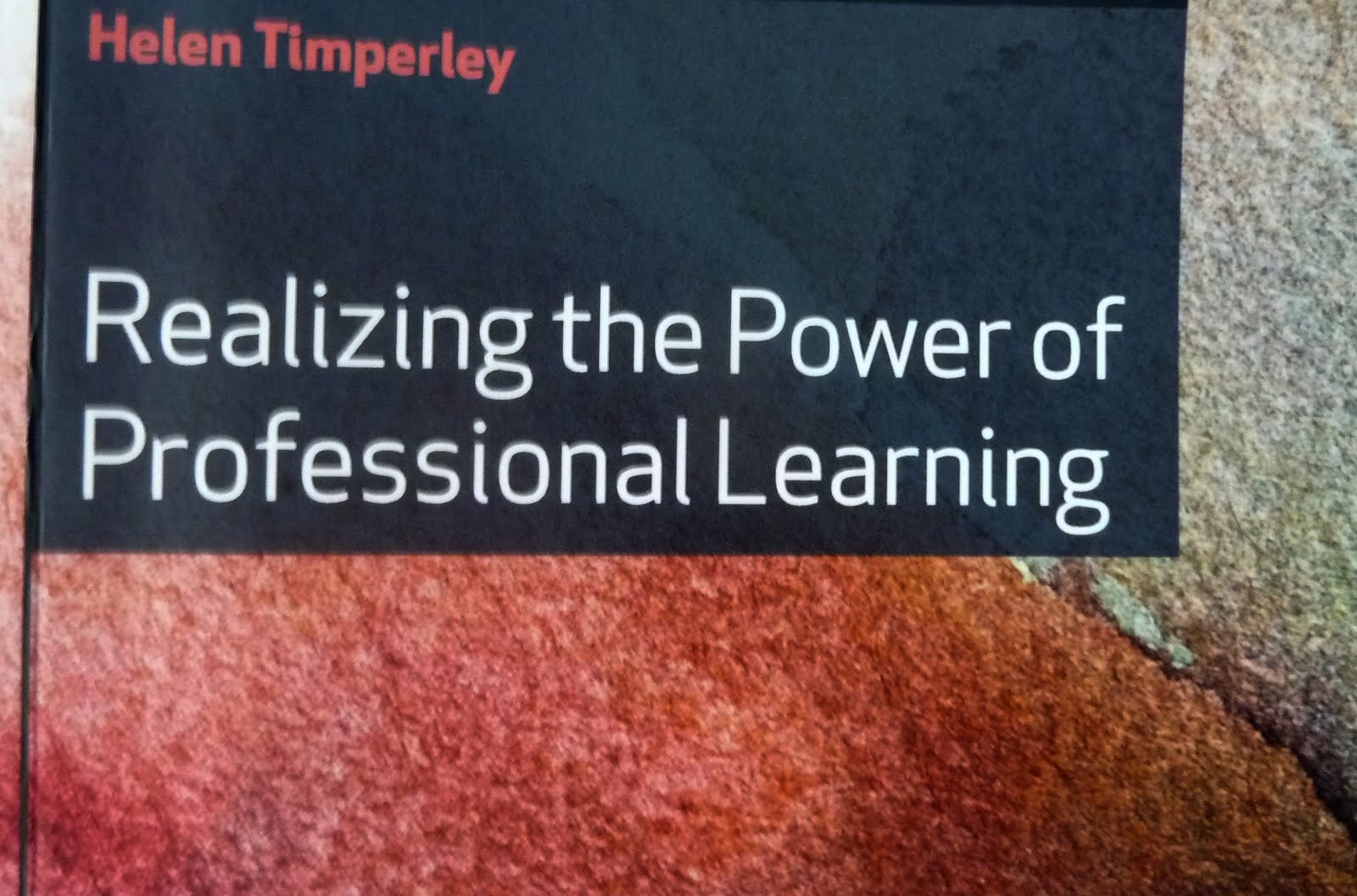
This book by educational researcher Helen Timperley published 2011, is all about tapping the power of teachers to enable all students to succeed. It is about helping teachers learn rather than telling them what to do; about putting student learning at the heart of the educational process; about developing a explicit inquiry approach to learning for teachers, students and principals;  about engagement not compliance. It seems like common sense -  but well researched common sense.

It seems their is a new consensus emerging - one that places empowering teachers as central to educational change. For many Timperley's book simply confirms beliefs many of us have held for years -  that it is the teachers professionalism that counts.  Developing teacher capacity to make informed judgements using an inquiry learning model  has underpinned the writings of Gwen Gawith ( Action learning) and Dr John Edwards, David Perkins,  Guy Claxton, Dean Fink and, more recently, even Michael Fullan who now writes that creating conditions to develop teacher confidence and ability is the key rather than imposing national agendas.  For those with a longer memory the excellent research of the Learning In Science Project ( 1980s) fits in with this 'new' constructivist thinking an approcah that values the prior ideas of students but with  a greater emphasis on teachers' thinking.

Creative principals and teachers have aways believed this although Timperley's book certainly outlines the inquiry cycle in endless detail. It is a shame the government is not following this capacity building approach instead of their obsession with imposing National Standards. This is a book that sees teachers as reflective professional judging success by evidence  not technicians complying to top down demands.

I am sure this will be a popular book for principals who want to  develop 'their' schools as inquiry learning communities where 'self regulated learners'  are able to demonstrate 'deep learning'.

In the introduction the editors of the series write that  education's mission  is 'enable everyone, without exception, to develops all their talents to the full and to realize their creative potential'.

To me this is the point of a modern education system .

The editors write that education has not 'aways kept up with the times'  and 'still seems in the past century'.  They continue that 'tinkering around the endless will not help' and that 'a bold and imaginative re-orientation to educational purposes' is required ; 'about what education could be; not what it has been'.

Unless school leaders appreciate that current thinking is the problem, that there is a need for a 'step change' in professional development,  they will continue to be 'tinkering'.

The book challenges school leaders to develop the 'conditions teachers need to learn in order to make a difference' and that these conditions reflect those needed by their students.

The book is about how teachers learn and why certain approaches to professional development work - an approach valuing and  engaging teachers prior conceptions. It is about appreciating the importance  of what teachers think about their studentsabout teachers  believing all students can learn rather than having a fixed innate intelligence.

The book is premised on the need for teachers to be engaged actively in practical  activities rather than just sitting and receiving knowledge from those who claim to know more than the teachers themselves.

And that the key to any success is teachers seeing their students improve as a result of their actions

Such ideas challenge school leaders and learning facilitators to create the learning conditions to empower teachers and to ensure student progress results. 'For far too many teachers...staff development is a demeaning mind numbing process and they passively sit and git"'

The various chapters of the book outlines in detail an inquiry process that actively involves teachers and implications for school leadership.

The  teacher inquiry model and knowledge building cycle is as follows:


What knowledge and skills do students need to meet important goals.

What knowledge and skills do we as teachers need to meet the needs of their students.

Opportunities to deepen and refine professional skills.

Engaging students in new learning experiences.

Evaluating the impact of changed actions?

( As mentioned in the introduction the editors of the series write that  education's mission  is 'enable everyone, without exception, to develops all their talents to the full and to realize their creative potential'. Imagine if the inquiry learning cycle was based around teachers working to realize this?)

The book makes it clear that this inquiry mindset  is an ongoing iterative process  resulting , if successful, in adaptive practitioners who are aways on the alert for opportunities to improve their teaching. It is also a process that is the default mode that humans are born with and one that underpins scientific and artistic innovations - all forms of 'enlightened trial and error'.

The cycle begins and ends with students and is sited in the real life circumstances individual teachers work in . The process is highly dependent on teachers assessing what students already know and what they can do - their prior experiences, and what they need to do, and how will they know if successful.

The second part of the cycles is determining what teachers need to know and be able to do to ensure all students achieve identifiable success. Students success depends on what teachers  do.  Teacher skill is the single most important influence on students learning so deepening teacher professional knowledge is vital and this is best learned through the inquiry process by trying out and evaluating  new ideas.

It is obvious that the school leaders role is to ensure conditions are in place for teachers to learn and to challenge and support their teachers - teachers are, in this respect, the leaders class. And, as with any class, it is not possible to believe all teachers are equally skilled. And also, as with teacher, leaders cannot choose to work with only those willing if a difference is to be made for all teachers. No teacher can be 'let of the hook.'

The remainder of the book details the various stages and implications of the learning inquiry process.

If I have a criticism, in contrast to the fine words in the preface about developing full range of talents of all students most examples refer to literacy programmes and the author writes that  some feel ( as I do) that  'has been at the cost of a wider and richer curriculum'. It is obviously easier for schools to use fit for purpose assessments of literacy and numeracy but a 21stC education requires a broader view of learning.

One example I enjoyed was  how one secondary teacher developed new knowledge to deal with misbehaving students.Another excellent example was the outlining of the research of Russell Bishop's Kotahitanga research which  illustrated the importance of relationships and cultural differences - and the negative impact of deficit theories of learning.

My favourite example was that of a UK secondary school exploring the development of the six personal learning and thinking skills to develop students as 'independent inquirers, creative thinker, reflective learners, team workers, self managers and effective particpators', to ensure students were prepared for a more challenging curriculum. The staff at this school developed a set of indicators to be considered as evidence of students being more reflective and independent.

If I were a principal this would be the area I would want to develop, along with a focus on developing all students gifts and talents, as they reflect the essence of the 2007 New Zealand Curriculum.

The key to develop engaged learners requires a rich inquiry based programmes across the curriculum and it would be  shame to see inquiry cycles limited to literacy and numeracy.

The book discusses the value of outside catalysts  to bring in a 'new lens' and to challenge 'existing social norms where these norms are directed to reinforcing rather than challenging the status quo'. Respectful relationships (  'relational trust') are required in all situations to promote inquiry habits of mind throughout the school. The importance of coaching, scaffolding of help, that leaves responsibility with the teacher is also an issue.  This of course applies to teachers and their students as well as between leaders,  facilitators and teachers.

The inquiry approach, if implemented,  will uncover teacher beliefs that will be problematic particularly if teachers hold traditional transmission view, or beliefs about innate fixed ability in contrast to growth mindsets. To ensure success  prior views  of teacher must be valued - the evidence of student success needs to be seen as the final arbiter. Uncovering teacher views is vital for any development to occur or for conflicts to be revolved.

The importance of school wide coherence is important but the author writes it 'can conjure up images of alignment with everything looking the same....Coherence  in a learning system, in fact, requites high levels of energy and innovation with studnts'. 'In reality, if leader wish teachers to become responsive to students, then adaptations should be expected'. ' The question is not about faithful implementation - 'adaptive experts are disciplined innovators who monitor their effectiveness in terms of the engagements, learning and well being of all students in their care'.

Adaptive students, adaptive teachers and adaptive schools is  the point of powerful professional learning.To be successful requires the collective will of all involved.

Monday, January 9, 2012

Educational Quotes 8: Curriculum


Schools have been trying to implement impossible curriculums based on a technocratic accountability model. The future demands students who retain a love of learning - students with their talents, dreams and passions developed. To achieve these demands a new appreciation of what a curriculum for the future should be.
 
 
'If we don't encourage others to find their own meaning, their own voice, we will never be able to sustain our own. Freedom comes from following you own voice not following another's' Peter Block
 
'If we wish to present ourselves to the wider world as New Zealanders then we must be able to listen to our own voices, and trace our own footsteps; we must have our own heroes and heroines inspire us; we must persist with building our own culture with the ingredients close to hand and not import theses ingredients ready made from abroad'. The late Michael King NZ Historian
 
'There is, it seems, more concern about whether children learn the mechanics of reading and writing than grow to love reading and writing; learn about democracy than have practice in democracy; hear about knowledge... rather than gain experience in personally constructing knowledge... see the world narrowly, simple and ordered, rather than broad complex and uncertain'. Vitto Perrone, 'Letter to Teachers'
 
'Standardization, the great ally of mediocrity, wins out over imagination.' Sergiovanni
 
'There is something about the Procrustean bed about schools; some children are left disabled by being hacked about to fit the curriculum; some are stretched to take up the available space, others less malleable are labeled as having special educational needs.' Chris Bowring-Carr and John Burnham West
 
'The constant need to move on, and to document progress, in normal schools means that education tends to be cut up into bite sized task..' Guy Claxton in 'Wise -Up'
 
'Teaching is impossible. If we simply add together all that is expected of a typical teacher... the sum makes greater demands than any individual can possibly fulfill'. Lee Shulman Stanford Univ
 
'If the shoe doesn't fit, must we change the foot?' Gloria Steinem US Feminist
 
'Could it be that the current education reforms have not yet fully dealt with what teaching and learning are all about? In a word, yes.' Peyton Williams ASCD President 2003
 
'We must beware of needless innovation, especially when guided by logic.' Winston Churchill
 
'How many students ... were rendered callous to ideas, and how many lost the impetus to learn because of the way in which learning was experienced by them?' John Dewey
 
Many school focus too much on achievement... (they need) to create opportunities for young people develop their learning muscles and their learning stamina through working on real problems... to reflect on and manage their own learning.' Guy Claxton
 
'Do not teach too many subjects and what you teach, teach thoroughly.' Alfred North Whitehead
 
'You have to take enough time to get kids deeply involved in something they can think about in lots of different ways,' Howard Gardner
 
'The real process of education should be the process of learning to think through the application of real problems.' John Dewey
 
'All the arts are brothers, each one throwing a light unto the others.' Voltaire
 
'Knowledge is a polite word for dead but not buried imagination.' e e cummings us poet
 
'Just because some of us can read and write and do a little math, that does not mean we deserve to conquer the universe.' Kurt Vonnegut Jnr Author
 
'What we want to see the child in pursuit of knowledge, and not knowledge in pursuit of the child.' G B Shaw
 
'The first people had questions, and they were free. The second people had answers, and they became enslaved.' Wind Eagle American Indian Chief


'The problem is fundamental... It is as if a secret committee, now lost to history, has made a study of children and, having figured out what the greatest number were least disposed to declared that all of them should do it.' Tracey Kidder
 
'Everything depends on the quality of the experience which is had.' John Dewey
 
'The central problem of an education based on experience is to select the kind of present experiences that live fruitfully and creatively in subsequent experience.' John Dewey
 
'Of course schools should be accountable- but accountable for what?... I would like to see schools accountable for developing students who have a love of learning - who are continually growing in wisdom and in their ability to function effectively( and happily) in the world.' Judy Yero http://www.teachersmind.com/
 
'We must not entrust the future of our children to habit.' Judy Yero
 
.Be careful what you give children, for sooner or later you are sure to get it back.' Barbara Kingsolver
 
'A teacher cannot build a community of learners unless the voices and lives of the students are an integral part of the curriculum.' Peterson 94
 
'The curriculum is to be thought of in terms activity and experience rather than knowledge to be acquired and facts to be stored.' Haddow Report UK 1931
 
'The main function of the school... lies in offering opportunities and an environment in which a child can explore freely, along many lines, and create in many media. In doing he will utilize his natural instinctive energies in the acquiring of skills and the building of interests.' Froebel Publication 1949
 
'Much of the material presented in schools strikes students as alien, if not pointless.' Howard Gardner
 
'the intuitive, the expressive, the un-measurable, the intensely personal have never found a satisfactory place in the curriculum, in assessment, in the publics esteem.' Hedley Beare Prof of Educ Melbourne
 
( Because) it is the intellect which dominates schooling ... the specifically soul making subjects- literature, drama, music, the visual arts- are progressively 'de-souled' as the child progresses through school' Dr Bernie Neville Aust Educator
 
'how we picture ourselves, the language we use about ourselves and our family, the stories we tell about ourselves or which we allow others to tell, whom we compare ourselves with, what we think we will become, how we define our own universe, these are the raw material from which we spin our web of personal mythology'. Hedley Beare Aust Educator
 
'Teaching which ignores the realities of children will be rejected as surely as any graft which attempts to ignore the body's immune system.' Howard Gardner
 
'Treat people as if they were what they might be, and you will help them become capable of being.' Goethe
 
'We should train ourselves not to ask 'How intelligent he/she is?' but 'Which intelligence doe he/she have most of?.' Charles Handy
 
'Thinking precedes literacy and numeracy but nowhere in the curriculum is that recognized.' Mc Gavin, Glasgow University
 
'We have to... immerse ourselves in interactive, real life, complex experiences out of which we can process new lives' Caine and Caine 97
 
'We should see schools as safe arenas for experimenting with life, for discovering our talents... for taking responsibity for tasks and others people, for learning how to learn... and for exploring our beliefs about life and society.' Charles Handy
 
'Nature is one. It is not divided into physics, chemistry, quantum mechanics.' Albert Szent-Gyorgi

'The greatest unexplored territory in the world is the space between the ears.' Bill O'Brien CEO
 
' New technology is common, new thinking is rare.' Sir Peter Blake
 
'Youth is wholly experimental.' R L Stevenson
 
'Intellectual activity anywhere is the same whether at the frontier of knowledge or in a third grade classroom.' Jerome Bruner
 
'The whole process of education should be thus conceived as the process of learning to think through the solutions of real problems.' John Dewey
 
'If you can teach a student a lesson for a day; but if you can teach him to learn by creating curiosity, he will continue the learning process as long as he lives.' Chinese proverb
 
'there can be no mental development without interest.' A N Whitehead
 
'He aha te mea nui o te ao?
He tangata, he tangata, he tangata'
'What is the most important thing in the world?
It is people, it is people , it is people.'  Maori saying

'Human beings are not machines. Human beings are complex adaptive systems living on the edge of the continuos ability to self-actualise. We are creative and in that creativity 'We can reinvent our own lives'. Maslow
 
'Our view of learning is much more like the learning of an artist or great scientist. The artist needs skills and tools....the artist armed with an idea...begins to create.. accompanied by many changes stops starts and erasers...they have a purpose that will lead somewhere that has meaning for the artist'Caine and Caine

Activity and reflection should complement and support each other. Action by itself is blind, reflection impotent.' Csikszentmihalyi

Saturday, December 17, 2011

Advice for 2009!!!!!


From a NZ teacher teaching in Melbourne – is this is what is in the future for us? Not so much the ‘nanny state’ but the ‘big brother’ state!

‘We are right into national testing over here. There is now national testing of all year 3, 5, 7, and 9 students. It just used to be in the other states. Victoria used to be told that we were lagging behind the other states but now, low and behold, after national teaching we are one of the top states. We also have online testing in Numeracy and Maths with the results going to the Department. This is done 3x a year. Our reports are also put directly into the Department. Accountability is everything, don't worry about the teaching. We are told that it does not matter where the students start our job is to get them up to national average and they are trying to bring in performance based pay as well. Also pay incentives for expert teachers and principals to work in disadvantaged areas.’

Read what Kelvin Smythe is on to - urgent


My good friend Paul Tegg recently send the below out to a number of schools he works with. I had forgotten I had written it and thought it worth repeating -even if to see what 'we' didn't achieve!

On more positive note an emphasis for 2009?

Developing Schools as ‘Communities of Inquiry’.

Challenge for 2009: To make the ‘Inquiry’ disposition central to all learning

The ‘new’ New Zealand Curriculum is all about students being: creative energetic and enterprising’ able to ‘make sense of their information, experiences and ideas’ so as to become ‘ confident , connected and actively involved life long learners.’

It asks schools to develop students who ‘are competent thinkers and problem solvers who actively seek, use, and create knowledge’. This involves giving students more choice and responsibility over their learning leading to a more ‘personalized’ approach.

The NZC is asking schools to develop an inquiry approach to all learning; to develop schools as ‘communities of inquiry’. An inquiry approach is about engaging students in difficult questions and issues that are meaningful to them. It is about placing ‘learnacy’ above literacy and numeracy.

This would be a major change of focus for schools. (And one few schiools took)

The need is to present learning contexts to challenge students (‘rich topics’) to be able to research and ‘reflect on their own learning, draw on personal knowledge and intuitions, ask questions and challenge the basis of assumptions and perceptions.’

Schools need to sort out an inquiry model for students to make use of. This model needs to move beyond the mere gathering of information to the deep construction of thoughtful understandings and, at the same time, develop the ‘key competencies’ or future attributes, or attitudes, or dispositions, required for ‘life long learning’.

Class inquiries ought to provide the ‘energy’ to focus the greater part of the school day and include the teaching of information research and presentation as part of the literacy programme as well as mathematical ideas that maybe required as part of any inquiries. The NZC suggests ‘doing fewer topics in greater depth’.

Such inquiries may feature one Learning Area in particular but will most likely involve aspects (strands) of other learning Areas as well. The curriculum is to be seen as ‘deep’ ‘connected’ and integrated. Teachers may need to plan collaboratively.

Teachers will need to develop focused independent group work in all learning blocks including dedicated inquiry time. Groups, or individuals, may research individual aspects and then to share findings, with a wider audience through exhibitions, publications, demonstrations, performances, information media, or posting on web. Such findings are powerful means of assessing depth of understanding and knowledge of process.

By covering a range of inquiry topics (covering the full range of learning Areas Strands) students will also be given the opportunity to uncover hidden gifts, talents and interests that might become life-long passions, or vocations.

Lack of dedicated inquiry time is an issue so the idea of ‘reframing’ the literacy and numeracy blocks to develop appropriate research skills would seem an obvious answer. This would also include integrating use of ICT

Somehow we never realized shools as 'communities of inquiry' - instead we are getting 'schools of compliance and conformity' -except for Charter Schools who are getting the freedom that all state schools ought to have. We didn't fight hard enough - we didn't really fight at all! We didn't defend the 2007 National Curriculum!! I wouldn't want principals on my side in a battle!


So what is the agenda for schools in 2012 - is there life beyond compliance . Or are we heading to a Medieval Dark Ages in education? Maybe all schools ought to become Charter Schools?

Sunday, November 20, 2011

Are we losing interest based teaching?


Seven and eight year old children study Fuchsias.


I have been busy cleaning out all the students work I have kept over the years - one teacher Bill Guild left me an amazing collection of research work, language and art.
I used to take selections of this work to show schools but I got the impression they thought it all beyond their own students ( 'students are different these days Bruce'). On two occasions I took work back to the schools that the work originally came from and in both cases teachers thought it was beyond their low decile students!

Teaching is about high expectations and skillful teacher interaction where teachers come alongside the learner assisting but taking care not to  do the work for the children. In this respect helping is an art form - the 'artistry' of the teacher is won through experience.

When visiting schools recently I have seen student work, some 'scaffolded', where it is hard to tell one students work from another. This applies whether it is research writing, layout of work, language and, worst of all, art.This of course is not what 'scaffolding' was meant to result in - student creativity and individuality was meant to be protected.

The Fuchsia study illustrated resulted from one teacher who had a particular fascination for fuchsias - it is amazing what individuals become fascinated in! As a result she took her students to visit a fuchsia nursery where the children were amazed by the variety of fuchsia and watched how fuchsia were propagated.All students left with a fuchsia cutting to propagate back at school.

At school students learnt about the fuchsia family ( discovering there were two native fuchsias they were unaware of), completed careful observational drawings, learnt about the structure of flowers and their role in pollination,  how to propagate plants, and wrote up notes of all they had learnt.

All very simple stuff but involving  a set of skills to be in place - how to go about observing, using water colours (and later pastels as they extended their ideas into pieces of creative work), and note taking and research writing.

It is from such experiences ( not always arising from teacher interests) that provide the means to develop creative learners and it is through such experiences student will develop their own set of personal interests - some of which may lead to a career or simply a life long interest.

The last few weeks of the year is great time for students to study aspects of their environment to demonstrate all the skills they have in place - what better form of evaluation could there be?.

One good study is  looking at the flax plant which is currently in flower.

Tuesday, October 25, 2011

Something I wrote a while ago - now on Phil Cullen's site


Take look at Phil Cullen's site Phil printed the below on his site.

The NZ government’s response to schools’ failure and poor teaching is to implementNational Standards aka Naplan in Australia and NCLB in the US, strategies that look back to the past for inspiration. This ‘rear-vision thinking’ is too simple and diverts attention.

Time for a public conversation. The biggest concern is that there seems to be “…no urgency for change…in schools…where disengaged students are reaching frightening proportions”. The standards agenda is “… rearranging the deck chairs on the Titanic to get a better view. The confusion around national standards actually makes ensuring all students achieve success difficult by distorting teacher energy, narrowing their teaching and making it difficult for teachers to focus on developing inquiry based learning.”

A Vision for New Zealand. ”We could do worse than follow the lead of Singapore with its ‘Thinking Schools, Thinking Nation’ motto. According to the Ministry of Education ‘thinking schools will be learning organisations in every sense, constantly challenging assumptions, and seeking better ways of doing things through participation, creativity and innovation…the spirit of learning should accompany our students even after they leave school… A Learning Nation envisions a national culture and social environment that promotes lifelong learning in our people.’ Singapore’s Education Minister explains that the big adjustment for teachers is the way we educate our young to develop a willingness to keep learning, and an ability to experiment, innovate, and take risks.” [If only Australia’s Minister for Education had visited Singapore in 2008, instead of New York!!]

Our schools could achieve such a vision if all their energies were focussed on implementing the current New Zealand Curriculum rather the standards. The same is true for Australia. Schools need to focus their collective energies on developing environments in which students and teachers’ creativity, in-depth understanding and thinking can flourish.”

Personalised learning. “We need teachers with the in-depth understanding able to help children to learn on their own, or as our currently side-lined NZ Curriculum says, to be their ‘own seekers, users and creators.’

Daniel Pink, in his latest book Drive: the Surprising Truth About What Motivates Us”,writes “the drive to do something because it is interesting, challenging, and absorbing – is essential for high levels of creativity. And, quoting research by Deci and Ryan on the self-determination theory, he writes, “We have three psychological needs – competence, autonomy, and relatedness. When these are satisfied, we’re motivated, productive and happy… [and] if there is anything fundamental about our nature, it’s the capacity for interest. Some things facilitate it. Some things undermine it.”  [ Australia’s passion for  a blanket testing regime certainly ‘undermines’ it]

Pink’s three conditions for success. The three conditions required for the motivation of all learners are : Autonomy – the provision of authentic choice;  Mastery – the desire to get better;  and Purpose – which provides the context for the next two. … The most powerful energiser of all is purpose – as seen through the eyes of learners.”

Having a winning mind-set. According to Carol Dweck [Stanford Uni.]: “People hold one of two views of their own intelligence. There are those who believe they are born talented [or dumb] and others believe in effort and practice. Those with a ‘fixed mindset’ give up and …those with a ‘growth mindset’ do not interpret mistakes as failing but merely as a means of improving.

Perkins [Making Learning Whole] outlines seven research based principles of teaching that can transform education, one of which is that students need to practice the ‘hard bits’ so as to achieve mastery in whatever they are attempting.”

The School As The Home of the Mind.  “Art Costa’s powerful metaphor is well known to New Zealand schools and are similar to Guy Claxton’s ideas of ‘learning power’ and his reference to ‘the mind as a muscle’ which grows with exercise… ideas which underpin the key assumptions of the NZ curriculum…The intentions of Costa, Claxton and the Key Competencies of the New Zealand Curriculum are all about cultivating thinking dispositions. Costa calls them ‘habits of the mind’; and Claxton ‘learning power’. Guy Claxton of England visits NZ occasionally. He has visited Australia, but Joel Klein with his hard-data system, became Ms Gillard’s favourite.

Inquiry learning. Student thinking and purposeful teacher interaction cannot develop in a vacuum. Learning needs meaningful contexts…Gardner’s multiple intelligence theory encourages teachers to explore chosen content through a variety of ways – through the arts, the sciences, mathematics, language, music, and physical activity. Integrated learning is natural to the very young [who are not aware of subject divisions] and teenagers today explore the world through technological media crossing subject boundaries with casual disregard. Secondary schools remain locked into compartmentalised and fragmented learning with their genesis is a past industrial era while their students experience and interconnected evolutionary real world.

The Big Picture. Schooling ought to be seen as central to the development of New Zealand as a ‘cutting edge’ society. Enough is now known about teaching and learning that no student need fail. The current NZ Minister’s emphasis on compliance [Hello, Julia] through national standards is characteristic of yesterday’s assembly-line thinking rather than looking towards the unknown challenges of the future. The real literacies of tomorrow entails the ability for students to  be their own navigators able to thrive in unpredictable situations supported and guided by the positive dispositions they have hopefully gained through their educational experience


Sunday, September 18, 2011

Placing in depth inquiry learning first!


Exploring the animal life in local stream, studying adaptation of the animals, investigating pollution, working out speed, depth and capacity of the water and, in one case in our province, exploring the river from its source on the mountain to the sea. This is the stuff of real learning.

Creative teachers have always placed developing authentic realistic and first hand experiences followed by creative expression through the arts central to their programmes .Important to such teachers was the need to provide opportunities to develop all the innate gifts and talents of their students. Today the emphasis being imposed by the government is on literacy and numeracy and, along with the conservative nature of most teachers, this has lead to less real in depth inquiry. And it needs to be made clear that creative teachers did not ignore literacy and numeracy but rather did their best to integrate it into their studies or at least to make it personally relevant to the learners so as to develop a positive attitude for such areas.

Even with inquiry being popular in schools as encouraged by outside experts it seems the emphasis is more on showing the process and not the in-depth understanding of the students of the content chosen. As someone has said , 'it is all recipe and no cake'. In earlier days pioneer creative teacher Elwyn Richardson warned that 'a study with no content is a study at risk.'

Today it is vital that teachers 're frame' their literacy and numeracy programmes so that , as much as is possible, they contribute the skills and knowledge required for students to be able to dig deeply into any content they are studying. It is all matter of emphasis. In depth content will call upon all the isolated skills often being taught out of context (and thus easily forgotten).

Jerome Bruner wrote wisely that teaching was 'the canny art of intellectual temptation' and teachers who appreciate this , and the innate curiosity of students, keep their eyes out for ideas to tempt their students with. They also tap into their students interests and concern and seasonal environmental experiences.

And they know the value of doing fewer things well.

With this in mind the following is a list of possible themes, topics, challenges that might be useful to tempt students with - topics that naturally involve a number of learning areas. Interested teachers can add greater depth to any of them. Many would fit under Learning Area Strands.

1 Animal companions - our relationship with certain animals, their welfare and habits....
2 Barriers -all about edges, frames, borders, boundaries - and things that stop us.....
3 Camouflage - how things merge into their surroundings in nature and man made.....
4 Changes - chemical, changes, life cycles, seasonal, cooking , fashion, art eras.....
5 Colour - colour mixing, meanings in colour, rainbows, how we use colour....
6 Dirt - what is it? .Different kinds of soils and rocks. Dirt and germs....
7 Faces - family resemblances, portraits, face maths, emotions, , face protection, masks..
8 Feet - types of feet, bones, what we put on them, specialised coverings, shoe fashions...
9 Flags and trademarks - countries, companies, logos, designing, history of....
10Food - where it comes from , how sold, preserving, healthy food, when it goes off...
11 Funny things - importance of humour, jokes, why we laugh ...
12 Inside/Outside -bodies, x-rays, openings, windows , doors...
13 Layers and cross sections - x-rays, fruit, cakes, buildings, skeletons, maths...
14 Life and death -life spans, wars, birth, seeds and fruits, extinctions, life after death...
15 Light - light sources, the sun, importance for plant growth, neon, electricity, shadows...
16 Looking - optical illusions, telescopes, perspective, memory and observational art..
17 Me - my appearance, dreams, things I own, habits, family tree, signature, interests...
18 Miniatures - replicas, scale models,working small, modern technology.
19 Money - history of, designs,counterfeiting, alternatives....
20 Pairs - things that come in twos, fingerprints, twins, shoes, binary numbers,symmetry..
21 Noises - sound effects, silence, scary noises, deafness, drawing sounds...
22 Reflections - mirrors,,distorting mirrors, refraction, mirror writing, history of mirrors..
23 Reproductions - of art work, printers, copiers, cloning, animal/plant reproduction...
24 Shadows - making shadows , sun dials, shadow puppets...
25 Surprises - surprise titles, surprise endings, birthdays, puzzles, jigsaws....
26 the Bush - plant life, animals, ecology, planing natives...
27 Time - old things, clock science, time lines, geological, memories, museums...
28 Wear and Decay - preservation of things, food and people, rust.....
29 Wet and Dry - keeping dry, melting ice, puddle evaporation, fountains....

Saturday, August 20, 2011

The power of visiting other schools


A display of work from Woodleigh School New Plymouth. Room environments are  important  'evidence' of what is held to be important by the school or teacher. Room environments send out powerful 'messages' to students and class visitors.

Last week I accompanied group of rural principals from out of the province  visit a selection of local schools worthy of observation. Schools were limited to ones I am familiar with and all were involved in inquiry learning to greater or lesser degree. None were totally inquiry focused schools with inquiry as their number one priority - this is difficult in today's environment.

It is my belief that focused school visits ( hence the need for a guide) are the most powerful means to gain professional development and, in particular, to gain insights in to what other schools/teachers feel important. This is all the more necessary as schools are increasingly under pressure to distort their teaching programmes by the need to respond to the reactionary and politically inspired introduction of National Standards.

What visitors gain depends on what they individually  bring to the situations visited. If ideas gained are to be made best use of then there needs to be focused action plans, assisted by an  independent 'outsider',  to implement ideas seen in their own schools and, at an agreed point, to evaluate progress.

I have to admit not being an entirely biased guideAs a result of my own experience I am influenced by an approach to teaching and learning that is somewhat in conflict with some of the idea currently being imposed or being implemented in schools.

My own agenda is:

To place in depth student inquiry studies central to all learning and for such inquiries not only to focus on the inquiry process but also to develop  in-depth understandings. Inquiries need to challenge and extend students' prior views. The most important phrase in the 2007 New Zealand Curriculum is for students to 'seek , use and create their own knowledge'.

To 'reframe ' literacy and, to a lesser degree numeracy, to ensure all the skills students require to undertake in-depth inquiry are in place.

Students need all the skills in place to 'seek and use' information. As for mathematics it needs to be based on real life or relevant inquiries to develop real 'feel' for mathematics.In my opinion the key to maths  is to do less maths and what is done to be done in depth. Conventional teaching places literacy and numeracy as the most important areas of learning and this will be further reinforced by National Standards.

 Literacy and numeracy  need to be seen as 'foundation skills' vitally important to be in place so as to allow students to complete their inquiry studies. I am also opposed to ability grouping and 'streaming' of such learning areas. I cannot see the latter suggestions being taken up by  teachers

To value the individual creativity, 'voice' and imagination of all students and in the process identify and extend every student's unique gifts and talents - every student's needs their own Individual Learning Programme.

With this in mind it would be interesting to learn what ideas individual visitors gained, what idea they saw that conflicted with their current ideas and what they intend to action on return to their own schools?

The challenge for teachers visiting inquiry based classrooms that value in depth understandings and student creativity, is to  begin with 'the  end in mind' by considering classroom displays, students' book work,  and students' competencies requiredand then to to consider all the various skills  that would need to be in place for students to develop and take responsibility for their own quality work  - both process and content.

Inquiry displays to have key questions , processes, and quality examples of finished work including research , language  and art - both descriptive, or observational, and creative.

Teachers should do their best to base their studies on students' questions and concern and to negotiate with their students  inquiry and learning tasks and also criteria for evaluating their achievements.

Students to have observational drawing and descriptive writing skills in place   in particular how to write 'research writing';  the writing up of experiments or activities; and  how to acknowledge sources of their information. Such skill teaching ought to be the focus of   'reframed' literacy and numeracy programmes.

Displays and student book work ought to illustrate studnts' prior ideas -answers ( theories) to their first questions;  learning can be evaluated by the degree students have extended their ideas.

Students need to be taught design /presentation skills so as to present their work in pleasing ways. If such 'scaffolds' , 'wizards' or guides are developed students need to be encouraged to make use of their own creativity.  Many students have never been taught how to layout their work. Best models are exhibits for Science or Maths fairs. Visual language skills need to be included in literacy programmes.

To achieve quality in depth  work students need to be placed in safe secure organisational patterns. Such patterns are best seen in the  literacy  and numeracy blocks but the group task idea needs to be extended to the afternoon inquiry studies. Few school do this.

In inquiry classrooms information technology ( ICT) is best integrated as a natural part of inquiry studies. New technology skills  could be introduced as a part of the literacy programme.

Other important aspects of a creative inquiry based  classroom.

Personalised writing about students' own lives. Student's able to focus on a small event in their lives and to write thoughtfully about it. Personal writing is the best way to ensure each child's voice is acknowledged. Such writing could be part of the literacy programme - with one piece completed , with an equally focused illustration, each week. Such writing could be an important part of any early reading programme.

Last thoughts:

Do fewer things well.

Slow the pace of students work.

Ensure students have skills and time to complete work

Value student's perseverance, effort or 'grit'.

Do the 'messages' of your classroom reflect and celebrate your students creativity .


Related blogs

Classroom displays

Quality student work

Student work

Observation skills

Personal writing


Tuesday, August 2, 2011

Let's celebrate those few creative teachers -and even fewer creative schools. They are the future.


The dam builders - how to control the flow of a river?


The process of developing a truly creative classroom.

'The wish to preserve the past rather than the hope of creating the future dominates the minds of those who control the teaching of the young.'    Bertrand Russell

If teachers have in their minds the need to develop their class as a learning community of scientists and artists then during the year, as skills develop, greater responsibility can be passed over to students.

During the first term teachers and students focus on how to work with each other so as to develop relationships of mutual respect.

The success of any class will depend on the expectations, attitudes and skills the students bring with them ; what they are able to do with minimal assistance.

If the school has a clear vision of the attributes they would like their students to achieve then there will be a continual growth  of  independent learning  competencies from year to year.   Schools that achieve such growth in quality learning usually have spent considerable time developing a set of shared teaching and learning beliefs  that all teachers agree with and see purpose in. Underpinning such  beliefs are assumptions about how students learn and the need to create the conditions for every learner to grow towards their innate potential.

If the big picture of learning is clear then making choices to achieve the end in mind is simplified.

Unfortunately, unless there is decisive leadership to keep agreed belies to the forefront, it is easy for busy teachers to slip back to counterproductive behaviours.

There are two basic positions teachers can take. One is to see their role as 'teaching' students what they need by introducing activities to assist students learning. In such classrooms, no matter how friendly they look, teachers are in control  and determine activities.

In contrast, to the above 'soft' transmission approach, creative teachers hold the view that the students must do their own learning . Such teachers see their role as ensuring all the necessary skills are in place so students can control their own learning.  Such teachers see learning as a personalised process, one where students have to create, or construct, knowledge for themselves.

There is a world of difference between the two approaches and the latter approach is hard to find.

Most classrooms are heavily determined by the teachers. In tuch heavily controlled classrooms literacy and numeracy take up most of the day  -   other learning areas seem to offer only  a little light relief from the main teacher tasks. And in such schools individual  classrooms look remarkably similar  as teachers are expected to follow agreed formulaic  'best' practices. This is not helped by an obsessive need to test students progress in literacy and numeracy and will be compounded by the introduction of National Standards.

In creative classrooms, or those moving in this direction, the 2007 New Zealand Curriculum gives excellent support. The important issue for such teachers  is whether every students is developing a growing sense of confidence and responsibility for their own learning. Growth in resilience, adaptability, perseverance and creativity  are seen  as important as literacy and numeracy -  these being seen as 'foundation skils' necessary for students to 'seek, use and create their own knowledge'. At the heart of a creative approach is the need to ensure  that every opportunity  is given for every learners special set of talents and gifts to be  developed.  .

In a creative classrooms teachers do their best to ensure every learner is an active contributor, has the skills to work in teams, and  is able to exercise initiative and personal creativity.The teacher's goal is to ensure every  student develops a positive learning identity

In my experience teachers in  such classrooms believe in negotiating all learning and tasks with their students and, where it is not possible, are open about imposed requirements. Such teachers believe in doing fewer things well  to allow their students to dig deeply into whatever they are studying individually or in groups. The energy for all learning is provided by the engagement of students in learning tasks in all learning areas students see the point of.

To achieve such a creative classroom teachers need to have knowledge in the various learning areas ( or know where to access such information) and to be able to work together to share ideas and to learn off each other.

The teacher's role is one of being a creative learning coach -  aways being careful not to take responsibility for learning away from the learner.

In a creative classroom of scientists and artists I would expect to see:

Powerful learning experiences taking priority over literacy and numeracy tasks.

Learning tasks to be negotiated with students and many originating out of students questions and concerns.

Students working in self managing groups ( caring for and challenging each other) independent of the teacher.

All around the room (and  in students' book work, in their computer portfolios) quality  examples of their finished work across all learning areas, usually displayed as part of a group or class investigative study. The whole learning environment a celebration of students' talents and gifts.

Close reading of whatever is displayed showing individual 'voice' or creativity.

For a creative school  all that  is required is to replace 'teacher', in the above description, with  'principal' and 'students' with 'teacher'.

'Each learner is new puzzle for a teacher to unlock.' Matt Damon Actor

Sunday, July 17, 2011

An overwhelming creative experience


Astronauts entering the space shuttle: Zero Gravity theme.


I was invited to visit Opunake Primary School to see the culminating display of their current topic 'Zero Gravity'-  open to parents and the public the last two days of the term.

To make a change from suffering from the  endless wet days we had been having I decided to take up the offer. I knew more or less what to expect as I had visited several other end of term culminating displays. To add to the fun I decided to ask an old friend of mine to come just for the ride which is about 45 minutes from where I live. I didn't tell my friend we were going to visit a school. I didn't think it would be much of an enticement and when we pulled up at the school he said he would be happy to sit in the car until I had completed my visit.

I insisted he accompany me and to say that it was a mind changing experience for my friend would not be far from the truth.

Opunake school is a very special school. However, before the appointment of the current principal Lorraine, things were less than wonderful. Opunake is a decile four school with a forty percent Maori role and, at at the time of Lorraine's appointment, had little parental support and the staff somewhat demoralised.

Although I am a fan of individual creative teachers, believing they hold the power to develop ideas that can change schools, this power is magnified if a school is led by a creative principal

What makes the school special are the educational changes Lorraine has introduced to develop a more positive  inclusive learning community at the school. The changes are based around a collaborative approach to teaching combined with the use of a range of innovative teaching strategies.

At the end of each year students are asked to think about what concern they have and they would like to study.  This idea is based on the writings of American Middle School educator James Beane. Students contribute their ideas and from  their ideas common themes are  decided upon for the next years studies. Interestingly enough the students ideas easily cover normal curriculum requirements.

Once the theme has been decided upon a provocative title is decided upon and then the theme is explored for the term, or longer. Themes I have observed have covered 'Harry Potter' ( mainly maths and science)  'Are You my Mummy' ( Egypt), 'Shackleton', 'Space', 'The local Environment' - I can't remember the exact  more interesting titles.

The current thee was called ' Zero Gravity' - about space exploration.The photo  above does not do the study justice.

The  theme follows along the following process.

The teachers plan an interesting introductory experience to motivate a range of study  questions from the students which become the basis for the study.  For the Egyptian study the teachers put on a shadow play which involved  teachers acting as priests preparing body for the mummification  process. This was authentic enough for a year one student to tell his mum that the teachers cut up a year eight students but that it was OK because the young learner concerned said he had seen the 'victum' later in the library!

Following the introductory experience the  teachers plan activities for students, arranged in family groups, to be involved with.Older students are 'trained' to assist younger children. For the current study eighteen science experiments were planned - providing more physical science than most primary students experience in a year. This involves afternoons for the first week or two.

Literacy and numeracy programmes cover the mornings  no doubt content from current themes is involved.

The 'end on mind' is to prepare exhibits for the end of term display.These displays transform a room ( once two classrooms) into what can be best expressed as a school version of Te Papa. Once the displays are in place it is impossible to recognise the rooms as classrooms.

Following the family grouped experiences teachers, in their individual classrooms and teams, plan out their exhibits for the  display room and undertake  research about the theme. The school uses an inquiry approach across the school and a range of thinking skills but, as important as the process is, the whole point is to develop the end of term display/experience.

Back to our school visit.

Visitors enter the room through a Ground Zero Entrance Gate and are welcomed by an episode of Star Trek to add to the ambiance. Once over a a raised foiled covered entrance way the main room is entered.The entire space floor and ceiling is covered with black plastic.No outside light enters - light come from spotlights,computers and digital projector screens.  Visitors are confronted with large models of spaceships, moon buggies, alien tea parties, science experiments, white coated astronauts and a robot that has moving arms ( powered by students who take turns). Metres of tin foil has been used contrasted with white painted rockets, space shuttles, and moon buggies. And, as you get used to the experience, there are an endless range of childrens' research, art and language to admire.

To add to the excitement students are guiding their appreciative parents around and, while we were there, the local kindergarten was visiting. One can only imagine what they were thinking.

The next day I returned with a retired teacher who was, in my opinion, one of the most creative teachers of his time.I also invited a scientist ( who had been an adviser to the nearby Maui plant) who now writes science features for the local paper.

They too were impressed.

Opunake is a special school.

Monday, May 30, 2011

An eye catching study topic!


A quick trip to any classroom if you have had a lot of experience visiting schools will soon indicate the quality of the learning in the classroom - the 'messages' of the room can be seen in a 'blink'. As they say you don't have to drink a whole bottle of wine to decide it is quality wine.One of the criteria is the depth of learning exhibited on the display walls.

It is interesting taking visiting teachers around classrooms in other schools, something I have been doing for decades.

I have aways believed that the best professional development comes from visiting and talking to other teachers but, to be successful, those visiting have to be open to what they are seeing.This, of course, is easiest if the visitors are already heading in a similar direction as the mind seems to want to confirm itself and resists disruptions.

However it is when the mind is challenged that real learning begins, particularly if you are unhappy with your current directions. If not, I note, teachers who feel happiest when they see rooms that more reflect, or confirm, their own teaching beliefs.

Anyway I am a great believer in studies that result in informative exhibitions for visitors to learn from what they have been studying. And I am a great believer in an active inquiry approach to learning across the curriculum. Iam really enthusiastic when I see the language arts (I dislike the narrow term literacy) and mathematics programme 're framed' so they contribute to developing research and expressive skills and in-depth content.These are programmes that reflect the New Zealand Curriculum's statement that students are to be seen as 'seekers, users and creators of their own knowledge'.

Back to the classroom display illustrated. I guess it was the result of a maths study around statistics but involved researching information about that unpopular vegetable Brussell Sprouts. The display of the work of an inventive teacher. Often these small studies reflect the best thinking.

A quick look around the room also showed a range of studies the students had explored.It was a room where the 'inquiries' were the important thing. Real content had been 'constructed' by the students but the vital thing was the attitude of students about learning that had gained by being in the room. It is this 'tacit' learning that remains and will inform students' future learning.

It is a shame that the emphasis on literacy and numeracy means that this tacit learning is undervalued - teachers and outside authorities judging success on qualitative data in these two areas.

Limited thinking.

Our kids deserve better.

Give them more Brussell Sprouts.


Design by Free Wordpress Themes | Bloggerized by Lasantha - Premium Blogger Templates